

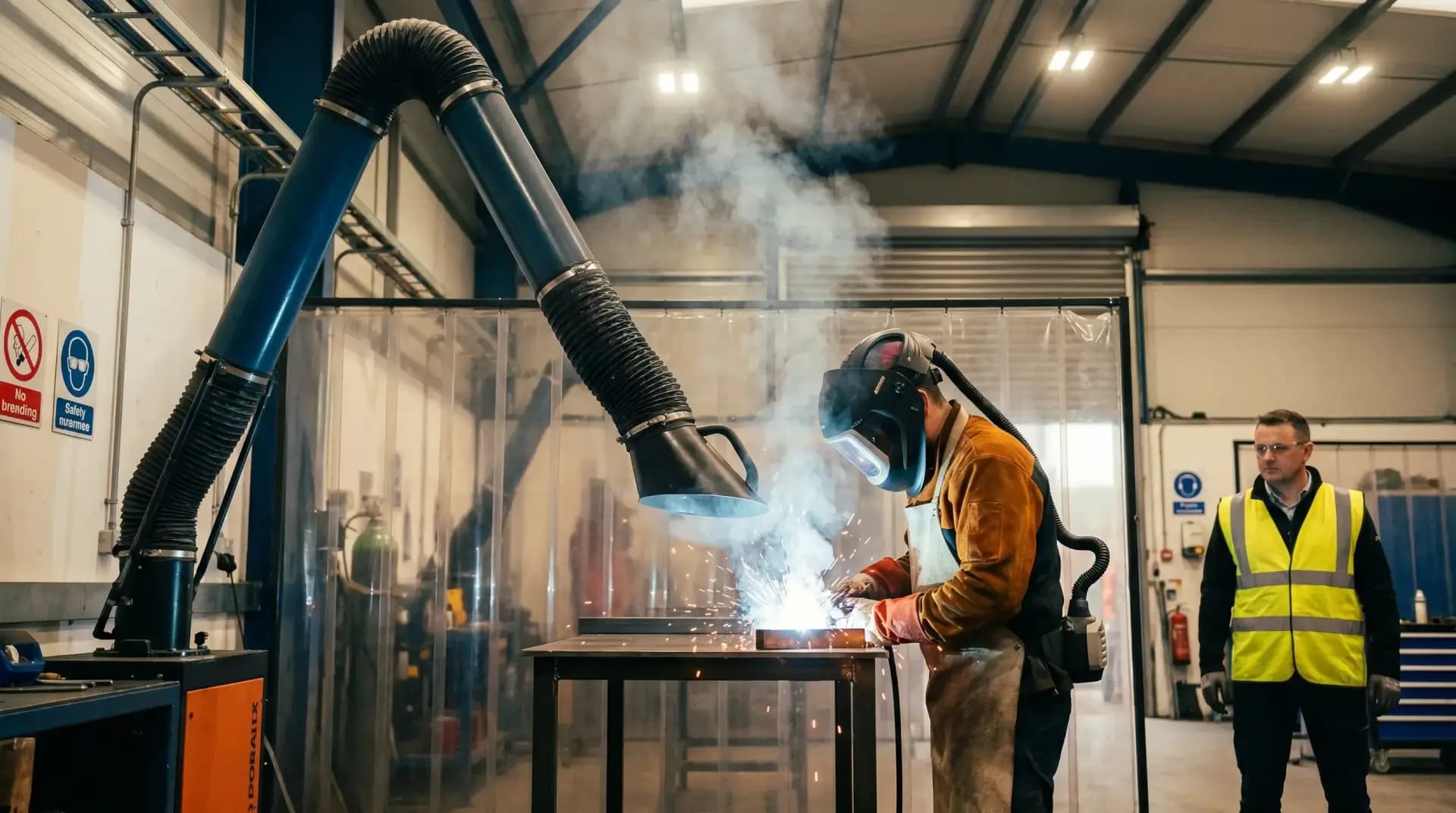
Welding fumes are hazardous airborne contaminants produced when metal, filler, flux, coatings, or surface residues are heated during welding, cutting, brazing, or gouging. The main control is not simply “wear a mask.” A reliable welding fume control program starts with avoiding unnecessary fume generation, then capturing fumes at source through local exhaust ventilation, supporting that with suitable respiratory protection where needed, and confirming effectiveness through supervision, maintenance, and exposure assessment.
The health risk is serious. Welding fumes are classified as carcinogenic to humans, and ultraviolet radiation from welding is also classified as carcinogenic to humans. Welding fumes may also contribute to asthma, metal fume fever, respiratory irritation, chronic lung effects, and neurological concerns where metals such as manganese are present. In Great Britain, HSE states clearly that all welding fume can cause lung cancer and that employers must put controls in place, even for small amounts of welding.
What Makes Welding Fumes Hazardous?
Welding fume is not one single substance. It is a complex mixture of fine particles and gases. The exact hazard depends on the welding process, base metal, filler metal, shielding gas, coating, surface contamination, ventilation, current settings, work position, and whether the work is done indoors, outdoors, or in a confined space.
Common hazardous components may include:
Source of Fume or Gas | Possible Hazard |
|---|---|
Mild steel welding | Iron oxide and other metal oxides |
Stainless steel welding | Hexavalent chromium and nickel compounds |
Manganese-containing filler metals | Manganese exposure concerns |
Galvanized steel | Zinc oxide and metal fume fever risk |
Painted or coated metals | Lead, chromates, isocyanates, decomposition products, or other toxic contaminants |
Degreased or contaminated surfaces | Hazardous breakdown products when heated |
Arc welding processes | Ozone, nitrogen oxides, carbon monoxide, and ultraviolet radiation hazards |
OSHA identifies welding, cutting, and brazing health hazards as including metal fume exposure and ultraviolet radiation, while safety hazards include burns, eye damage, electrical shock, cuts, and crushing injuries.
The practical lesson is that “welding fume” should never be treated as a generic nuisance dust. Before the job begins, I want to know what is being welded, what is on the metal, what process is being used, and where the welder’s breathing zone will be during the task.
Health Effects of Welding Fume Exposure
The main route of exposure is inhalation. The welder and nearby workers may breathe fine particles and gases, especially when the plume rises directly into the breathing zone or when general ventilation is poor.
Potential health effects include:
Eye, nose, and throat irritation
Coughing, chest tightness, and breathing difficulty
Metal fume fever, especially with zinc-containing fumes
Occupational asthma
Reduced lung function over time
Chronic obstructive respiratory disease patterns
Lung cancer risk
Possible neurological effects associated with manganese exposure
Kidney, liver, skin, eye, and respiratory system effects where hexavalent chromium is present
NIOSH notes that welding fumes are composed of metals and that most fumes contain some manganese, with continuing concern about possible neurological and neurobehavioral effects from manganese in welding fumes. OSHA states that hexavalent chromium can cause cancer and may affect the respiratory system, kidneys, liver, skin, and eyes; it also identifies hot work such as welding on stainless steel and other chromium-containing alloy steels as a major source of worker exposure.
This is why short-duration welding should not be dismissed. A brief job on the wrong material, in the wrong location, without proper extraction or respiratory protection, can create a high exposure.
Factors That Increase Welding Fume Risk
In welding fume control, the task conditions often matter as much as the process itself. I pay close attention to these risk multipliers:
Welding Process
Some welding and cutting methods generate more fume than others. High-energy processes, high current settings, flux-cored arc welding, air carbon arc gouging, and cutting through coated material can generate significant airborne contamination.
Material and Coating
Stainless steel, galvanized steel, painted surfaces, plated parts, lead-containing coatings, cadmium-containing materials, and chromate primers require stricter controls. Surface preparation is often one of the most effective risk-reduction steps.
Work Position
A welder leaning over the arc is usually in the worst position because the plume rises directly toward the breathing zone. Small changes in body position, work height, or fixture design can reduce exposure.
Indoor or Confined Work
Indoor welding without effective extraction allows fumes to accumulate. Confined spaces create additional concerns because fumes, gases, oxygen deficiency, and rescue limitations can combine quickly.
Nearby Workers
Welding fumes do not only affect the person holding the torch. Helpers, fitters, fire watchers, inspectors, and workers passing through the area can also be exposed if fumes are allowed to spread.
Welding Fume Control Measures
The correct approach is the hierarchy of controls: eliminate or reduce the hazard first, then use engineering controls, then administrative controls, and finally PPE. NIOSH describes the hierarchy of controls in the preferred order of elimination, substitution, engineering controls, administrative controls, and PPE.
1. Eliminate or Reduce Fume Generation
Before selecting a respirator, ask whether the fume can be reduced at the source.
Useful measures include:
Use mechanical fastening or lower-fume joining methods where practical.
Remove paint, oil, grease, plating, coatings, and residues before welding.
Use lower-fume welding processes where suitable.
Optimize current, voltage, and wire feed settings.
Avoid overwelding.
Use clean base materials and consumables.
Position the work so fumes rise away from the breathing zone.
Use jigs, rotators, or turntables to improve welding position.
This is the most overlooked part of welding fume control. Many exposure problems are created before welding starts because contaminated, coated, or poorly prepared material is sent to the welder without adequate hazard review.
2. Use Local Exhaust Ventilation
Local exhaust ventilation, commonly called LEV, should capture fumes as close as possible to the source before they enter the breathing zone. HSE’s current welding fume guidance for Great Britain places controls in the order of avoiding or reducing exposure, using LEV to take fume away at source, and using suitable respiratory protective equipment where needed.
Common LEV options include:
On-torch extraction
Movable extraction arms
Capture hoods
Downdraft or backdraft benches
Enclosed or semi-enclosed welding booths
Extracted welding tables
Portable extraction units with suitable filtration
LEV must be correctly positioned. A hood that is too far from the arc may look impressive but capture very little fume. Extraction arms also need regular repositioning as the weld progresses. In my reviews, poor LEV use is often not a design failure; it is a usability and supervision failure.
3. Provide Effective General Ventilation
General ventilation helps dilute and remove residual contaminants, but it should not be relied on as the primary control for significant welding fume exposure. HSE’s enforcement position for Great Britain specifically warns that general ventilation does not achieve the necessary control for all welding fume, including mild steel welding.
General ventilation is useful when it supports LEV, prevents background build-up, and maintains safe air movement. It is not enough when the plume passes through the welder’s breathing zone before being diluted.
4. Use Suitable Respiratory Protective Equipment
Respiratory protective equipment, or RPE, is required when exposure cannot be adequately controlled by elimination, substitution, work methods, and ventilation alone. Outdoor welding may also require RPE because wind can make fume capture difficult and may blow the plume into the breathing zone.
Respirator selection should be based on:
The contaminants present
Exposure level
Oxygen level
Confined space conditions
Facial hair and face seal requirements
Welding helmet compatibility
Assigned protection factor
Work duration and physical workload
Filter type and change-out arrangements
Fit testing requirements where tight-fitting respirators are used
For welding, powered air-purifying respirators integrated with welding helmets can be useful where suitable for the contaminant and exposure level, especially for longer tasks. However, no respirator should be selected by guesswork. The wrong filter, poor fit, damaged face seal, or incompatible helmet arrangement can give a false sense of protection.
5. Apply Administrative Controls
Administrative controls support engineering controls and PPE. They do not replace them.
Effective administrative controls include:
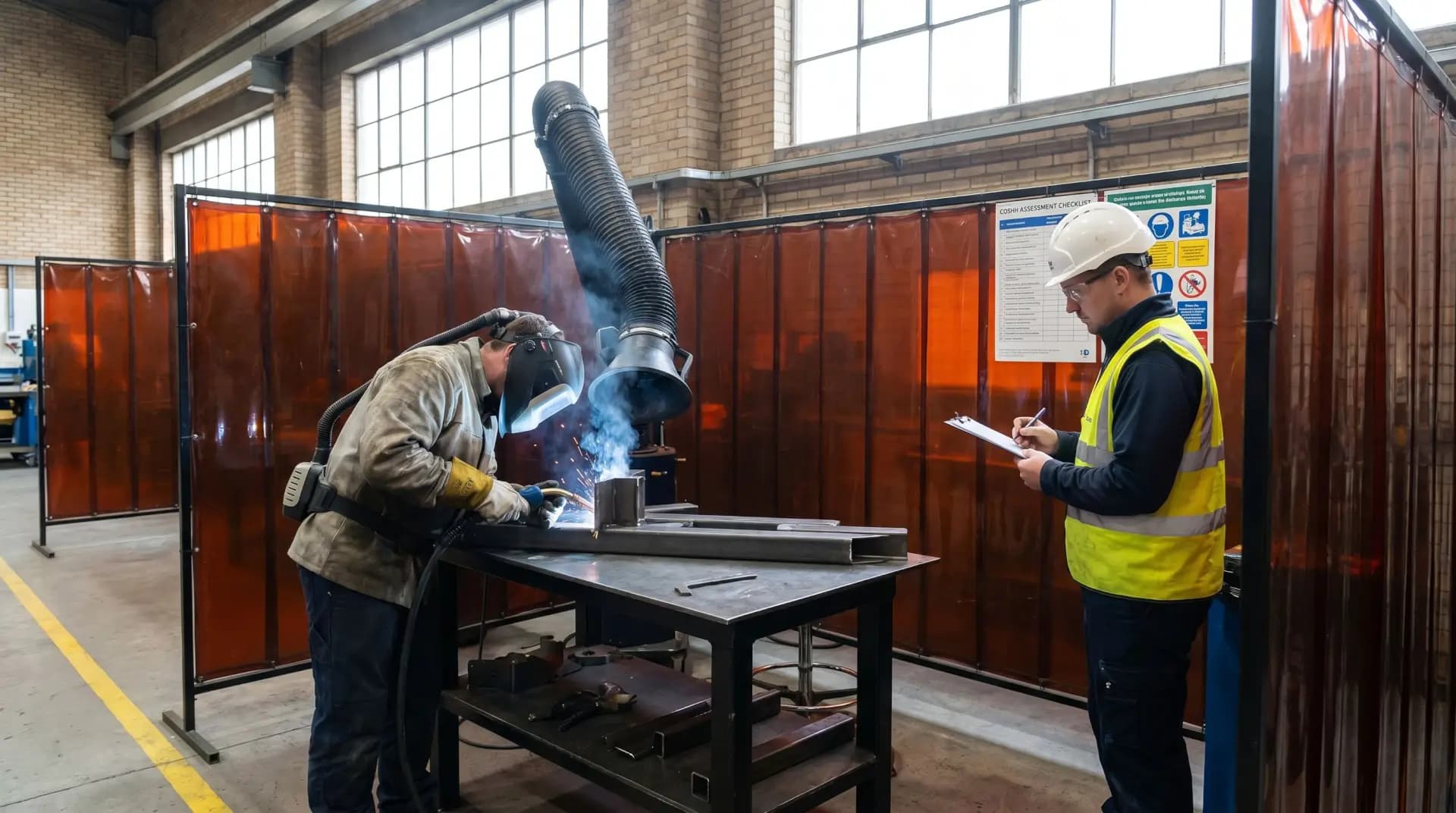
Welding fume risk assessments before work starts
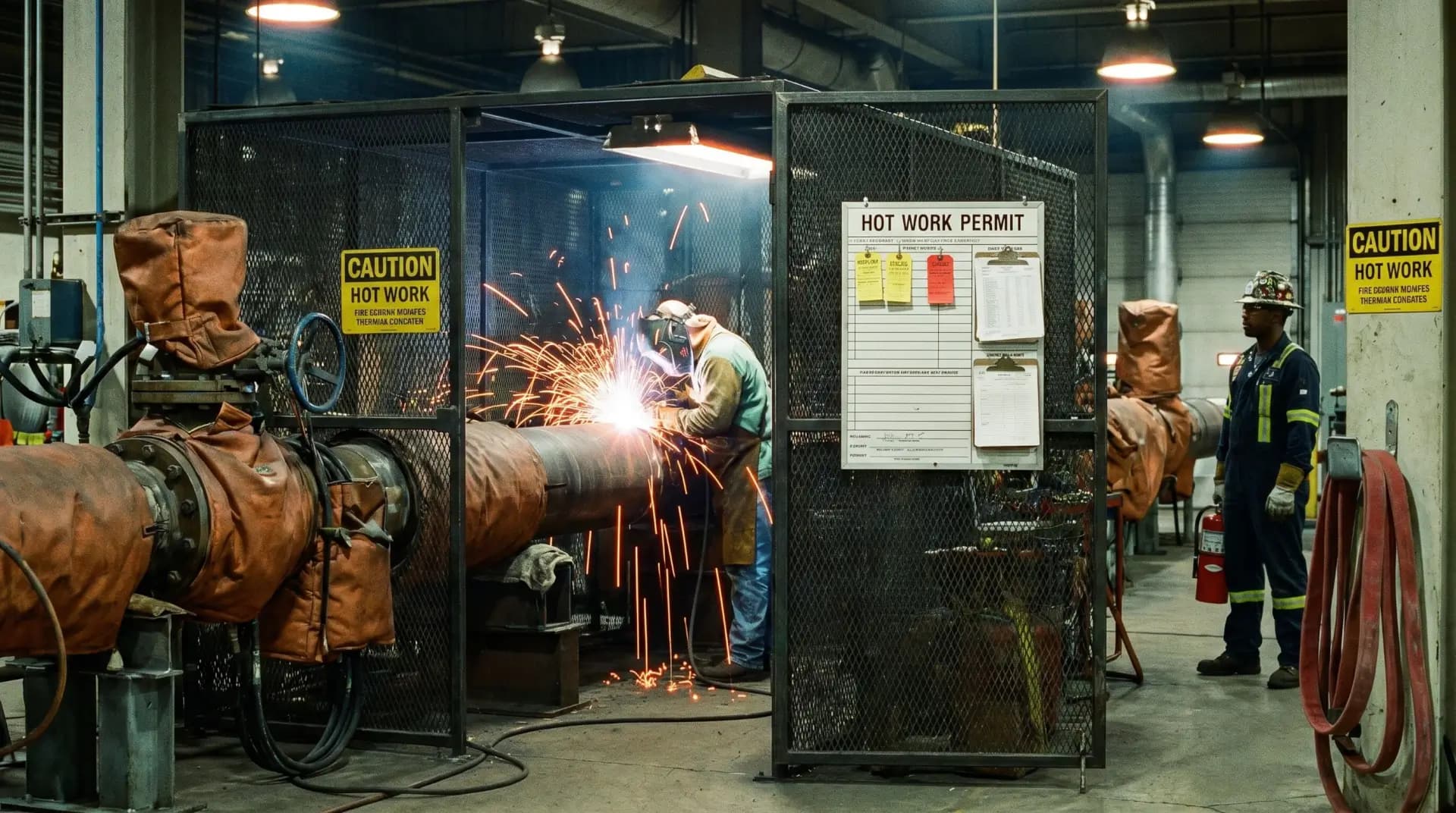
Hot work permits that include fume control, not only fire control
Restricted access to welding areas
Job rotation where appropriate
Clear procedures for coated, plated, or unknown metals
Training on fume hazards and LEV positioning
Preventive maintenance for extraction systems
Housekeeping to prevent dust and residue contamination
Exposure monitoring where required
Health surveillance where required by jurisdiction and risk profile
A welding fume procedure should be specific enough for supervisors to enforce. “Use adequate ventilation” is not enough. The procedure should say what type of extraction is required, where it must be positioned, when RPE is required, and what to do if controls are unavailable.
Regulatory and Compliance Considerations
Welding fume control is both a health requirement and a compliance requirement. The exact legal duties depend on jurisdiction, but the core principle is consistent: employers must assess the hazard and control exposure.
In the United States, OSHA addresses welding, cutting, and brazing under standards for general industry, maritime, and construction. OSHA’s construction welding ventilation standard requires mechanical ventilation systems or local exhaust systems where needed to maintain welding fumes and smoke within safe limits. OSHA’s general industry welding standard also identifies circumstances where local exhaust ventilation or airline respirators are required or desirable, including certain indoor, confined space, stainless steel, lead, cadmium, and beryllium-related operations.
In Great Britain, HSE requires control of welding fume exposure and has strengthened its position because all welding fume, including mild steel welding fume, is treated as capable of causing lung cancer. HSE expects engineering controls for indoor welding and suitable RPE where LEV does not adequately control exposure; suitable RPE is also expected for outdoor welding where needed.
Professional caution: This article provides general HSE guidance. Welding fume controls must be matched to the actual material, process, workplace, exposure level, and applicable jurisdiction. Where carcinogens, confined spaces, toxic coatings, stainless steel, cadmium, lead, beryllium, or unknown materials are involved, competent industrial hygiene support should be used.
Practical Welding Fume Control Checklist
I use a simple field sequence when reviewing welding fume control. It keeps the focus on actual exposure, not paperwork alone.
Before Welding
Confirm the base metal, filler, coating, and surface condition.
Remove paint, oil, grease, plating, and contamination where possible.
Check whether a lower-fume process or method can be used.
Confirm whether the work is indoors, outdoors, or in a confined space.
Select the correct LEV method.
Confirm RPE requirements.
Check that nearby workers are protected.
Review emergency arrangements for confined or poorly ventilated work.
During Welding
Keep the breathing zone out of the plume.
Position LEV close enough to capture the fume.
Reposition extraction as the weld progresses.
Keep doors, fans, and cross-drafts from pushing fumes into workers’ faces.
Wear selected RPE correctly.
Stop work if extraction fails or visible fume accumulates.
Prevent other workers from entering the fume zone unnecessarily.
After Welding
Allow extraction to continue long enough to clear residual fume.
Inspect filters, hoses, hoods, and capture arms.
Clean surfaces using safe methods that do not re-suspend hazardous dust.
Report control failures.
Review whether exposure monitoring or process changes are needed.
Common Mistakes in Welding Fume Management
Mistake 1: Assuming Outdoor Welding Is Automatically Safe
Outdoor work can reduce accumulation, but it does not guarantee breathing zone protection. Wind may move fumes unpredictably, and welders can still inhale the plume directly.
Mistake 2: Using General Fans Incorrectly
A fan that blows fumes away from one welder may push them toward another worker. Air movement should be planned, not improvised.
Mistake 3: Welding Coated Material Without Review
Coatings and residues can change the hazard completely. A mild steel job can become a high-risk exposure if the surface contains lead paint, chromates, zinc, cadmium, or chemical residues.
Mistake 4: Treating LEV as a Static Control
LEV only works when it captures the plume. If the hood is too far away, behind the welder, blocked by the workpiece, or affected by cross-drafts, exposure may remain high.
Mistake 5: Issuing Respirators Without a Program
Respirators require correct selection, fit testing where applicable, maintenance, storage, filter management, user training, and supervision. They are not a standalone shortcut.
Conclusion
Welding fume hazards require disciplined control because the risk is often invisible, variable, and underestimated. The most effective approach is to reduce fume generation, capture fumes at source with properly used LEV, support the system with general ventilation, provide suitable RPE where needed, and verify that controls work in real conditions.
A good welding fume control program protects welders and nearby workers from cancer risk, respiratory disease, metal-specific toxicity, and acute irritation. It also changes the culture of welding safety. The job is no longer judged only by weld quality and fire prevention; it is judged by whether the worker can complete the task without breathing hazardous fume.


Responses