

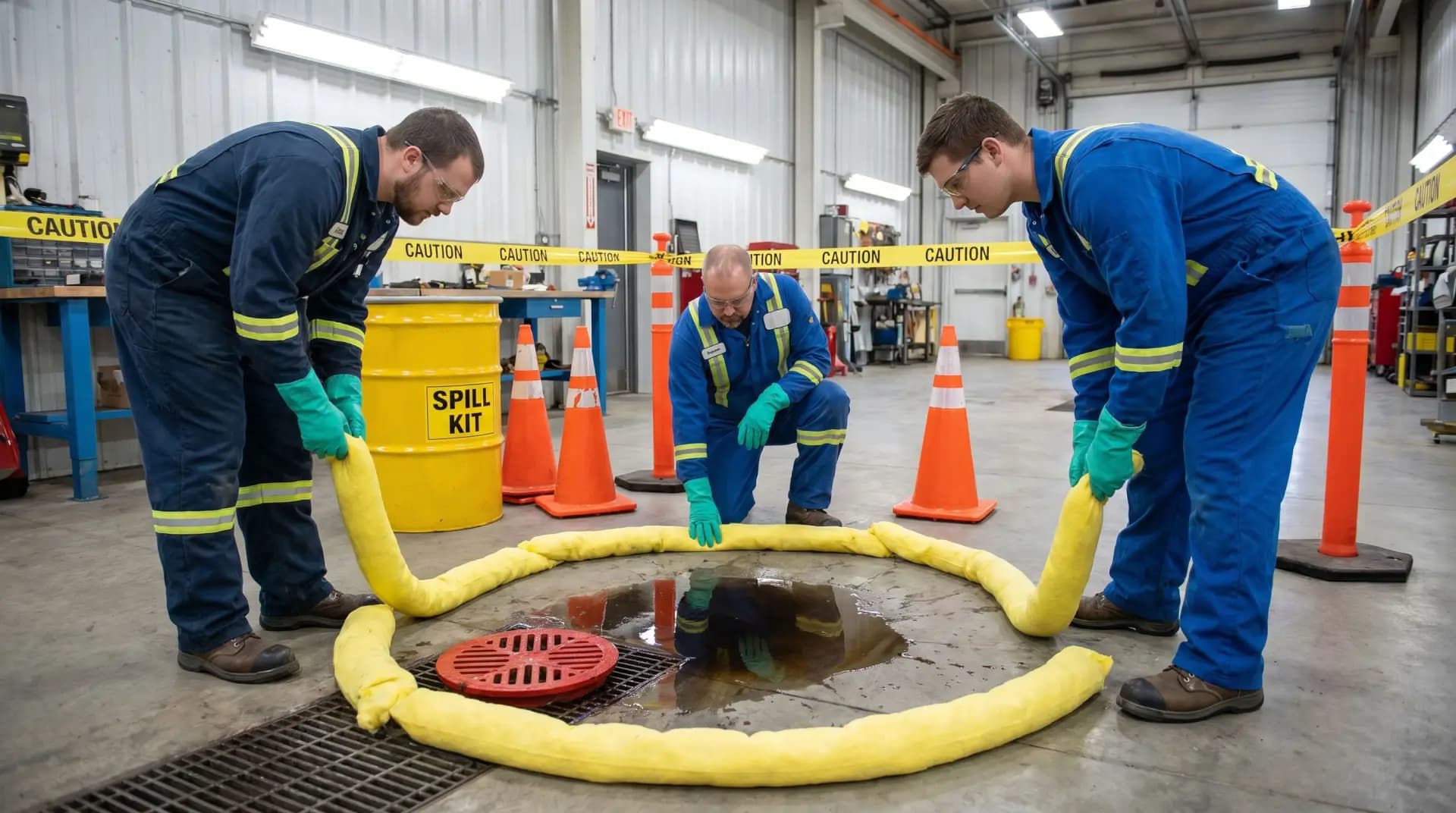
Oil spill response at work must start with one clear priority: protect people first, then prevent the oil from spreading, then clean it up safely, and finally dispose of contaminated waste correctly. A workplace oil spill is not just a housekeeping issue. It can create slip hazards, fire risk, chemical exposure, drainage contamination, equipment damage, and regulatory reporting obligations depending on the location, oil type, quantity, and route of release.
In practical HSE terms, a good oil spill response procedure answers six questions before the spill happens:
Who raises the alarm?
Who is trained to respond?
What oil has been spilled?
How will people be protected?
How will the spill be contained?
How will waste, reporting, and investigation be managed?
The safest procedure is not the one that looks impressive on paper. It is the one that workers can follow under pressure without guessing.
What Counts as an Oil Spill at Work?
An oil spill at work is any uncontrolled release of oil, fuel, lubricant, hydraulic fluid, transformer oil, waste oil, cooking oil, or oil-contaminated liquid from its intended container, system, or process.
Common workplace examples include:
Diesel leaking during refuelling
Hydraulic oil released from a burst hose
Lubricating oil spilled during maintenance
Waste oil leaking from drums or intermediate bulk containers
Oil escaping from generators, compressors, forklifts, pumps, or vehicles
Oil-contaminated water overflowing from containment areas
Cooking oil spills in commercial kitchens or food production areas
The scale can vary from a small drip under a machine to a release large enough to reach drains, soil, surface water, ignition sources, or public areas. The response level should be based on risk, not only volume.
A small oil spill in a workshop may be safely managed by trained employees using a spill kit. The same quantity near a storm drain, hot work area, food zone, confined space entry point, or public walkway may require escalation.
Immediate Oil Spill Response Steps
The first few minutes decide whether an oil spill remains controlled or becomes an emergency. I train teams to think in this order: stop, warn, assess, control, clean, report.
Step | Action | Purpose |
|---|---|---|
1 | Stop work and stay clear | Prevent exposure, slips, ignition, and spread |
2 | Warn others and isolate the area | Keep unprotected people away |
3 | Identify the oil and hazards | Confirm SDS, flammability, temperature, additives, and exposure risks |
4 | Stop the source if safe | Close valves, upright containers, shut down pumps, or isolate equipment |
5 | Protect drains and sensitive areas | Prevent environmental release |
6 | Contain the spill | Use absorbent socks, booms, drain covers, bunds, or barriers |
7 | Clean up with suitable PPE and materials | Remove oil safely without spreading contamination |
8 | Dispose of waste properly | Treat absorbents, PPE, and residues as controlled waste where applicable |
9 | Report and investigate | Capture causes, corrective actions, and regulatory duties |
Step 1: Stop Work and Protect People
No one should rush into an oil spill. The first action is to stop nearby work and check whether anyone is injured, contaminated, trapped, or at risk of slipping.
Workers should keep clear of the spill until the hazards are understood. Oil on smooth concrete, metal platforms, stairs, ladders, or vehicle routes can cause serious falls. If the spill is near moving vehicles or machinery, traffic should be stopped or diverted immediately.
If there is a fire risk, vapour concern, hot surface, electrical equipment, or confined space nearby, the response must be escalated. Workers should not attempt cleanup unless they are trained, equipped, and authorised.
Step 2: Raise the Alarm and Isolate the Area
The spill area should be isolated using cones, barriers, tape, signs, or a physical exclusion zone. Access must be controlled so that employees, contractors, visitors, and drivers do not walk or drive through the oil.
The person discovering the spill should notify the supervisor, control room, emergency coordinator, or spill response team according to the site procedure.
A simple reporting message works best:
Exact location of the spill
Type of oil, if known
Estimated quantity
Whether the spill is still leaking
Whether anyone is injured or exposed
Whether drains, soil, water, ignition sources, or traffic routes are affected
What immediate controls have been applied
This prevents confusion and helps the right level of response arrive quickly.
Step 3: Identify the Oil and Review the SDS
Not all oils present the same risk. Diesel, petrol-contaminated residues, hydraulic oil, used engine oil, cutting oils, transformer oils, and food oils require different controls.
The Safety Data Sheet should be checked where available, especially for:
Flammability
Skin and eye contact hazards
Inhalation hazards
Additives or contaminants
Required PPE
Spill containment instructions
Firefighting measures
Waste disposal requirements
Used oil deserves particular caution because it may contain degraded additives, metals, combustion by-products, or process contamination. The response team should not assume it is harmless because it “looks like normal oil.”
Containment: Stop the Oil from Spreading
Containment is the turning point in oil spill response. Once oil reaches drains, soil, waterways, pits, sumps, cable trenches, or porous surfaces, the incident becomes harder, more expensive, and potentially reportable.
The response team should contain the spill before starting full cleanup.
Practical Containment Methods
Common containment controls include:
Absorbent socks around the edge of the spill
Oil-only absorbent pads for surface oil
Drain covers or drain mats
Sandbags or temporary bunds
Spill booms for larger releases
Drip trays under leaking equipment
Overpack drums for leaking containers
Portable bunds for damaged drums or containers
Non-sparking tools where flammable vapours may be present
The basic rule is to contain from the outside and work inward. Do not push or hose oil across the floor. Water often spreads the problem and can carry oil into drains or separation systems.
Protecting Drains and the Environment
Drain protection should be one of the first response actions. Many workplace spills become serious because oil enters a stormwater drain before anyone thinks about containment.
Workers should know the difference between:
Stormwater drains
Process drains
Foul sewer systems
Oil-water separators
Interceptors
Sumps
Blind drains
Surface channels
A site spill plan should identify sensitive routes clearly. Drain covers, absorbent socks, and spill kits should be positioned where oil is stored, transferred, or used—not locked away in a distant store.
PPE and Safety Controls for Oil Spill Cleanup
PPE must match the oil, the quantity, the location, and the exposure route. For many routine oil spills, gloves, safety footwear, eye protection, and coveralls may be sufficient. For larger or more hazardous spills, respiratory protection, chemical-resistant clothing, face protection, or specialist response may be required.
Typical PPE for Workplace Oil Spill Response
Hazard | Possible Control |
|---|---|
Skin contact | Oil-resistant gloves and coveralls |
Eye splash | Safety goggles or face shield |
Slips | Slip-resistant safety footwear |
Vapour or mist | Ventilation and respiratory protection where assessed |
Fire risk | Remove ignition sources and use suitable fire controls |
Traffic movement | Barriers, spotters, and vehicle isolation |
Manual handling | Use tools, containers, and team lifting where needed |
PPE is the last line of defence, not the full solution. The better controls are isolation, source control, containment, ventilation, and safe work methods.
Ignition and Fire Controls
Some oils and fuels can create serious fire hazards, especially diesel mist, petrol-contaminated oil, heated oil, and spills near hot surfaces or welding activity.
The response team should:
Stop hot work nearby
Remove or isolate ignition sources if safe
Shut down affected equipment where required
Keep vehicles away from the spill
Use intrinsically safe equipment where flammable vapours may be present
Keep suitable fire extinguishers available
Escalate immediately if vapours, heat, or fire risk cannot be controlled
No cleanup should continue in an unsafe atmosphere.
How to Clean Up an Oil Spill Safely
Cleanup should only begin after the spill is assessed, the area is isolated, the source is controlled, and the spill is contained.
Small Oil Spill Cleanup Procedure
For a small, controlled spill that trained workers can manage safely:
Put on the required PPE.
Stop the source if it can be done safely.
Place absorbent socks around the spill boundary.
Cover the oil with suitable absorbent pads or granules.
Allow the absorbent to take up the oil.
Collect used absorbents with suitable tools.
Place contaminated materials into labelled waste bags or containers.
Clean the floor using an approved degreasing method if required.
Check that the walking surface is dry and slip-free.
Restock the spill kit.
Report the spill and record corrective actions.
The area should not be reopened until it is safe for normal movement and operations.
Larger or Uncontrolled Spill Procedure
A larger oil spill, or any spill that is still spreading, must be escalated. The internal spill response team, emergency services, environmental response contractor, or regulator may need to be notified depending on the circumstances and jurisdiction.
Escalation is required when:
The source cannot be stopped safely
The spill reaches drains, soil, water, or public areas
There is fire, vapour, or explosion risk
The oil is unknown or contaminated
Workers may be exposed beyond normal controls
The spill is beyond the capacity of available spill kits
Specialist pumping, recovery, or environmental cleanup is needed
Legal reporting thresholds may apply
In these cases, untrained workers should withdraw, restrict access, and wait for competent responders.
Spill Kits, Equipment, and Preparedness
Oil spill response fails when equipment is missing, unsuitable, empty, or located too far from the hazard. A spill kit should be selected based on the site’s oil inventory, maximum credible spill, storage layout, drainage routes, and response capability.
What an Oil Spill Kit Should Include
A typical oil spill kit may include:
Oil-only absorbent pads
Absorbent socks or mini booms
Drain covers or drain mats
Disposal bags or containers
Chemical-resistant gloves
Eye protection
Instructions or spill response card
Warning signs or barrier tape
Non-sparking tools where required
Temporary leak sealing materials where suitable
Universal absorbents are not always the best choice. Oil-only absorbents are useful where oil may be present with water, because they are designed to absorb oil while resisting water uptake.
Where Spill Kits Should Be Located
Spill kits should be placed near:
Fuel storage areas
Refuelling points
Oil drum stores
Waste oil collection points
Generator rooms
Maintenance workshops
Loading bays
Hydraulic systems
Vehicle parking and service areas
Chemical and oil transfer points
They should be visible, accessible, labelled, protected from damage, and inspected regularly. A locked spill kit may satisfy a checklist, but it does not support fast response.
Roles, Training, and Communication
A written oil spill procedure is not enough. Workers need to know what they are expected to do and what they must not do.
Key Workplace Roles
Role | Responsibility |
|---|---|
All employees | Stop work, warn others, report spills, avoid unsafe cleanup |
Area supervisor | Control the area, escalate, coordinate initial response |
Spill response team | Assess, contain, clean, and manage waste within competence |
HSE team | Maintain procedures, training, inspections, and investigations |
Maintenance team | Isolate equipment and repair leak sources |
Waste contractor | Collect and dispose of contaminated materials |
Emergency coordinator | Liaise with emergency services or regulators where required |
The most important boundary is competence. General workers may be trained to report and isolate. Spill responders may be trained to contain and clean. Specialist contractors may be needed for hazardous, large, environmental, or complex releases.
Training Topics for Oil Spill Response
Training should cover:
Common oil spill scenarios at the site
Alarm and reporting routes
SDS use
Spill kit locations and contents
Drain protection
PPE selection and limitations
Source control methods
Cleanup techniques
Waste labelling and storage
Fire and ignition control
When to escalate
Incident reporting and investigation
Drills should be realistic. A good drill does not only ask whether workers know where the spill kit is. It checks whether they can protect the drain, isolate traffic, choose the correct absorbent, communicate clearly, and avoid unsafe shortcuts.
Waste Disposal, Reporting, and Investigation
Oil spill cleanup is not complete when the floor looks clean. Used absorbents, contaminated PPE, oily rags, sludge, recovered liquid, and contaminated soil or debris may need controlled disposal according to local environmental and waste requirements.
Waste should be:
Segregated from general waste
Stored in suitable labelled containers
Protected from rainwater
Kept away from ignition sources where relevant
Collected by approved waste handlers where required
Recorded through the site waste management process
Never place oil-contaminated materials into ordinary bins unless the waste classification confirms it is allowed. Oily rags and absorbents can also create fire risk if poorly stored.
Incident Reporting
The spill report should capture:
Date, time, and exact location
Substance and estimated quantity
Source of release
Immediate cause
People involved
Injuries, exposures, or near misses
Drains, soil, water, equipment, or product affected
Response actions taken
Waste generated and disposal route
Notifications made
Photos, sketches, or CCTV review where useful
Corrective and preventive actions
For regulatory reporting, the duty depends on jurisdiction, material, quantity, receiving environment, and legal thresholds. In the United States, for example, workplace safety requirements and environmental oil spill prevention obligations may both apply depending on the facility and discharge route. In the United Kingdom, health and safety duties, COSHH-related emergency planning, environmental permitting, and pollution reporting duties may be relevant depending on the activity and impact. Other countries have their own notification rules. The site procedure must state the applicable local reporting route clearly.
Root Cause Investigation
A spill investigation should go beyond “operator error.” Most oil spills have system causes.
Common root causes include:
Poor storage layout
Damaged hoses or fittings
Overfilled containers
Missing drip trays
Inadequate secondary containment
Poor transfer practices
No pre-use inspection
Unlabelled containers
Vehicle impact
Weak contractor control
Lack of maintenance
Spill kits not available
Drains not identified
Workers not trained
Corrective actions should remove the reason the spill happened, not only replace the absorbent pads used during cleanup.
Prevention: The Best Oil Spill Response Is Avoiding the Spill
Strong oil spill prevention is built into daily operations. It should not depend on luck or individual memory.
Practical prevention controls include:
Secondary containment for oil storage
Bunded pallets for drums and containers
Regular inspection of tanks, hoses, valves, and seals
Controlled refuelling procedures
Overfill protection where needed
Clear labelling of oils and waste oils
Closed transfer systems where practical
Drip trays for routine maintenance
Good housekeeping in workshops and stores
Protection of tanks and pipework from vehicle impact
Separation of oil storage from drains
Planned maintenance for hydraulic equipment
Contractor controls during service work
Spill response drills and kit inspections
From an HSE perspective, prevention and response must be connected. If the same area has repeated small spills, the issue is not absorbent supply. The issue is usually design, maintenance, behaviour, supervision, or planning.
Conclusion
Oil spill response procedures at work should be simple enough to follow under pressure and strong enough to protect people, property, and the environment. The correct sequence is to stop work, warn others, assess the hazards, isolate the area, stop the source if safe, protect drains, contain the spill, clean it up with suitable PPE and absorbents, dispose of waste correctly, and report the incident.
The most reliable workplaces do not treat oil spills as routine mess. They treat them as preventable loss events. They train workers, position spill kits where they are needed, inspect storage areas, protect drainage routes, and investigate causes properly. That is how an oil spill procedure becomes more than a document—it becomes a working control.


Responses