

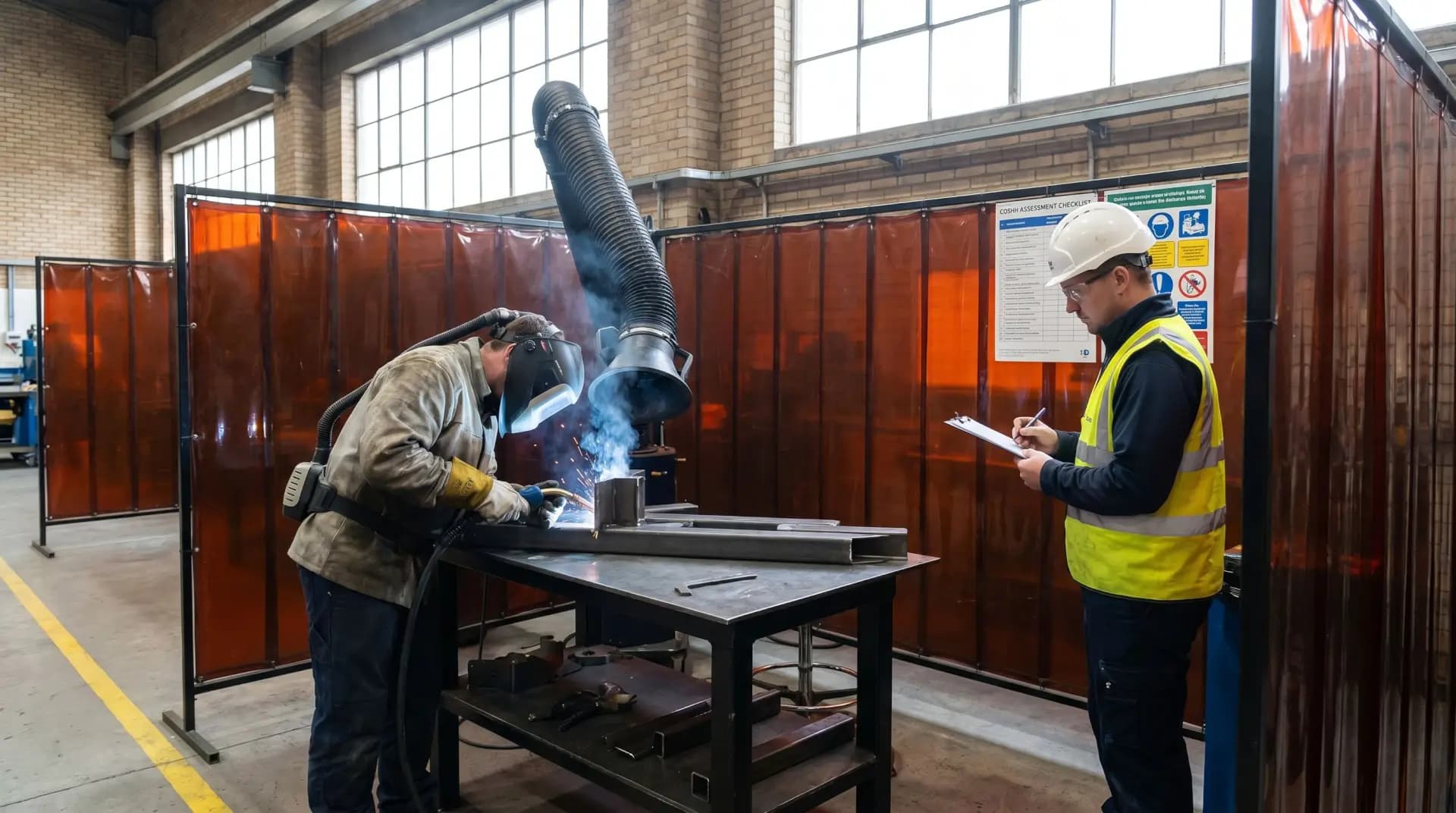
A COSHH assessment for welding fume exposure must prove one thing clearly: the employer has identified the hazardous substances created during welding, evaluated who may breathe them in, and selected controls that prevent or adequately reduce exposure. Welding fume cannot be treated as a minor nuisance or normal workshop smoke. It is a hazardous airborne contaminant that can damage the lungs, trigger occupational asthma, cause metal fume fever, and increase cancer risk.
Under the United Kingdom’s Control of Substances Hazardous to Health Regulations, welding fume must be assessed and controlled wherever welding, cutting, gouging, brazing, or similar hot work produces airborne contaminants. The same practical principle applies internationally, even where the regulation name is different: identify the fume, control it at source, verify that controls work, and keep workers informed, trained, and medically protected where required.
A proper COSHH assessment for welding fume is not a paperwork exercise. It should influence how the job is planned, where extraction is placed, what respiratory protection is issued, how confined spaces are managed, and how supervisors confirm that controls are actually being used.
What Makes Welding Fume a COSHH Hazard?
Welding fume is a mixture of very fine airborne particles and gases generated when metals, coatings, filler materials, fluxes, and shielding gases are heated. The exact composition changes from job to job. That is why a generic “welding risk assessment” is rarely enough on its own.
A COSHH assessment should consider:
Source of Exposure | Examples of Hazardous Substances |
|---|---|
Base metal | Mild steel, stainless steel, aluminium, galvanized steel |
Filler wire or rods | Metal oxides, flux decomposition products |
Surface coatings | Paint, primer, zinc coating, oil, grease, residues |
Welding process | Fume, ozone, nitrogen oxides, shielding gas displacement |
Work location | Indoor bays, tanks, vessels, pits, enclosed fabrication areas |
Work duration | Short tack welding, production welding, repair work, continuous welding |
Stainless steel welding needs particular attention because fume may contain chromium and nickel compounds. Galvanized steel can release zinc oxide fume. Painted or coated metals may release toxic decomposition products depending on the coating. Aluminium welding can generate ozone under certain conditions. These differences matter because control selection depends on the material, process, and environment.
The common mistake I see in welding assessments is assessing only the visible plume. Some hazardous welding contaminants are not obvious by sight or smell. A clean-looking weld area does not automatically mean safe breathing air.
Key Information to Collect Before Writing the Assessment
A welding fume COSHH assessment should start with the work itself, not with a template. Before deciding controls, I would expect the assessor to understand the task in practical detail.
The assessment should record:
Welding process
MIG, MAG, TIG, MMA, flux-cored arc welding, plasma cutting, oxy-fuel cutting, gouging, brazing, or soldering.Materials being welded or cut
Mild steel, stainless steel, galvanized steel, aluminium, high-strength alloys, coated metals, or contaminated scrap.Consumables and safety data sheets
Welding rods, wires, fluxes, gases, anti-spatter products, cleaners, and any surface preparation chemicals.Work location
Open workshop, welding booth, fabrication line, outdoor work, confined space, vessel, tank, duct, pit, or poorly ventilated area.Frequency and duration
Occasional short welds need control, but continuous welding creates a very different exposure profile.People exposed
Welders, helpers, fitters, inspectors, cleaners, nearby workers, visitors, and maintenance personnel.Existing controls
Local exhaust ventilation, on-tool extraction, general ventilation, welding screens, work positioning, respiratory protective equipment, and supervision.Evidence that controls work
LEV examination records, face-fit testing, exposure monitoring where needed, health surveillance records, training records, and maintenance logs.
A strong COSHH assessment is specific enough that a supervisor can use it at the job location. If it only says “use ventilation and PPE,” it is not controlling the risk; it is describing an intention.
How to Assess Welding Fume Exposure
The core of the assessment is exposure judgement. The assessor should decide whether workers may inhale welding fume and whether the existing controls are enough.
Consider the Route of Exposure
For welding fume, inhalation is the main route. Skin and eye risks may also exist from ultraviolet radiation, spatter, heat, and chemicals, but the COSHH focus is mainly on hazardous substances entering the body through breathing.
The breathing zone is critical. If the welder’s head is positioned in or close to the rising plume, exposure can be significant even when the workshop looks well ventilated. Fume extraction must protect the breathing zone, not simply clear the room later.
Consider the Level of Risk
Risk increases where:
Welding is done indoors without effective local exhaust ventilation.
The welder leans over the workpiece and breathes through the plume.
Stainless steel, galvanized metal, coated metal, or contaminated metal is welded.
High-fume processes or high current settings are used.
Welding takes place in restricted, enclosed, or confined spaces.
Extraction arms are too far from the arc.
Respirators are issued without face-fit testing or maintenance.
Nearby workers are not protected from drifting fume.
The assessment should not assume that outdoor welding is automatically safe. Outdoor work may reduce accumulation, but wind direction, work posture, material type, and time on task still matter. Where fume enters the breathing zone, control is required.
Decide Whether Exposure Monitoring Is Needed
Air monitoring is not always required for every simple welding task, but it becomes useful where exposure is uncertain, controls are being validated, welding is frequent, materials are more hazardous, or regulators or clients require evidence.
Monitoring may be appropriate when:
Stainless steel or other alloy welding is frequent.
Workers report respiratory symptoms.
LEV effectiveness is questioned.
Multiple welders operate in one area.
Work is carried out in enclosed or poorly ventilated spaces.
There is a need to compare exposure with occupational exposure limits.
Monitoring should be planned by a competent person. Poorly designed sampling can give false reassurance.
Control Measures for Welding Fume Under COSHH
COSHH requires exposure to be prevented where reasonably practicable. Where prevention is not possible, exposure must be adequately controlled. For welding fume, that usually means using a hierarchy of controls rather than relying on disposable masks.
1. Eliminate or Reduce Fume at Source
The first question is whether the work can be changed to produce less fume.
Possible reduction measures include:
Using a lower-fume welding process where suitable.
Reducing welding current and voltage to the lowest effective setting.
Removing paint, oil, grease, coatings, and contamination before welding.
Using pre-fabrication or mechanical fastening where welding is not essential.
Selecting consumables that reduce fume generation where technically acceptable.
Improving joint preparation to reduce rework and excessive weld passes.
This stage is often overlooked because people jump straight to PPE. In practice, reducing fume generation makes every downstream control more reliable.
2. Use Local Exhaust Ventilation
For most indoor welding, local exhaust ventilation is the main engineering control. It should capture fume at or near the source before it enters the worker’s breathing zone.
Effective LEV depends on:
Correct hood or extraction arm position.
Adequate capture velocity.
Keeping the extraction point close to the weld.
Avoiding cross-draughts that push fume away from the hood.
Maintaining filters, ducts, fans, and indicators.
Training welders to reposition the extraction as the weld progresses.
The practical weakness with many LEV systems is not the design on paper; it is daily use. Extraction arms are left too far away, blocked by workpieces, or moved aside because they feel inconvenient. A COSHH assessment should address that human factor through supervision, layout, and worker involvement.
3. Improve General Ventilation
General ventilation helps dilute background fume and protect other workers in the area, but it should not be treated as a substitute for source extraction. It is a supporting control.
General ventilation is especially important where multiple welding stations operate in the same workshop. However, simply opening doors or using fans can create uncontrolled airflow and may push fume across other work areas. Air movement should be planned, not guessed.
4. Use Respiratory Protective Equipment Where Needed
Respiratory protective equipment is required where engineering controls alone do not adequately control exposure, where welding is short-duration but still hazardous, or where the work location makes extraction difficult.
RPE selection should consider:
Fume type and concentration.
Welding duration.
Compatibility with welding shields.
Assigned protection factor.
Facial hair and face seal requirements.
Fit testing for tight-fitting masks.
Filter type and replacement schedule.
Storage, cleaning, inspection, and maintenance.
Powered air-fed welding helmets are often more practical for regular welding than tight-fitting disposable masks, especially where comfort and consistent use are concerns. However, they still need inspection, maintenance, battery management, and user training.
RPE should never be used to excuse poor planning. It is a final layer of protection, not the whole control strategy.
5. Protect Nearby Workers
Welding fume exposure is not limited to the person holding the torch. Helpers, grinders, inspectors, and workers in adjacent bays may also be exposed.
The assessment should include:
Segregation of welding areas.
Welding screens or curtains.
Restricted access during high-fume work.
Airflow control to prevent fume drift.
Housekeeping to avoid contaminated dust build-up.
Communication with other trades working nearby.
This is where many assessments fail. They identify the welder but ignore the second person standing beside the job, often without any respiratory protection.
Health Surveillance, Training, and Competence
Because welding fume can affect respiratory health, health surveillance may be required where there is a reasonable likelihood of work-related disease despite controls, or where regulation and competent occupational health advice indicate it is necessary.
Health surveillance may include respiratory questionnaires, lung function testing, symptom reporting, and referral pathways. It should not be used as a replacement for exposure control. Its purpose is early detection and prevention of further harm.
Workers should be trained to understand:
Why welding fume is hazardous.
Which materials create higher-risk fume.
How to position extraction correctly.
Why keeping the head out of the plume matters.
How to inspect and use RPE.
When to stop work and report control failure.
Why facial hair affects tight-fitting respirators.
How to recognize symptoms that need reporting.
Competence also applies to assessors, supervisors, maintenance teams, and anyone responsible for LEV testing or respirator management. A good COSHH assessment loses value quickly if the people implementing it do not understand the controls.
COSHH Assessment Checklist for Welding Fume
A practical assessment should be clear enough to audit. The following checklist can be used as a structured review.
Assessment Item | What to Check | Evidence Required |
|---|---|---|
Task description | Welding process, material, location, duration | Job method statement, work order |
Hazard identification | Fume, gases, coatings, consumables | SDS, material data, process review |
People exposed | Welders and nearby workers | Work area layout, task observation |
Existing controls | LEV, ventilation, RPE, segregation | Inspection records, photos, site check |
Exposure judgement | Likelihood of inhalation exposure | Observation, monitoring where needed |
Control adequacy | Whether exposure is prevented or reduced | LEV test, RPE fit test, supervision |
Maintenance | LEV and RPE condition | Maintenance logs, statutory examinations |
Training | User understanding and competence | Training records, toolbox talks |
Health surveillance | Need based on exposure and risk | Occupational health programme |
Emergency arrangements | Confined spaces, gas displacement, control failure | Rescue plan, permit system |
Review triggers | Process, material, symptoms, incidents, monitoring results | Assessment review record |
A useful rule is this: if the assessment cannot tell a welder exactly what control to use for a specific job, it is not yet finished.
Common Mistakes in Welding Fume COSHH Assessments
The most common weakness is generic wording. Welding fume assessments often fail because they look acceptable in a folder but do not match the actual job.
Common mistakes include:
Treating all welding work as the same risk.
Ignoring stainless steel, galvanized steel, and coated materials.
Relying on natural ventilation indoors.
Listing LEV without confirming capture at the source.
Issuing disposable masks without fit testing.
Ignoring nearby workers.
Forgetting confined space risks.
Failing to review the assessment after process changes.
Not involving welders in control selection.
Keeping no evidence of inspection, maintenance, or training.
Another serious mistake is using PPE as the first answer. When workers are exposed to welding fume, the stronger professional judgement is to ask why the fume is reaching the breathing zone in the first place.
Example Structure for a Welding Fume COSHH Assessment
A welding fume COSHH assessment should include the following sections:
1. Activity Details
Describe the welding task, process, material, location, frequency, and duration. Include whether the work is routine, maintenance, repair, or project-based.
2. Hazardous Substances
Identify fume, gases, metal oxides, coating decomposition products, and any substances from consumables or surface contamination.
3. Persons at Risk
List welders, assistants, nearby workers, contractors, cleaners, inspectors, and anyone entering the welding area.
4. Exposure Potential
Describe how exposure may occur, including breathing zone exposure, poor ventilation, enclosed work, plume direction, and fume drift.
5. Existing Controls
Record current engineering controls, work practices, RPE, access control, training, and supervision.
6. Additional Controls Required
State what must be improved, by whom, and by when. This may include LEV installation, RPE upgrade, fit testing, health surveillance, or layout changes.
7. Monitoring and Review
Include LEV examination, RPE checks, exposure monitoring where needed, health surveillance review, and reassessment triggers.
YMYL Safety Note
This article provides professional HSE guidance for developing and reviewing a COSHH assessment for welding fume exposure. It does not replace a site-specific assessment by a competent person, occupational hygienist, occupational health provider, or regulatory specialist. Welding fume control must account for the actual process, material, work environment, exposure duration, ventilation performance, and applicable legal jurisdiction.
For higher-risk work such as stainless steel welding, galvanized material welding, coated metal hot work, confined space welding, or repeated production welding, competent technical input should be obtained before work begins.
Conclusion
A COSHH assessment for welding fume exposure should lead to practical control, not just compliance paperwork. The assessment must identify the fume source, understand who may inhale it, evaluate the real working conditions, and apply controls that reduce exposure at the source.
The strongest welding fume controls usually combine process planning, local exhaust ventilation, good work positioning, general ventilation, suitable respiratory protection, training, maintenance, and health surveillance where required. No single control is enough for every welding task.
In my view, the most reliable assessment is one that can be tested on the shop floor. Stand beside the work, observe the plume, check the extraction, look at the welder’s breathing zone, speak to the worker, and confirm the evidence. That is where a COSHH assessment becomes a health protection tool rather than a document.

Responses