

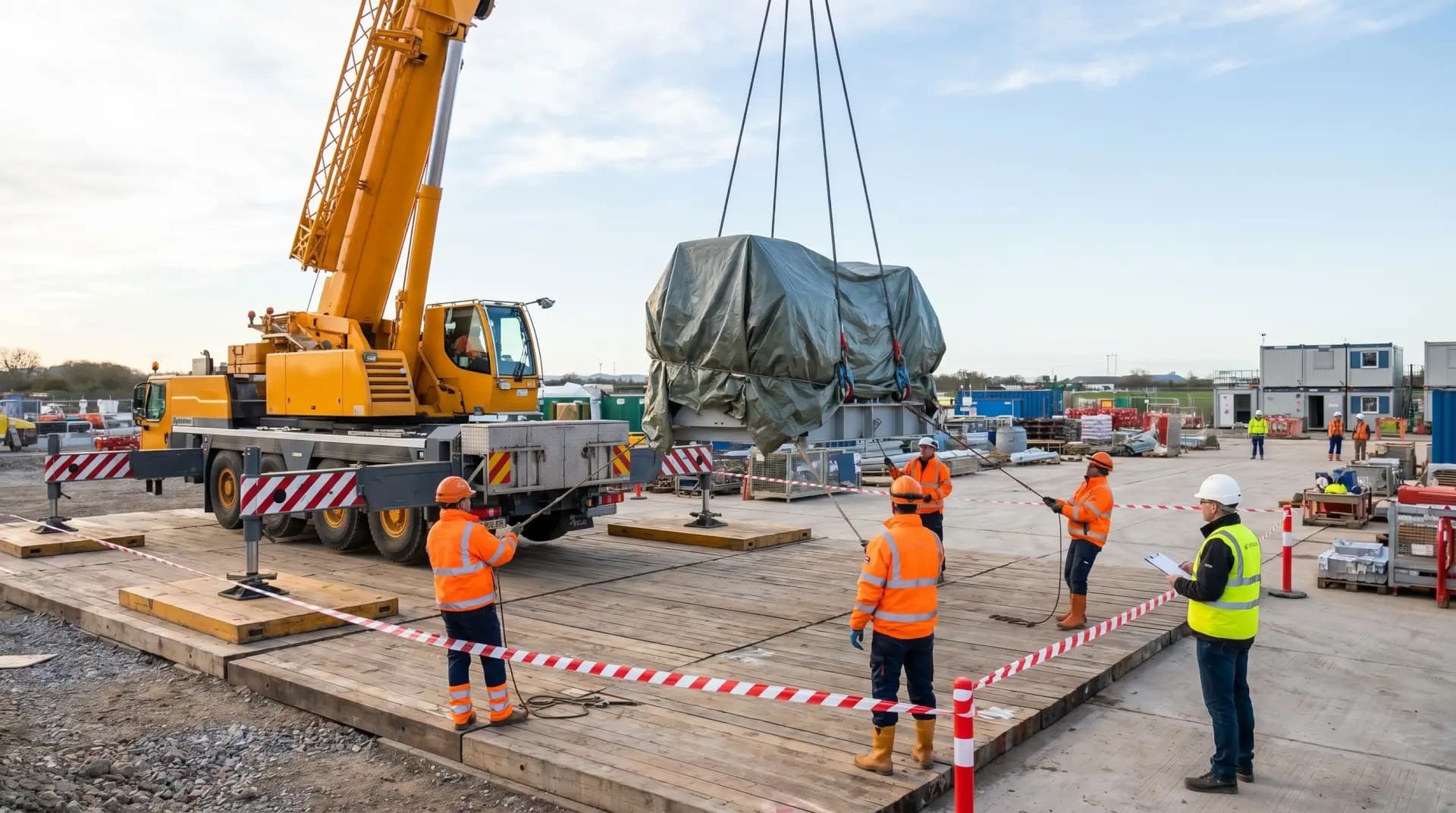
A Job Safety Analysis for lifting operations is a structured review of the lifting task before the load is moved. Its purpose is simple: identify what can go wrong, decide who controls each risk, and confirm that the lift can be executed safely under the actual site conditions.
In lifting work, the danger is rarely only the weight of the load. The real risk sits in the combination of load stability, crane capacity, rigging method, ground conditions, exclusion zones, weather, communication, people movement, and last-minute changes. A good JSA brings these factors into one practical document that the lifting team can understand and follow before the hook is loaded.
The JSA does not replace the lift plan, method statement, crane manual, permit to work, or legal inspection requirements. It supports them. In my practice, I treat the JSA as the field-level safety check that connects the written plan with the reality of the job location.
What Is a Job Safety Analysis for Lifting Operations?
A Job Safety Analysis, also called JSA or Job Hazard Analysis, breaks a lifting task into logical steps and identifies the hazards, consequences, and control measures for each step. For lifting operations, this normally covers the full sequence from planning and equipment inspection to rigging, lifting, landing, and demobilization.
A lifting JSA should answer five practical questions:
What exactly is being lifted?
How will it be lifted, moved, and landed?
What can fail or change during the operation?
Who is responsible for each control?
What conditions require the lift to stop?
A lifting operation may involve a mobile crane, tower crane, crawler crane, overhead crane, forklift with approved attachment, chain block, hoist, telehandler, winch, or other lifting equipment. The JSA must match the equipment and the complexity of the lift.
For a routine low-risk lift, the JSA may be short and task-focused. For a critical lift, tandem lift, blind lift, lift near live services, lift over occupied areas, or lifting of personnel, the JSA must be more detailed and aligned with a formal lift plan prepared by competent personnel.
Why Lifting Operations Need a Specific JSA
Lifting operations deserve specific attention because the hazards are dynamic. Once a load is suspended, the risk changes immediately. The load can swing, rotate, fall, strike workers, damage structures, contact power lines, overload equipment, or destabilize the crane.
A general risk assessment is not enough when the work involves suspended loads. The lifting JSA must focus on the specific lift path, people involved, communication method, rigging configuration, lifting points, environmental conditions, and emergency response.
Common high-risk factors include:
Unknown or poorly confirmed load weight
Incorrect sling angle or rigging arrangement
Damaged lifting accessories
Unstable or weak ground
Crane set up outside approved operating limits
People working inside the drop zone
Poor visibility between the operator and signal person
Wind affecting large or awkward loads
Lifting close to overhead power lines or structures
Last-minute changes without reassessment
One common misconception is that lifting safety is mainly the crane operator’s responsibility. That is incorrect. The operator is critical, but safe lifting depends on the planner, lifting supervisor, rigger, signal person, site management, maintenance team, and workers in the surrounding area. The JSA must make these interfaces clear.
Key Steps in a Lifting Operation JSA
A useful lifting JSA follows the work sequence. I prefer this approach because it helps the team visualize the job instead of reading a list of disconnected hazards.
Job Step | Typical Hazards | Essential Controls |
|---|---|---|
Pre-lift planning | Wrong crane selection, unknown load weight, unclear lift path | Confirm load details, crane capacity, radius, lift plan, permits, and competent personnel |
Site preparation | Poor ground, congestion, underground services, overhead obstructions | Verify ground bearing, access route, exclusion zone, barricades, and service information |
Equipment inspection | Defective crane, damaged slings, missing certificates, faulty hooks | Check inspection status, safe working load, hooks, latches, shackles, slings, and lifting points |
Rigging the load | Incorrect sling angle, sharp edges, unstable center of gravity | Use approved rigging method, edge protection, tag lines, competent riggers, and balanced load test |
Trial lift | Load tilt, brake issue, poor balance, unexpected movement | Lift slightly, hold, check balance, communication, brakes, and rigging tension |
Main lift and travel | Swinging load, struck-by risk, collision, loss of control | Maintain exclusion zone, use agreed signals, control speed, avoid personnel under load |
Landing and release | Crush points, unstable placement, trapped rigging | Prepare landing area, use packing or supports, keep hands clear, release tension safely |
Demobilization | Stored energy, poor housekeeping, damaged gear reused | Inspect gear after use, remove barricades safely, report defects, close permits |
The JSA must be specific enough that a competent person can read it and understand how the lift will actually be controlled. Generic statements such as “be careful,” “use PPE,” or “follow procedure” are weak controls unless they are supported by clear actions.
Critical Hazards to Cover in a Lifting JSA
Load Weight and Center of Gravity
Every lifting operation starts with knowing the load. Estimated weight is not enough for anything beyond simple routine work. The team should confirm the load weight from drawings, manufacturer data, markings, weighing records, or engineering calculation.
The center of gravity is equally important. A load can be within crane capacity and still become unsafe if it tilts, rotates, or shifts because the lifting points are wrong. Irregular loads, fabricated structures, tanks, machinery, and bundled materials need careful review.
The JSA should specify:
Confirmed load weight
Load dimensions
Center of gravity concerns
Approved lifting points
Sling configuration
Requirement for trial lift
Tag line use where appropriate
Crane Capacity, Radius, and Ground Conditions
Many lifting failures begin with poor setup. The crane may be capable on paper but unsafe at the actual working radius, boom length, ground condition, or configuration.
The JSA should require verification of the crane load chart, outrigger setup, mats or pads, ground bearing capacity, slope, underground voids, nearby excavations, and travel route if the crane will move with a load. Ground preparation is not a minor detail. It is a primary lifting control.
Rigging and Lifting Accessories
Slings, shackles, hooks, beams, clamps, spreader bars, chain blocks, and lifting eyes must be suitable for the load and inspected before use. The safe working load must not be exceeded, and the effect of sling angles must be understood.
A lifting JSA should cover:
Correct accessory rating
Inspection before use
Valid certification or examination status where required
Protection from sharp edges
Correct shackle orientation
Hook latch condition
Removal of damaged accessories from service
Control of loose items on the load
Exclusion Zone and Dropped Object Risk
No person should stand under a suspended load. This rule sounds basic, but it is still one of the most important controls in lifting safety.
The exclusion zone must cover more than the exact footprint of the load. It should consider the swing radius, possible dropped objects, load rotation, crane movement, and the path of travel. Barricades, warning signs, spotters, and access control may be required depending on the location.
For congested sites, I recommend assigning one person to control the lifting area. When everyone assumes someone else is watching the zone, the control usually fails.
Communication and Signaling
Poor communication can turn a controlled lift into an uncontrolled event. The JSA should define the communication method before the lift starts.
This includes:
Who gives signals
What hand signals or radio commands will be used
What language or standard terms will be followed
What happens if communication is lost
How blind lifts will be controlled
Who has authority to stop the lift
Only one designated signal person should direct the crane operator unless an emergency stop is required. Everyone involved must understand that any person can call a stop if they see an unsafe condition.
Weather and Environmental Conditions
Wind, rain, lightning, poor lighting, dust, heat, cold, and restricted visibility can all affect lifting safety. Wind is especially important for wide, light, or irregular loads because the sail effect can make the load difficult to control even when the weight is within capacity.
The JSA should state the weather limits for the lift, especially for cranes and large surface-area loads. It should also include what action to take if conditions change during the operation.
Competency and Responsibility in Lifting JSA
A lifting JSA is only useful when the right people are involved. The document should not be written in isolation by someone who does not understand the lift. It should involve the lifting supervisor, crane operator, rigger, signal person, site supervisor, and HSE representative where required.
Typical responsibilities include:
Role | Main Responsibility in the JSA |
|---|---|
Lift planner or competent person | Confirms lifting method, equipment suitability, and planning assumptions |
Lifting supervisor | Controls execution of the lift and confirms readiness at site |
Crane or equipment operator | Operates within equipment limits and stops if unsafe |
Rigger or slinger | Selects and attaches lifting gear correctly |
Signal person or banksman | Controls communication and load movement signals |
HSE professional | Verifies risk controls, exclusion zones, permits, and compliance expectations |
Area supervisor | Controls surrounding work activities and access |
Competency should be based on training, experience, knowledge of the equipment, and understanding of the specific lifting risks. A certificate alone does not guarantee safe judgment. The person must be capable of recognizing when the plan no longer matches the site condition.
Sample JSA Format for Lifting Operations
A lifting JSA should be simple enough to use in the field but detailed enough to control the risk. The following format works well for most lifting activities.
JSA Element | What to Include |
|---|---|
Task description | What is being lifted, from where, to where |
Location | Exact work area, access restrictions, nearby hazards |
Equipment | Crane, hoist, forklift attachment, rigging gear, lifting accessories |
Load details | Weight, size, center of gravity, lifting points, sharp edges |
Personnel | Operator, rigger, signal person, supervisor, standby support |
Permits | Lifting permit, work at height permit, road closure, electrical isolation, excavation interface |
Step-by-step hazards | Hazards for each phase of the lift |
Control measures | Practical controls assigned to responsible persons |
Emergency arrangements | Rescue plan, communication, first aid, emergency stop process |
Stop-work criteria | Weather limits, equipment defects, communication loss, unauthorized entry, load instability |
Approval | Competent review and pre-lift briefing sign-off |
Example Control Statements
Weak control:
“Ensure lifting is safe.”
Better control:
“Lifting supervisor to verify crane setup, outrigger mats, lift radius, exclusion zone, communication method, and rigging arrangement before authorizing the trial lift.”
Weak control:
“Use proper rigging.”
Better control:
“Rigger to use inspected slings rated for the load, confirm sling angle, protect slings from sharp edges, and conduct a trial lift to verify balance before the main lift.”
A good JSA uses language that can be checked at the worksite. If a control cannot be observed, assigned, or verified, it needs to be rewritten.
Pre-Lift Checklist for the JSA Briefing
Before the lift begins, the team should hold a pre-lift briefing. This is where the JSA becomes active. The briefing should not be a signature exercise. It should confirm that every person understands the task and controls.
Use the following checklist as a practical guide:
Load weight and center of gravity confirmed
Crane or lifting equipment suitable for the task
Lifting accessories inspected and correctly rated
Lift plan reviewed where required
Ground conditions checked and approved
Outriggers, mats, or supports correctly positioned
Weather conditions acceptable
Lift path clear of obstructions
Exclusion zone installed and controlled
Communication method agreed
Signal person identified
Tag lines available where needed
Landing area prepared
Emergency arrangements understood
Stop-work conditions agreed
Unauthorized workers removed from the lifting area
The most important part of the briefing is alignment. Every person should know the sequence of the lift, the expected movement of the load, and the exact point where the job must stop if conditions change.
Stop-Work Conditions for Lifting Operations
A lifting JSA must clearly state when the operation must be stopped. This protects the team from pressure, assumptions, and unsafe improvisation.
Stop the lift when:
The actual load differs from the planned load
The load weight is unknown or uncertain
The crane radius or configuration changes
Ground conditions appear unstable
Wind or weather exceeds agreed limits
Communication is lost
A person enters the exclusion zone
Rigging appears damaged or incorrectly installed
The load tilts, shifts, or behaves unexpectedly
The operator, rigger, or supervisor raises a safety concern
The lift plan no longer matches site conditions
Stopping a lift is not a failure. Continuing with uncontrolled uncertainty is the failure. In lifting operations, a pause for reassessment is often the strongest safety decision available.
YMYL Safety Note: Compliance and Professional Judgment
Lifting operations are regulated differently across jurisdictions. In the United States, OSHA requirements apply to cranes and derricks in construction and other relevant workplace standards. In Great Britain, LOLER requires lifting operations involving lifting equipment to be properly planned by a competent person, appropriately supervised, and carried out safely. Internationally, ILO guidance and conventions emphasize suitable design, strength, installation, maintenance, examination, and safe use of lifting appliances and gear.
This article provides general HSE guidance and should not replace local legal requirements, manufacturer instructions, engineering review, competent lift planning, or site-specific procedures. For complex lifts, critical lifts, personnel lifting, tandem lifts, or lifts near public areas and live services, the JSA should be supported by formal engineering and competent-person review.
Conclusion
A Job Safety Analysis for lifting operations is not paperwork for compliance. It is a practical control tool for preventing struck-by incidents, dropped loads, equipment failure, crushing injuries, and uncontrolled movement of suspended loads.
The best lifting JSA is specific, field-tested, and understood by the people doing the work. It confirms the load, equipment, rigging, ground conditions, exclusion zone, communication method, responsibilities, and stop-work criteria before the lift begins.
In my view, the quality of a lifting JSA can be judged by one question: does it help the lifting team make safer decisions at the hook? If the answer is yes, it is doing its job. If it only repeats generic safety phrases, it needs to be rewritten before the load leaves the ground.

Responses