

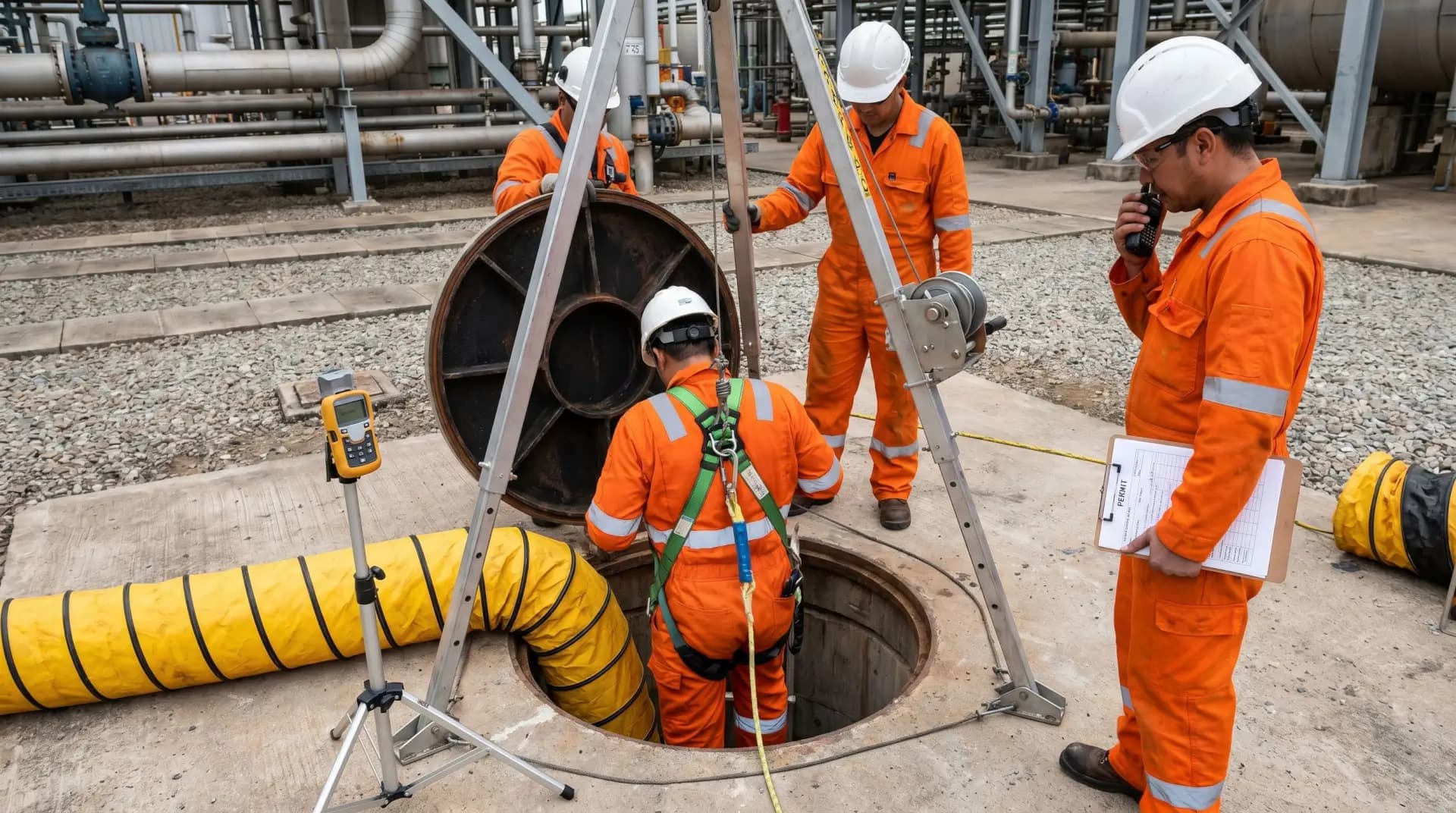
Confined space rescue is not a reaction after something goes wrong; it is a planned control that must be designed before entry begins. The safest rescue technique is usually non-entry rescue, supported by retrieval equipment, atmospheric control, communication, trained attendants, and a tested emergency plan. Entry rescue should only be used when non-entry rescue is not feasible and when a competent rescue team has the right respiratory protection, access equipment, monitoring instruments, and medical response capability.
In my HSE practice, I treat confined space rescue as a life-critical system. A permit, gas test, tripod, harness, or radio by itself does not make a rescue plan. The rescue method must match the space, the hazard, the entrant’s position, the opening size, the likely injury, and the time available before conditions become fatal.
What Confined Space Rescue Really Means
Confined space rescue is the planned removal of a person from a space that is not designed for continuous occupancy and may contain serious hazards such as oxygen deficiency, toxic gases, flammable atmospheres, engulfment, restricted access, or mechanical energy.
A rescue plan should answer five practical questions before entry:
How will the entrant be reached?
How will the entrant be removed without making more casualties?
What hazards could worsen during rescue?
Who is competent to perform each rescue role?
What equipment is already staged, inspected, and ready for use?
The most dangerous mistake is assuming that nearby workers can “just pull someone out.” Many confined space fatalities involve would-be rescuers who enter without protection, without testing the atmosphere, or without understanding the hazard. A rescue attempt that creates additional casualties is not rescue; it is loss of control.
Regulatory and Professional Duty
In the United States, OSHA’s permit-required confined space standard requires rescue and emergency arrangements for permit spaces, including evaluation of rescue capability and appropriate training and equipment. In Great Britain, the Confined Spaces Regulations 1997 require suitable and sufficient emergency arrangements before work starts. ISO 45001 also expects organizations to plan and test emergency preparedness and response arrangements.
The wording differs by jurisdiction, but the professional principle is the same: no confined space entry should begin unless rescue has been planned, resourced, and understood.
Main Confined Space Rescue Techniques
Confined space rescue techniques are usually grouped into three categories: self-rescue, non-entry rescue, and entry rescue. The correct method depends on the hazard profile and the physical layout of the space.
1. Self-Rescue
Self-rescue means the entrant exits the confined space without external physical removal. This is the preferred outcome whenever warning signs appear.
Self-rescue may be triggered by:
Gas monitor alarm
Loss of ventilation
Unusual smell, heat, dizziness, or breathing difficulty
Change in work conditions
Communication failure
Instruction from the attendant
Permit suspension or emergency alarm
Self-rescue works only when entrants are trained to leave immediately. Delayed exit is a common human-factor problem. Workers may try to finish a task, retrieve tools, or diagnose the alarm. I consider that unacceptable in confined space work. A gas alarm or emergency instruction means stop work, leave, and reassess.
2. Non-Entry Rescue
Non-entry rescue removes the entrant without another person entering the space. This is usually achieved through a retrieval system such as a full-body harness, lifeline, winch, davit arm, or tripod.
Non-entry rescue is commonly used for vertical entries such as:
Manholes
Tanks
Vessels
Pits
Lift stations
Silos
Underground chambers
The main advantage is that it protects rescuers from exposure. It also allows faster initial action when the entrant is attached correctly and the retrieval path is clear.
However, non-entry rescue is not automatically suitable for every job. It may fail or cause injury if:
The entrant must move around internal obstructions
The lifeline could snag on ladders, mixers, baffles, or pipework
The space has horizontal access
The entrant may fall into material or become engulfed
The casualty’s body position prevents smooth extraction
The opening is too narrow for safe retrieval
The harness connection creates a risk of suspension injury or impact
A common misconception is that “harness plus tripod” equals rescue compliance. It does not. The system must be compatible with the space and the rescue scenario.
3. Entry Rescue
Entry rescue means trained rescuers enter the confined space to reach, stabilize, package, or remove the casualty. This is the highest-risk rescue method and should never be improvised by untrained coworkers.
Entry rescue may be required when:
The casualty is not connected to a retrieval line
The retrieval line is trapped or damaged
The space has a horizontal or complex layout
The casualty is injured and cannot be dragged safely
Internal obstacles prevent direct extraction
The entrant needs airway support or medical stabilization before movement
The rescue route requires technical rope or stretcher handling
Entry rescuers may need supplied-air breathing apparatus or self-contained breathing apparatus, chemical protective clothing, intrinsically safe communication equipment, rescue stretchers, lighting, and continuous atmospheric monitoring.
In my judgment, entry rescue should be treated as a specialist operation. The team must be trained, drilled, medically fit, and familiar with the specific type of space. Calling public emergency services without verifying their confined space capability is not a rescue plan.
Essential Confined Space Rescue Equipment
The right rescue equipment depends on the space and the hazards, but several equipment groups appear repeatedly in effective rescue planning.
Equipment Category | Typical Items | Main Purpose |
|---|---|---|
Retrieval equipment | Full-body harness, lifeline, winch, tripod, davit arm | Remove entrant without entry where feasible |
Atmospheric testing | Multi-gas detector, sampling pump, calibration gas | Identify oxygen, toxic, and flammable hazards |
Ventilation | Blower, ducting, extraction unit, air mover | Control atmospheric hazards before and during entry |
Respiratory protection | SCBA, supplied-air respirator, escape set | Protect rescuers or entrants from hazardous atmospheres |
Communication | Radios, hardwired communication, signals | Maintain contact between entrant, attendant, and rescue team |
Rescue access equipment | Rope system, pulleys, anchor points, ladders | Support vertical or difficult access rescue |
Casualty handling | Rescue stretcher, immobilization device, lifting bridle | Package and remove injured personnel safely |
Lighting | Intrinsically safe lamps, headlamps | Maintain visibility in hazardous or dark spaces |
PPE | Helmet, gloves, safety boots, eye protection, chemical suit | Protect against physical, chemical, and environmental hazards |
First aid and medical response | Oxygen kit where allowed, AED, trauma kit, first aid supplies | Support immediate post-rescue care |
Gas Detection Equipment
Atmospheric testing is one of the most important rescue controls. A confined space atmosphere may be oxygen-deficient, oxygen-enriched, toxic, or flammable. A rescuer entering without testing can collapse within seconds in some conditions.
Gas testing should normally consider:
Oxygen level
Flammable gases or vapors
Carbon monoxide
Hydrogen sulfide
Other task-specific contaminants
Testing should be done before entry and, where risk requires it, continuously during the job. The instrument must be suitable for the expected gases, bump-tested or function-checked according to the organization’s procedure, calibrated as required, and used by a competent person.
Tripods, Davit Arms, Winches, and Lifelines
Tripods and davit systems are common for vertical entry rescue. The equipment must be rated, stable, correctly positioned, and used with compatible connectors and harnesses. The retrieval line should remain attached unless it creates a greater hazard.
Important checks include:
Load rating of the system
Condition of cable, rope, hooks, and connectors
Locking function of the winch
Secure footing and positioning
Edge protection where needed
Clearance above the opening
Compatibility with the entrant’s harness
Rescue path free of obstructions
A winch should not be used carelessly to drag a casualty around sharp edges, internal steelwork, or pipework. Rescue movement must be controlled.
Respiratory Protection for Rescue
Respiratory protection is critical when the atmosphere is unknown, oxygen-deficient, toxic, or immediately dangerous to life or health. Filtering respirators are not suitable for oxygen-deficient atmospheres. Entry rescuers may require SCBA or supplied-air systems, depending on the hazard and rescue duration.
Respiratory protection must be selected by competent persons and supported by:
Fit testing where required
User training
Medical suitability where required
Maintenance and inspection
Air supply management
Emergency escape arrangements
No rescue team should enter a hazardous atmosphere with respiratory equipment they have not been trained and drilled to use.
How to Build a Confined Space Rescue Plan
A confined space rescue plan should be specific to the space and the job. A generic statement such as “call emergency services” is not enough for high-risk entry.
Step 1: Identify the Space and Rescue Constraints
Start by assessing the physical layout:
Vertical, horizontal, or complex entry
Opening size and shape
Internal ladders, platforms, baffles, or pipework
Distance to casualty location
Slips, falls, heat, noise, or poor visibility
Engulfment or flooding potential
Mechanical or electrical hazards
Access for emergency vehicles and rescue equipment
The rescue method must be practical in the actual space, not just acceptable on paper.
Step 2: Define the Likely Emergency Scenarios
A good plan considers what could realistically go wrong:
Entrant collapse due to atmosphere
Fall during entry or exit
Burns, heat stress, or chemical exposure
Entrapment by material
Drowning or flooding
Fire or explosion
Medical emergency unrelated to the task
Communication failure
Power or ventilation failure
Each scenario may require a different rescue response.
Step 3: Select the Rescue Method
Choose the safest effective method in this order:
Self-rescue
Non-entry rescue
Entry rescue by trained rescuers
Where non-entry rescue is selected, confirm that the retrieval line will not increase risk. Where entry rescue is selected, confirm that the rescue team can arrive, enter, reach the casualty, protect themselves, and remove the casualty within the required time.
Step 4: Assign Roles Clearly
A confined space rescue arrangement usually includes:
Entrant
Attendant
Entry supervisor
Rescue team
First aider or medical responder
Standby support
Incident controller where needed
The attendant’s role is especially important. The attendant must monitor entrants, maintain communication, recognize emergency signs, initiate rescue procedures, and prevent unauthorized entry. The attendant should not enter the space unless formally relieved and assigned as part of a trained rescue team.
Step 5: Stage and Inspect Equipment
Rescue equipment should be at the entry location or immediately available according to the rescue plan. “Available somewhere on site” is often too vague for confined space emergencies.
Before entry, verify:
Rescue equipment inspection status
Gas detector function
Ventilation setup
Harness and lifeline condition
Communication method
Rescue team availability
First aid readiness
Access route for responders
Permit and emergency contacts
Step 6: Drill the Rescue
A rescue plan that has never been practiced is an assumption. Rescue drills reveal problems that paperwork hides, such as poor radio signal, tripod instability, snagging lifelines, awkward stretcher angles, missing connectors, or unrealistic response times.
Drills should be realistic enough to test the plan without exposing workers to uncontrolled danger. Lessons learned should be recorded and used to improve the permit system, training, equipment selection, and contractor coordination.
Common Mistakes That Make Confined Space Rescue Fail
The most serious confined space rescue failures usually come from planning weaknesses, not from a lack of courage.
Common failures include:
No space-specific rescue plan
Overreliance on emergency services without confirmation of capability
No retrieval system where one is feasible
Rescue equipment stored too far away
Gas testing done only at the opening
No continuous monitoring during changing conditions
Attendant distracted or assigned other work
Poor communication inside metal or underground spaces
Workers entering spontaneously to help a collapsed coworker
Rescue team unfamiliar with the actual space
No drill before high-risk or unusual entry
Failure to isolate mechanical, electrical, hydraulic, or process energy
One judgment call I emphasize is this: if the rescue plan depends on luck, speed, or bravery, the entry should not proceed.
Training and Competence for Confined Space Rescue
Confined space rescue training must go beyond classroom awareness. Workers need practical competence matched to their role.
Entrants Should Know
Confined space hazards
Permit conditions
Gas monitor alarms
Communication method
Exit routes
Self-rescue triggers
Harness and lifeline use
Stop-work authority
Attendants Should Know
Entrant tracking
Communication requirements
Alarm recognition
Emergency escalation
Non-entry rescue actions where assigned
Prevention of unauthorized entry
Permit limits and emergency shutdown triggers
Rescue Teams Should Know
Hazard assessment
Atmospheric monitoring
Respiratory protection
Rope and retrieval systems
Casualty packaging
Vertical and horizontal extraction
Rescue communication
Medical handover
Equipment inspection
Scenario-based drills
For higher-risk entries, I prefer practical demonstrations of competence rather than relying only on training certificates. A certificate shows attendance; a drill shows whether the system works.
Practical HSE Checklist Before Confined Space Entry
Use this checklist as a professional control prompt before authorizing entry.
Checkpoint | Confirmed |
|---|---|
Confined space entry avoided where reasonably practicable | ☐ |
Space classified and hazards assessed | ☐ |
Permit prepared and authorized | ☐ |
Isolation completed and verified | ☐ |
Atmosphere tested by competent person | ☐ |
Ventilation provided where required | ☐ |
Rescue method selected and documented | ☐ |
Non-entry rescue considered first | ☐ |
Rescue equipment staged and inspected | ☐ |
Entrants wearing suitable harness/retrieval equipment where required | ☐ |
Attendant assigned with no conflicting duties | ☐ |
Communication tested | ☐ |
Rescue team available and competent | ☐ |
First aid and medical response arranged | ☐ |
Emergency access route clear | ☐ |
Rescue drill completed where required by risk | ☐ |
Professional Safety Note
Confined space rescue is a high-risk activity that may involve legal duties, specialist equipment, and immediately life-threatening hazards. This article provides professional HSE guidance, not a substitute for jurisdiction-specific legal compliance, competent risk assessment, or specialist rescue training. Always follow applicable regulations, approved codes of practice, manufacturer instructions, and your organization’s permit-to-work system.
Conclusion
Confined space rescue must be planned before entry, not invented during an emergency. The best rescue technique is the one that removes the casualty without exposing others to the same hazard, which is why self-rescue and non-entry rescue should always be considered before entry rescue.
The equipment must fit the space, the hazards, and the likely emergency. A tripod, harness, gas detector, or rescue team only adds value when it is selected correctly, inspected, staged, and practiced. In confined space work, rescue readiness is not a backup formality. It is one of the main controls that decides whether a bad event remains manageable or becomes fatal.

Responses