

Work-related driving includes company vehicles, hired vehicles, motorcycles, bicycles used for work, and in many cases privately owned “grey fleet” vehicles used for business journeys. UK HSE guidance is clear that employers must manage road risks for workers who drive or ride as part of work, and that the main risk assessment areas are the journey, the driver or rider, and the vehicle.
Speed is a serious workplace risk because it affects both the likelihood of a crash and the severity of injury. WHO states that higher speed increases crash likelihood and injury severity, and that every 1% increase in mean speed is associated with a 4% increase in fatal crash risk. For an employer, this turns speed management into a core occupational safety control, not simply a traffic-law issue.
Why Speed Management Matters at Work
Speeding at work rarely starts with a driver deciding to be reckless. In many organisations, it grows from poor planning: unrealistic delivery windows, excessive daily mileage, late route changes, fatigue, weak supervision, or reward systems that praise speed more than safe completion.
That is why I treat speed management as a management-system issue. A driver’s right foot is only the final point in a chain of decisions made by planners, supervisors, dispatchers, procurement teams, contract managers, and senior leaders.
A sound speed management programme reduces:
High-speed crashes on public roads
Reversing and manoeuvring incidents on sites
Pedestrian and vehicle conflicts
Harsh braking and loss-of-control events
Fatigue-related errors caused by rushed schedules
Vehicle wear linked to aggressive driving
Legal exposure after serious incidents
The global road safety context is significant. WHO’s Global Status Report on Road Safety 2023 estimates 1.19 million road traffic deaths per year worldwide and frames road safety as part of the UN Decade of Action target to halve road deaths and injuries by 2030. For organisations, that means road risk cannot sit outside the HSE system simply because the vehicle leaves the gate.
The Employer’s Role in Controlling Speed
A workplace speed policy must go beyond one sentence in a driver handbook. It should define what the company expects, how the expectation is supported, and what happens when the system creates pressure to drive too fast.
In the UK context, HSE advises employers to plan journey times that allow safe driving within speed limits, including realistic allowances for traffic, red lights, road type, and road conditions. It also warns against company policies that pressure drivers or riders into unnecessary risks, such as exceeding safe speeds to meet arrival times.
In the US context, OSHA similarly advises employers to ensure workloads and schedules allow employees to drive at a safe speed and comply with applicable hours-of-service rules. OSHA also highlights the value of systems that inform drivers about road construction, closures, bad road conditions, and hazards.
A practical employer-led speed management system should include:
Control Area | What Good Practice Looks Like |
|---|---|
Policy | Clear rules on speed limits, mobile phone use, fatigue, seat belts, and journey refusal in unsafe conditions |
Planning | Realistic route timing, rest breaks, weather checks, and avoidance of unnecessary journeys |
Supervision | Active review of speeding trends, harsh braking, complaints, near misses, and incident learning |
Vehicle control | Suitable vehicles, maintenance, tyres, braking systems, speed assistance, and telematics where justified |
Site traffic | Designed routes, segregation, safe speed limits, traffic calming, visibility, lighting, and pedestrian protection |
Contractor control | Road safety requirements included in contracts, inductions, monitoring, and review meetings |
Culture | No reward for unsafe speed, no blame for stopping when conditions are unsafe, and fair investigation of breaches |
The important point is this: if the organisation creates the pressure, the organisation must remove the pressure.
Workplace Traffic Speed: Yards, Depots, Warehouses, and Construction Areas
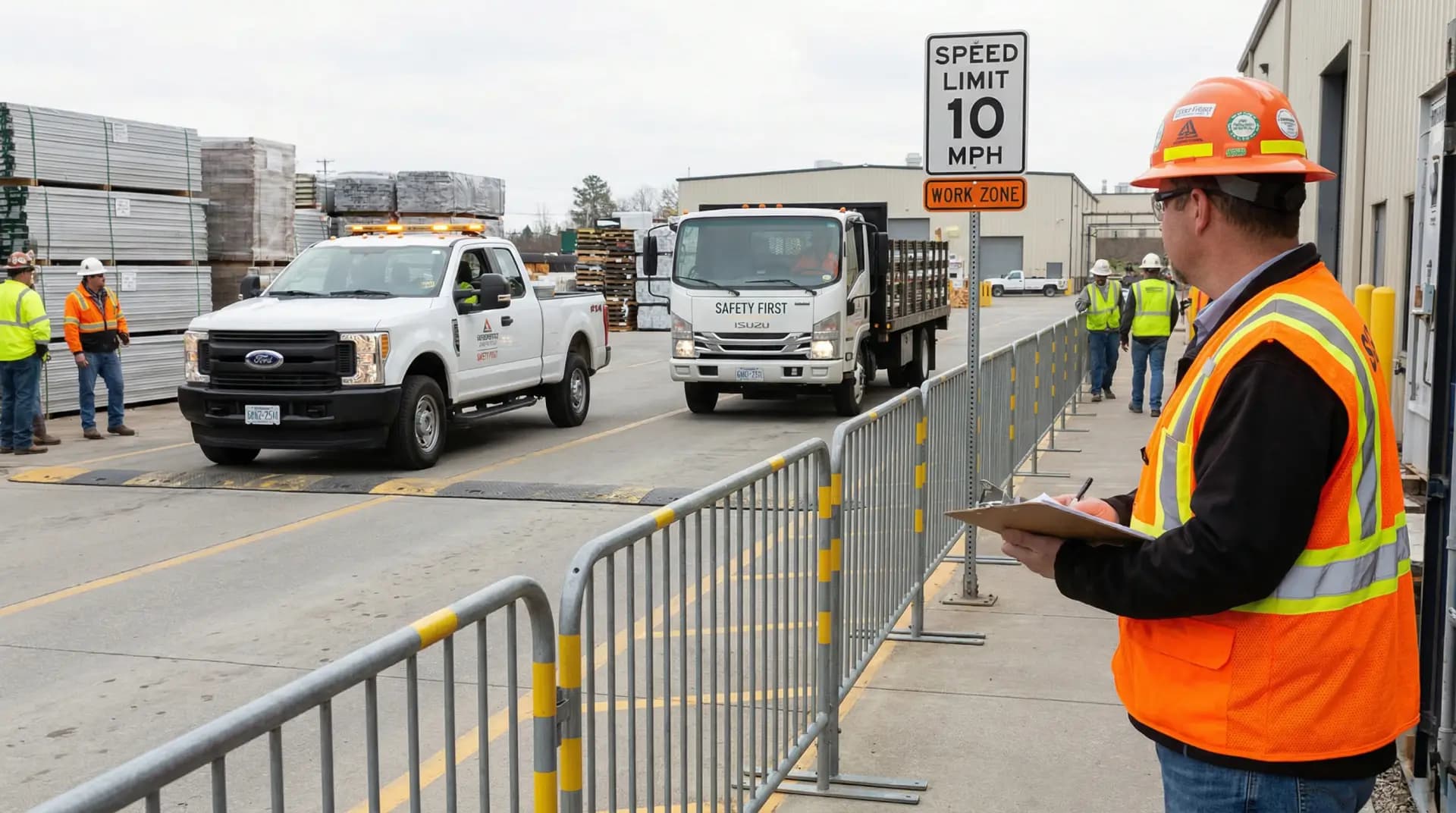
On private sites, the problem is often low-speed impact with high-consequence potential. A forklift, loader, van, yard tractor, dump truck, or delivery vehicle does not need to be moving fast to cause serious injury to a pedestrian.
For workplace transport, UK HSE states that limiting vehicle speed is an important part of controlling traffic, and that fixed features that physically prevent vehicles from moving too quickly are often better than speed-limit signs alone. Examples include speed humps, narrowed routes, bollards, raised kerbs, chicanes, pinch points, rumble strips, and clearly visible traffic-calming measures.
I prefer to think in this order:
Eliminate unnecessary vehicle movement. Can the job be reorganised so fewer vehicles enter the area?
Separate people and vehicles. Use physical barriers, marked walkways, protected crossing points, and controlled access.
Design the route for the desired speed. A wide, straight, open yard invites speed. A controlled route discourages it.
Set a site speed limit. Make it suitable for the vehicle type, surface, visibility, pedestrian presence, and turning movements.
Monitor behaviour. Use supervisor observations, near-miss reports, CCTV review where lawful, and telematics where appropriate.
Correct the system before blaming the person. Ask why the driver felt able or pressured to exceed the safe speed.
A common mistake is placing a 10 km/h or 5 mph sign at the gate and assuming the risk is controlled. Signs are useful, but they are weak controls when the site layout encourages higher speed. Physical design, pedestrian segregation, and supervision carry more weight.
Journey Planning and Safe Speed on Public Roads
Most serious work-related road risk happens away from the workplace. Once drivers are on public roads, employers cannot control every variable, but they can control the work design.
A good journey plan should answer:
Is the journey necessary?
Is the route suitable for the vehicle?
Has enough time been allowed for legal and safe speeds?
Are rest breaks built into the schedule?
Are poor weather, night driving, roadworks, and congestion considered?
Is the driver authorised to delay, stop, or refuse the journey if conditions become unsafe?
Are customer promises realistic?
Is the driver carrying a load that affects braking, stability, or stopping distance?
UK HSE recommends considering whether the journey is necessary, choosing the safest route for the vehicle, planning routes with drivers or their representatives, and taking account of rest breaks and welfare needs. It also advises employers not to pressure workers to complete journeys in exceptionally difficult weather.
From practice, I see three planning failures repeatedly:
First, schedules are calculated using best-case travel time. That creates pressure as soon as the driver meets traffic, loading delay, weather, or a customer access problem.
Second, planners forget the non-driving work. Loading, documentation, customer handover, refuelling, parking, vehicle checks, and waiting time all consume time. If they are not planned, drivers often recover the lost time on the road.
Third, late changes are treated as normal. Dispatch systems, apps, and phone calls can become a source of distraction and pressure. OSHA specifically warns that dispatching and rerouting systems can contribute to cognitive, visual, and manual distraction if poorly managed.
Safe speed starts before the vehicle moves.
Using Technology Without Losing HSE Judgment
Telematics, speed limiters, intelligent speed assistance, dash cameras, route planning software, fatigue detection, and in-vehicle monitoring systems can all support road safety. They should not replace leadership, supervision, and good planning.
UK HSE notes that telematics can help monitor risky behaviours such as excessive speed, harsh braking or acceleration, swerving, cornering, distraction, and drowsy driving. It also advises that outputs must be linked to the risk being managed, that management and coaching are critical, and that employers should not rely solely on in-vehicle feedback. OSHA also states that in-vehicle monitoring systems may help reduce crash risk by identifying risky driving behaviours for self-correction and supervisor coaching.
The best use of telematics is not to create a punishment scoreboard. It is to identify patterns:
Which routes produce repeated speeding alerts?
Which customers create time pressure?
Which shifts show fatigue-related driving behaviours?
Which vehicle types are associated with harsh braking?
Which supervisors tolerate unsafe driving to meet production targets?
Which drivers need coaching, support, or reassessment?
A fair system separates occasional human error from repeated risk-taking and from management-created pressure. That distinction matters. If a driver repeatedly speeds because the route plan is impossible, disciplinary action alone will not fix the hazard.
Building a Practical Speed Management Programme
A reliable programme should be simple enough to run and strong enough to withstand investigation after a serious event.
1. Define the scope
Include all work-related road activity:
Company cars
Vans
Heavy vehicles
Buses and shuttles
Motorcycles and bicycles used for work
Mobile plant crossing traffic routes
Contractors and subcontracted transport
Grey fleet business travel
Delivery, courier, and gig-type arrangements where applicable
ISO 39001:2012 provides a road traffic safety management system framework for organisations that interact with the road traffic system, with the aim of reducing death and serious injuries from road traffic crashes they can influence. ISO states that the standard remains current after review and includes policy, objectives, action plans, legal requirements, and factors the organisation can control or influence.
2. Assess the risk
Review:
Routes and road types
Site traffic plans
Driver competence and behaviour
Vehicle suitability and maintenance
Work schedules and fatigue exposure
Historical incidents, near misses, fines, complaints, and insurance claims
Seasonal risks such as rain, ice, fog, heat, darkness, and holiday traffic
Vulnerable road users such as pedestrians, cyclists, motorcyclists, and roadside workers
3. Set safe speed rules
Rules should cover both legal speed limits and lower safe speeds required by conditions. A driver may be within the posted limit but still too fast for rain, poor visibility, heavy load, roadworks, pedestrians, or site manoeuvring.
4. Design controls
Use the hierarchy of control where possible:
Level | Speed Management Example |
|---|---|
Elimination | Remove unnecessary trips through remote meetings or consolidated deliveries |
Substitution | Use safer routes or safer transport modes |
Engineering | Traffic calming, barriers, vehicle speed limiters, ISA, improved lighting |
Administrative | Journey planning, driver rules, fatigue controls, supervision, contractor requirements |
PPE | High-visibility clothing for exposed workers, used as a last layer and not a substitute for traffic control |
5. Train and coach
Training should cover stopping distance, speed selection, defensive driving, fatigue, distraction, vulnerable road users, adverse weather, load effects, and site rules. Coaching should use real patterns from the organisation, not generic slides alone.
6. Monitor leading and lagging indicators
Useful leading indicators include:
Percentage of journeys planned with realistic timing
Speeding events per distance travelled
Harsh braking trends
Driver coaching completion
Vehicle defect closeout time
Site traffic observation scores
Contractor compliance checks
Lagging indicators include:
Collisions
Near misses
Speeding fines
Insurance claims
Customer or public complaints
Injury reports
Vehicle damage
7. Review after change
Road risk changes when the business changes. New contracts, new delivery windows, new vehicles, new depots, new apps, new contractors, and new customer demands can all alter speed behaviour.
Legal and Ethical Assurance
Speed management is a legal, operational, and ethical duty. Jurisdiction matters, so organisations should always check the road traffic law, occupational safety law, vehicle operator rules, insurance duties, and working-time requirements that apply in their country or region.
In the UK, HSE explains that road traffic law is enforced by the police and Driver and Vehicle Standards Agency, while employers also have general duties under health and safety law for driving and riding for work. HSE further notes that serious management failures may lead to investigation and, in fatal cases, potential prosecution under gross negligence manslaughter or corporate manslaughter legislation where the legal tests are met.
This is where senior management must be honest. If the organisation knows that routes are impossible, drivers are fatigued, vehicles are poorly maintained, or supervisors ignore speeding to protect delivery performance, the risk is not hidden. It is waiting for an incident.
A strong assurance process should ask:
Can drivers meet targets without exceeding safe speed?
Are managers measured on safety as well as delivery?
Are speeding alerts reviewed fairly and consistently?
Are customers told when delivery windows are unsafe?
Are contractors held to the same road safety expectations?
Are serious near misses investigated with the same discipline as injury events?
Are workers protected when they stop a journey for safety reasons?
Conclusion
Speed management and road safety at work require more than driver discipline. They require a system that removes time pressure, designs safer routes, controls site traffic, uses vehicles fit for the task, monitors behaviour intelligently, and gives drivers clear authority to choose safety over schedule.
My professional view is straightforward: when an organisation manages speed well, it is usually managing many other HSE risks well too. The same habits appear—realistic planning, worker consultation, visible leadership, learning from near misses, and controls that match the actual risk.
Safe speed is not slow work. It is controlled work. And in road safety, control is what prevents ordinary journeys from becoming life-changing events.



Responses