

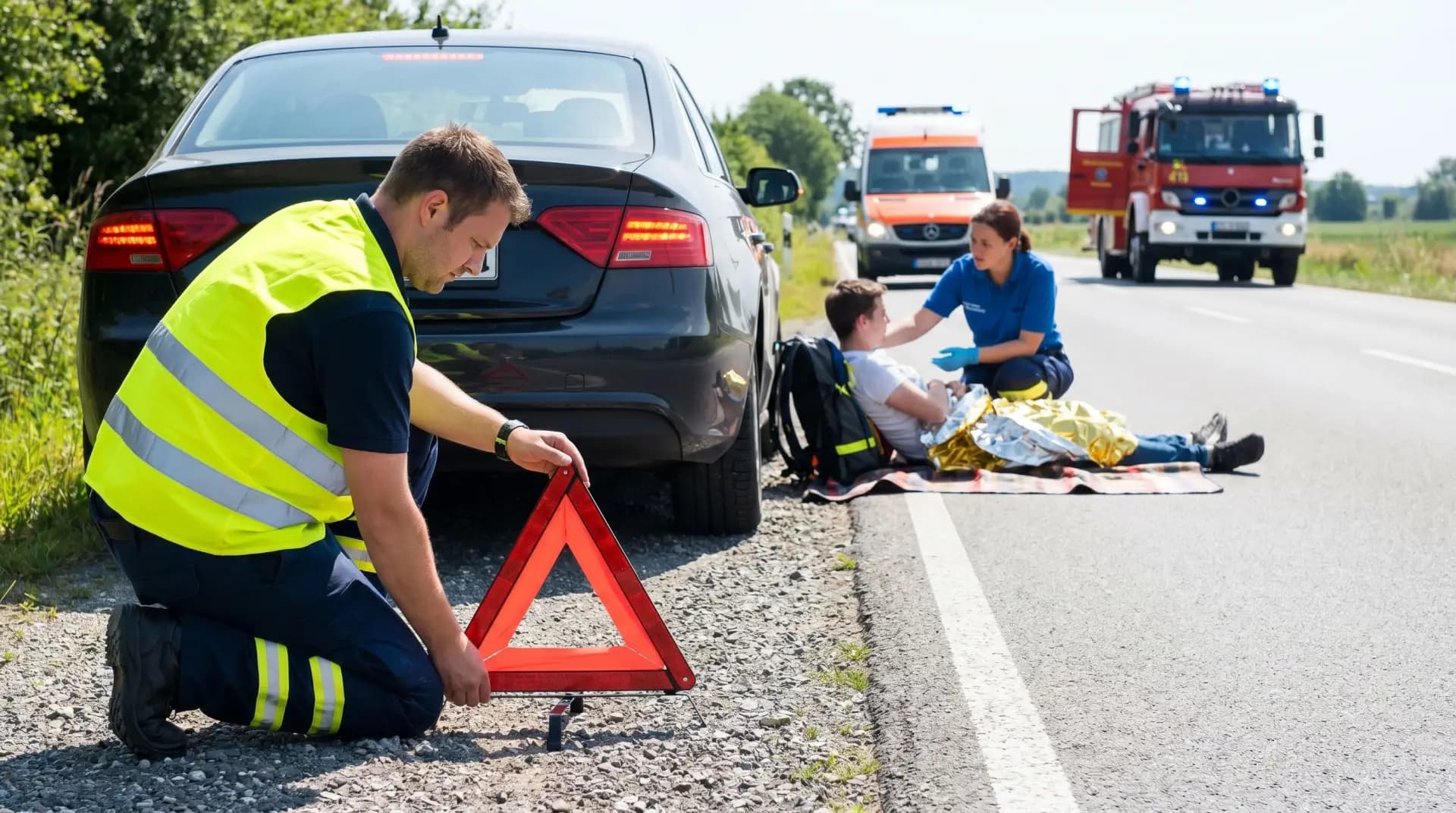
A safe and effective response to a road traffic accident starts with three priorities in sequence: protect the scene, assess casualties, and activate emergency support. Any delay or misstep in these first minutes can escalate injuries, create secondary accidents, or compromise legal and medical outcomes. My approach in the field has always centered on controlled action—never rushing blindly, but never hesitating where immediate intervention is required.
Secure the Scene First
Before assisting anyone, you must ensure the area is safe—for yourself, the injured, and other road users.
Key actions:
Park at a safe distance and switch on hazard lights
Use warning triangles or cones if available
Turn off ignitions of involved vehicles (if safe to do so)
Watch for fuel leaks, fire risk, or unstable vehicles
Control traffic flow if no authorities are present
In many incidents I’ve assessed, secondary collisions occur because initial responders focus only on victims and ignore ongoing road hazards. Scene control is not optional—it is the foundation of all further response.
Perform a Rapid Casualty Assessment
Once the environment is safe, immediately evaluate the condition of injured persons using a structured approach.
Primary assessment priorities:
Airway – Is it clear and unobstructed?
Breathing – Is the casualty breathing normally?
Circulation – Check for severe bleeding
Consciousness – Responsive or unconscious?
Avoid moving injured individuals unless there is immediate danger (e.g., fire risk). Improper handling can worsen spinal injuries.
Critical observation signs:
Unconsciousness
Heavy bleeding
Difficulty breathing
Deformities or suspected fractures
From my experience, untrained responders often panic and attempt to “do everything.” Controlled observation and prioritization save more lives than rushed, unstructured actions.
Call Emergency Services Immediately
Once you identify injuries or hazards, contact emergency services without delay.
Provide clear information:
Exact location (landmarks, road names, direction)
Number of vehicles involved
Number and condition of casualties
Any hazards (fire, fuel spill, blocked road)
Stay on the call if instructed. Clear communication improves response time and preparedness of emergency teams.
Provide Basic First Aid Within Your Limits
You are not expected to perform advanced medical procedures unless trained. Focus on life-preserving actions.
Essential first aid steps:
Control bleeding using firm pressure
Keep the casualty still and calm
Support the head and neck if spinal injury is suspected
Place unconscious but breathing casualties in recovery position
Monitor breathing continuously
Never give food or drink. Avoid removing helmets unless necessary for airway management.
In real-world scenarios, I’ve seen well-intentioned but untrained actions cause more harm than good. Staying within your competence is a critical safety principle.
Manage Bystanders and Maintain Control
Crowds can quickly form around accident scenes, often creating confusion and additional risk.
Your role includes:
Preventing overcrowding near casualties
Asking bystanders to assist in controlled ways (e.g., directing traffic)
Discouraging filming or interference
Maintaining calm authority
An unmanaged crowd can delay emergency response and increase stress for injured individuals.
Preserve Evidence and Follow Legal Protocols
Once immediate risks are controlled, avoid disturbing the scene unnecessarily.
Important considerations:
Do not move vehicles unless required for safety
Avoid altering positions of debris or evidence
Cooperate with authorities when they arrive
Provide factual statements only
In many jurisdictions, interfering with accident scenes can have legal consequences. More importantly, it can hinder proper investigation and accountability.
Understand Common Mistakes in Accident Response
From years of observation and audits, these are the most frequent errors:
Rushing into unsafe scenes
Moving injured persons unnecessarily
Failing to call emergency services promptly
Ignoring personal safety
Allowing uncontrolled crowd interference
Correcting these behaviors significantly improves survival and recovery outcomes.
Integrating Preparedness into Everyday Driving
Effective response begins before any accident occurs.
Practical preparedness measures:
Keep a basic first aid kit in your vehicle
Learn certified first aid and CPR
Understand emergency contact systems in your region
Maintain awareness while driving to anticipate hazards
Prepared drivers consistently respond better under pressure because they rely on training, not instinct.
Conclusion
Responding to a road traffic accident is not about heroic action—it is about disciplined, structured decision-making under pressure. Secure the scene, assess casualties methodically, and activate emergency support without delay. Everything else builds on these core principles. In my professional judgment, the difference between effective and ineffective response is rarely knowledge—it is the ability to apply that knowledge calmly and correctly when it matters most.


Responses