

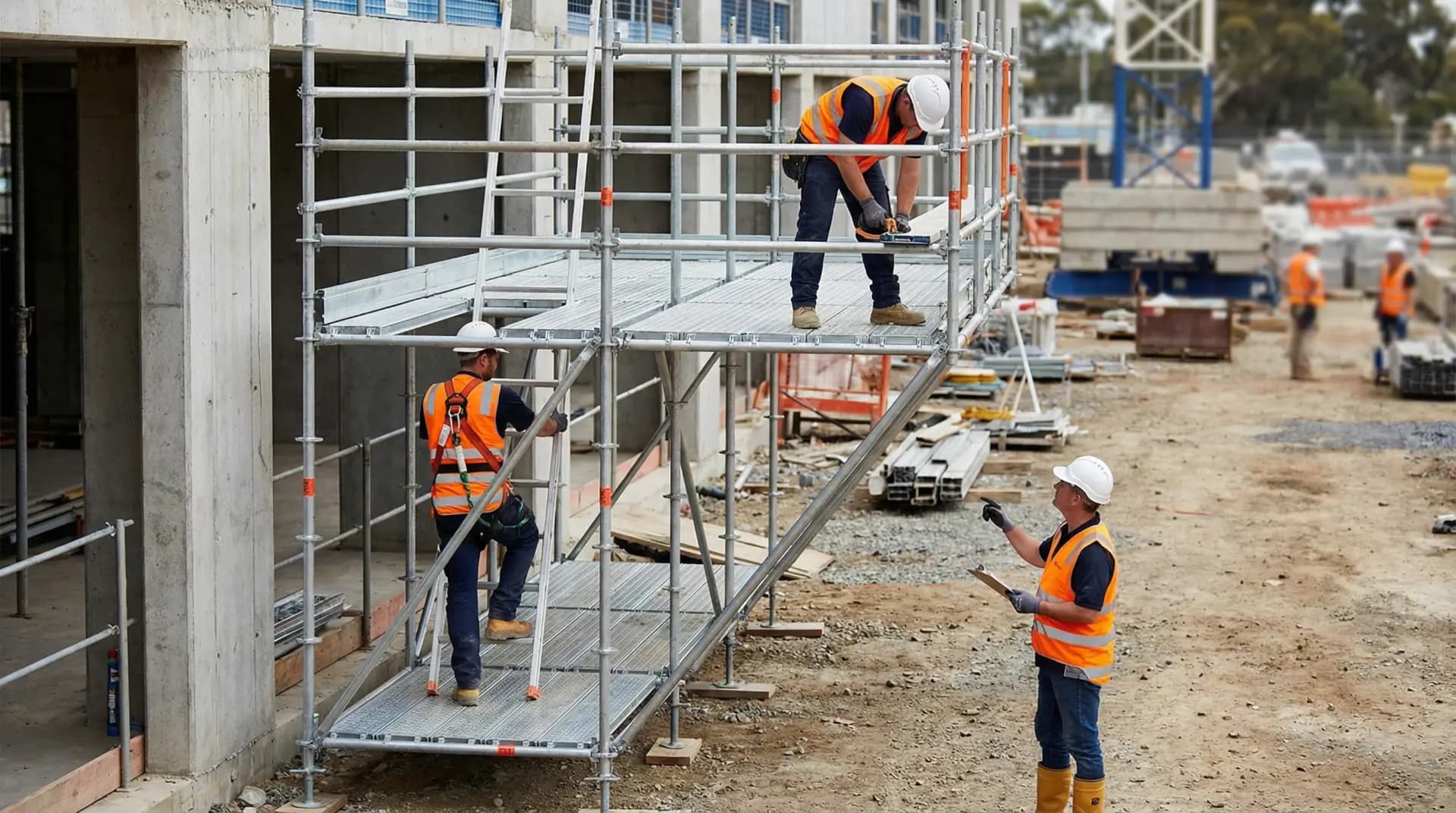
Scaffolding safety comes down to a few non-negotiables: use only a scaffold that has been properly designed and erected, inspect it before use, access it safely, protect every open edge, control loads, and stop work the moment wind, defects, missing components, or electrical hazards appear. In the United States, OSHA requires fall protection for workers on scaffolds more than 10 feet above a lower level, competent-person inspections before each shift, safe access when platforms are more than 2 feet above or below the access point, and footing that is level, sound, and rigid. In Great Britain, HSE guidance likewise emphasizes competent erection, regular inspection, guardrails, toeboards, and stopping work when conditions make the scaffold unsafe.
Falls remain the leading cause of construction worker deaths, which is why I do not treat scaffolding as “just access.” I treat it as a temporary work platform that can fail quickly when people improvise, overload, skip inspections, or work through weather and electrical risk.
Safety note: This article is general operational guidance. Scaffold design, erection, alteration, rescue planning, and legal compliance must be verified by a competent or qualified person under the rules that apply in your jurisdiction.
The rules I consider non-negotiable
Never use a scaffold that was erected, altered, or moved by untrained or unauthorized people.
Never climb a scaffold by its cross-braces.
Never accept missing planks, missing guardrails, missing toeboards, or mixed incompatible components.
Never overload a platform with workers, stored materials, or point loads.
Never work on a scaffold in strong wind, storms, or on snow, ice, or slippery platforms.
Never work near energized power lines unless the required controls are in place.
Never move a mobile tower with people or materials still on it.
1) Only competent people should erect, alter, move, or inspect the scaffold
The first rule is simple: workers should not “fix” scaffolding on the fly. OSHA requires erection, moving, dismantling, and alteration to be done under the supervision and direction of a competent person, and HSE says scaffolds should be designed, erected, altered, and dismantled only by competent people under competent supervision.
From a practical HSE standpoint, this matters because most serious scaffold failures do not begin with dramatic collapse. They begin with small unauthorized changes: a brace removed to make room, a platform extended without design review, a mobile tower used without the correct stabilizers, or mixed parts forced together because they “seem to fit.” OSHA warns against intermixing components unless they fit together properly and the scaffold remains structurally sound, while HSE notes that towers can collapse if sections are left out.
2) Never step onto a scaffold unless the platform, footing, and access are right
Before I accept any scaffold for use, I look at three things first: the base, the deck, and the access. OSHA requires footings to be level, sound, rigid, and capable of supporting the loaded scaffold without settling or displacement, and it expressly prohibits using unstable objects to support scaffolds or as working platforms. It also requires platforms to be fully decked or planked in most cases.
Access is another point workers often underestimate. Under OSHA, when a scaffold platform is more than 2 feet above or below a point of access, a proper ladder, stair tower, ramp, walkway, integral frame access, or equivalent safe access must be used; cross-braces are not a legal means of access. For supported scaffold erection and dismantling, safe access is required when it is feasible and does not create a greater hazard.
For mobile towers, HSE adds a practical rule I strongly support: the tower should stand on firm, level ground with locked castors or properly supported base plates, never on bricks or building blocks, and it should never be moved while people or materials are on it.
3) Fall protection and falling-object control must already be in place
Many workers think a scaffold is safe if it “feels steady.” That is not the test. The real test is whether edge protection, personal fall protection where required, and falling-object controls are already in place before work starts.
In the United States, OSHA requires every employee on a scaffold more than 10 feet above a lower level to be protected from falling, with the exact method depending on the scaffold type. OSHA also requires additional protection from falling tools, debris, and small objects through hard hats plus measures such as toeboards, screens, guardrails, debris nets, catch platforms, or canopies. In Great Britain, HSE states that top guardrails on construction scaffolds should be at least 950 mm above the platform, the gap to the intermediate rail should not exceed 470 mm, and toeboards must be suitable and sufficient to prevent people or materials from falling.
The worker-level rule is clear: do not wait until you are already on the platform to ask where the guardrail, lifeline, or toeboard is. If fall protection is incomplete, the scaffold is not ready. That is especially important during erection, alteration, and dismantling, where both OSHA and HSE require fall hazards to be controlled through competent planning and safe methods.
4) Use the scaffold only within its design limits
A scaffold is not a storage rack, a lifting device, or an invitation to improvise. OSHA requires scaffold platforms to support their own weight plus at least four times the maximum intended load, and it prohibits loading the scaffold beyond its capacity. Overloading can come from too many workers, too much stored material, or concentrated loads in one area.
This is where good workers make disciplined choices. Keep materials spread correctly, keep platforms clear of debris, and do not stack more than the platform was meant to carry. Do not use forklifts, loaders, pallets, boxes, bricks, or other makeshift arrangements to create “extra height” or temporary support. OSHA explicitly prohibits unstable objects as supports and places tight limits on using equipment such as forklifts and front-end loaders to support scaffold platforms.
A simple test I teach is this: if the scaffold is being used for anything other than the purpose it was planned and erected for, stop and re-check the design. Temporary structures fail fastest when the job changes but the scaffold setup does not.
5) Inspection is not paperwork; it is a live risk control
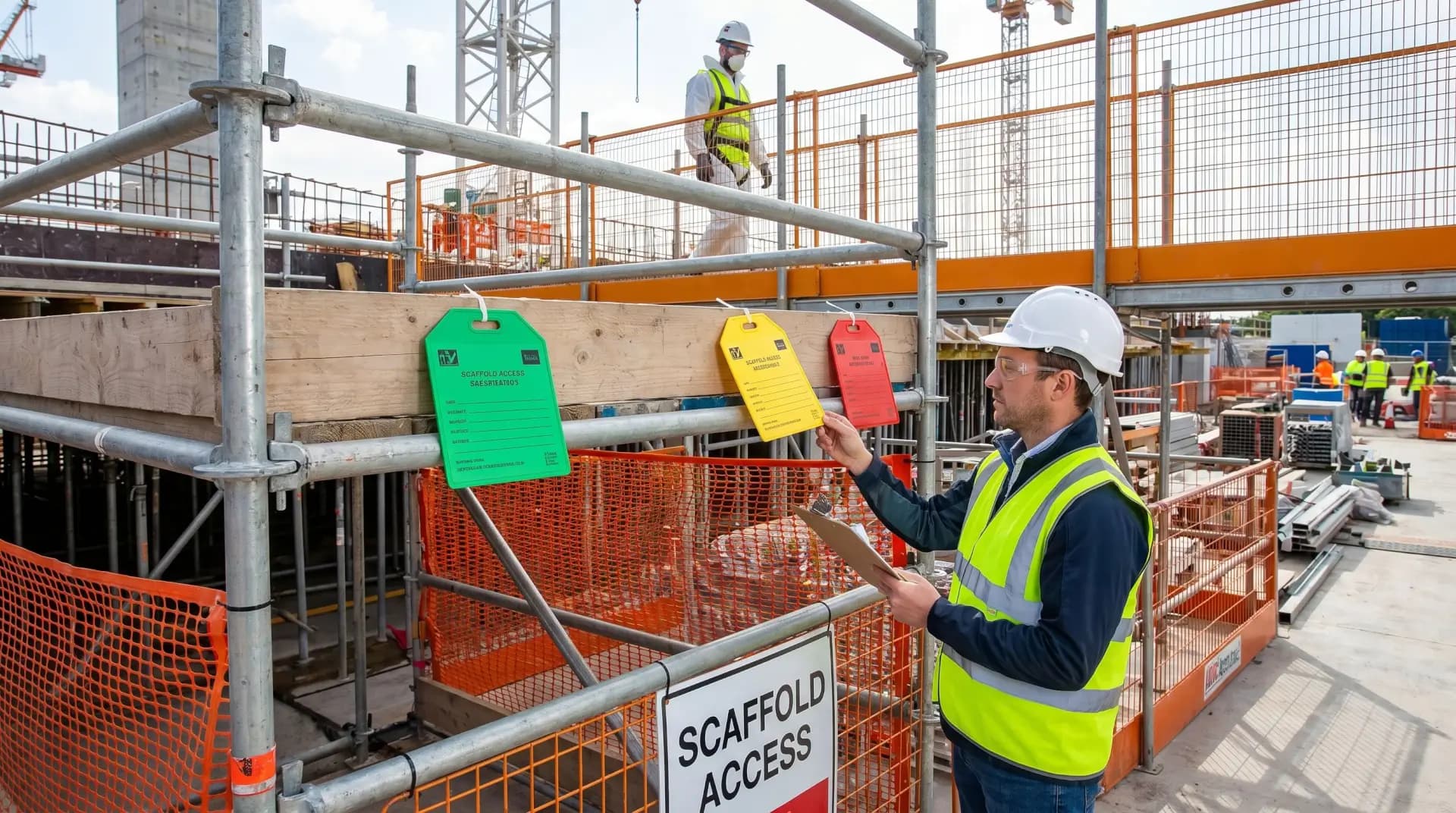
Inspection should happen before trust. OSHA requires scaffold and scaffold-component inspection for visible defects by a competent person before each work shift and after any occurrence that could affect structural integrity. HSE guidance for construction scaffolds calls for inspection before first use, at least every 7 days, and after events such as adverse weather or substantial alteration. HSE also notes that visible tag systems can support, but do not replace, inspection records.
What should workers look for even before the formal inspection result is confirmed? I teach people to scan for five obvious warning signs:
leaning, settlement, or movement
missing braces, ties, planks, guardrails, or toeboards
damaged boards, bent frames, broken welds, or defective wheels or castors
unauthorized modifications or mixed components
overhead obstructions, including power lines
If any of those signs appear, the right action is not to “be careful.” The right action is to stop use, isolate the scaffold if needed, and get it checked by the competent person.
6) Weather, electricity, and movement change the risk immediately
Scaffolds become dangerous very quickly when conditions change. OSHA prohibits work on scaffolds covered with snow, ice, or other slippery material except as necessary for removal, and it prohibits work during storms or high winds unless a competent person determines it is safe and workers are protected appropriately. HSE also warns never to use a tower in strong winds.
Electrical risk deserves the same seriousness. OSHA sets minimum clearance distances from exposed and energized power lines for scaffolds and conductive materials and allows closer work only when the utility or system operator has taken protective action such as de-energizing, relocating, or covering the lines. On site, the worker rule is even simpler than the regulation: if the scaffold, tools, materials, or movement path can enter the power-line zone, stop and escalate the hazard before anyone climbs.
For mobile towers, movement itself is a hazard. HSE says to reduce tower height before moving, check for overhead obstructions and ground defects, push or pull from the base, and never move the tower with people or materials on it.
What every worker should do before climbing
I keep this pre-use check practical:
Confirm the scaffold is tagged or released according to site procedure and has been inspected by the right person.
Check the ground, wheels, base plates, and overall plumb.
Confirm full decking or proper platform condition with no gaps, damage, or makeshift boards.
Check safe access. Do not climb cross-braces.
Verify guardrails, toeboards, and any required personal fall protection.
Look up for overhead power lines and look down for people working below.
Check the weather and surface condition.
Ask one final question: “Has anything changed since this scaffold was last checked?”
Conclusion
Scaffolding safety is not complicated, but it is unforgiving. Every worker should know that a safe scaffold is competently erected, fully decked, properly accessed, protected at the edges, used within load limits, inspected before use, and taken out of service the moment conditions change. That is the standard I apply in practice, because most scaffold incidents are not random. They are usually the final result of small rule-breaking that everyone saw and nobody stopped.


Responses