

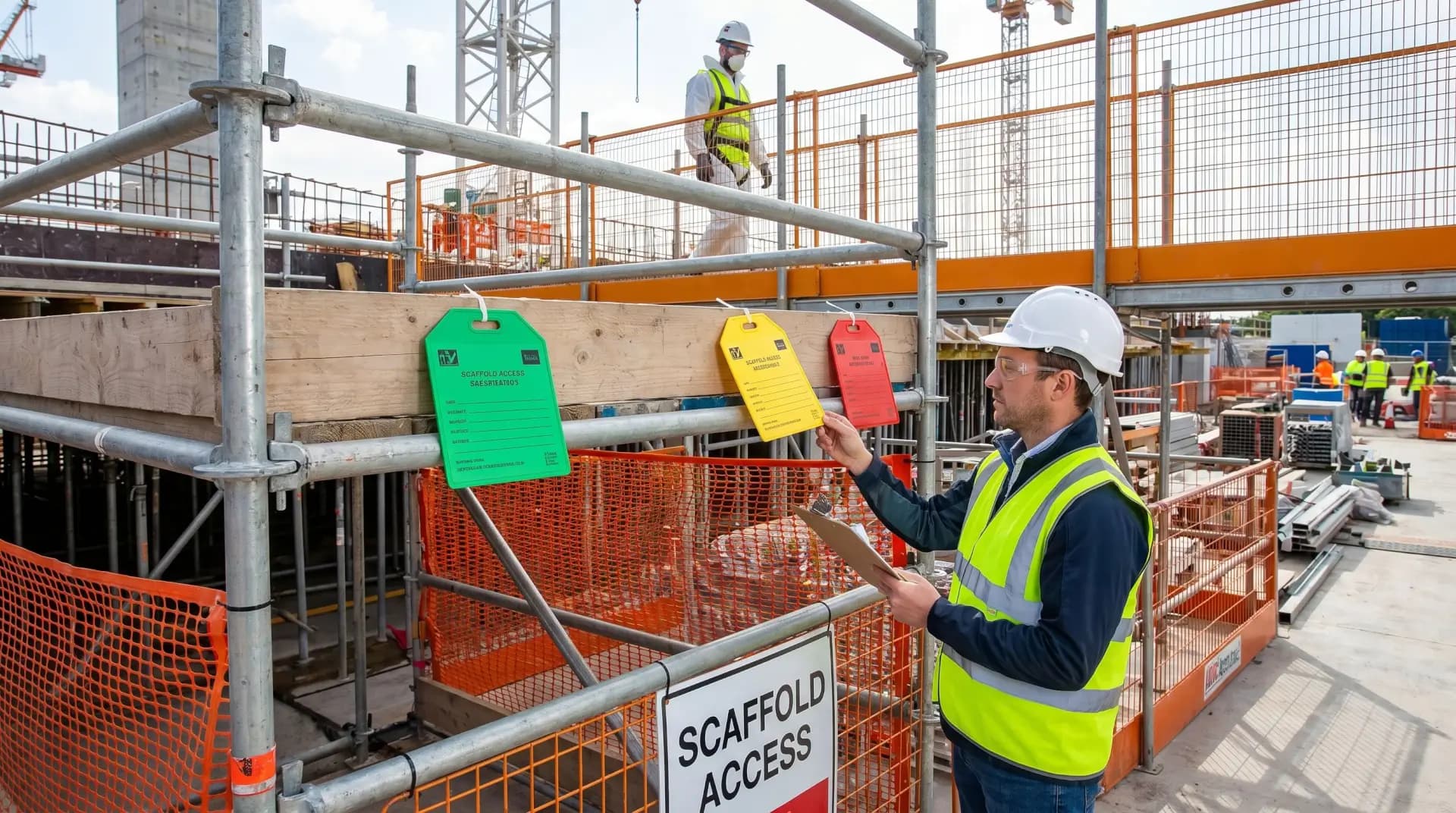
A scaffold tagging system is a simple visual control that tells workers whether a scaffold is safe to use, restricted, or completely prohibited. The common color code is straightforward: green means safe for use, yellow means use with specific precautions, and red means do not use.
This system does not replace inspection, training, supervision, or legal requirements. It supports them by making scaffold status clear at the point of access.
What Is a Scaffold Tagging System?
A scaffold tagging system is a color-coded identification method fixed near the scaffold access point. It helps workers, supervisors, and inspectors understand the scaffold’s current condition before anyone climbs onto it.
A proper scaffold tag normally shows:
Tag Information | Purpose |
|---|---|
Scaffold status | Safe, restricted, or unsafe |
Inspection date | Confirms recent inspection |
Inspector name/signature | Shows accountability |
Location or scaffold ID | Avoids confusion on large sites |
Load rating or duty class | Prevents overloading |
Restrictions | Clarifies special controls |
The key rule is simple: no worker should use a scaffold unless its status is clear and authorized.
Green Scaffold Tag: Safe for Use
A green scaffold tag means the scaffold has been inspected by a competent person and is suitable for normal use within its approved design and load limits.
A green tag is typically used when:
The scaffold is fully erected and complete.
Guardrails, midrails, toe boards, platforms, access points, ties, and base supports are in place.
No visible defects or unsafe conditions are found.
The scaffold is approved for the intended task.
The inspection is current.
A green tag does not mean “use without thinking.” Workers must still avoid overloading, removing components, climbing on braces, or altering the scaffold.
Yellow Scaffold Tag: Restricted Use
A yellow scaffold tag means the scaffold may be used only under specific restrictions or additional controls. In practice, this tag is often misunderstood, so the restrictions must be written clearly.
A yellow tag may apply when:
Full edge protection is not possible in a specific area.
Fall arrest equipment is required.
Access is limited to trained or authorized workers.
A section is under controlled modification.
The scaffold is suitable only for a particular task.
Weather, loading, or site conditions require extra caution.
The yellow tag must never be vague. “Use with caution” is not enough. It should explain exactly what the worker must do, such as:
“Full body harness required.”
“Do not access top lift.”
“Maximum two workers on platform.”
“For inspection work only.”
“Do not load materials.”
Red Scaffold Tag: Do Not Use
A red scaffold tag means the scaffold is unsafe, incomplete, under erection, under dismantling, damaged, or not approved for use. No worker should access it unless they are part of the authorized scaffold crew and the work is controlled.
A red tag is required when:
The scaffold is incomplete.
Components are missing or damaged.
Platforms are not fully decked.
Guardrails or toe boards are missing where required.
The scaffold has been affected by impact, high winds, settlement, or unauthorized alteration.
The inspection has failed or expired.
The scaffold is being erected, altered, or dismantled.
From an HSE perspective, a red tag must be treated like a hard stop. It is not a warning label; it is a prohibition.
Who Can Inspect and Tag a Scaffold?
Scaffold inspection and tagging must be done by a competent person. This means someone with the knowledge, training, experience, and authority to identify scaffold hazards and take corrective action.
The competent person should check:
Foundation, sole boards, and base plates
Standards, ledgers, transoms, braces, and couplers
Planks, platforms, gaps, and board condition
Guardrails, midrails, toe boards, and openings
Safe access and egress
Scaffold ties, anchors, and stability
Load capacity and material storage
Electrical hazards and nearby work interfaces
Signs of damage, movement, corrosion, or alteration
In my professional view, the most common weakness is not the absence of a tag. It is a tag that stays in place after the scaffold condition has changed.
When Should Scaffold Tags Be Updated?
A scaffold tag should be updated whenever the scaffold status changes. Inspection frequency depends on local regulations, company procedures, scaffold type, and site risk, but inspection is commonly required before first use, before each work shift in some jurisdictions, after alteration, and after any event that could affect structural integrity.
Tags should be reviewed after:
Heavy rain, strong wind, or storm conditions
Impact from vehicles, plant, or dropped materials
Scaffold modification or partial dismantling
Change in work activity or loading
Discovery of missing parts or defects
Long periods without use
Any reported unsafe condition
A tag is only useful when it reflects the actual condition of the scaffold today.
Common Scaffold Tagging Mistakes
The scaffold tagging system fails when people treat it as paperwork instead of a live safety control.
Common mistakes include:
Leaving a green tag after scaffold alteration
Using yellow tags without written restrictions
Allowing workers to use untagged scaffolds
Placing tags where workers cannot see them
Not removing tags during dismantling
Letting unauthorized workers change tags
Treating the tag as a substitute for inspection
Ignoring load limits after approval
A practical control is to place the tag at every main access point, not only on one side of the scaffold. Workers should not need to search for the scaffold status.
Best Practices for an Effective Scaffold Tagging System
A strong scaffold tagging system should be simple, consistent, and enforced.
Use these practices:
Standardize the color code
Use green, yellow, and red consistently across the site.Assign competent persons
Only authorized and competent personnel should inspect and change tags.Write clear restrictions
Yellow tags must state exact conditions of use.Control access during erection and dismantling
Red tags and physical barriers should be used together where needed.Train workers
Every worker should know what each tag means before using scaffolds.Inspect after change
Any alteration, impact, adverse weather, or suspected defect requires reassessment.Audit the system
Supervisors should verify that tags match actual scaffold conditions.
Conclusion
The scaffold tagging system is one of the clearest communication tools on a construction or maintenance site. Green means the scaffold is inspected and approved for use. Yellow means use only under stated restrictions. Red means do not use.
The system works only when inspections are competent, restrictions are specific, and workers respect the tag before accessing the scaffold. A scaffold tag is not decoration. It is a visible decision point that can prevent falls, collapse, unauthorized access, and serious injury.



Responses