How to Manage Compressed Gas Cylinders in Labs

Compressed gas cylinders in laboratories can turn into fire, explosion, toxic exposure, and projectile hazards when they are stored, moved, connected, or used badly. This guide explains how to manage compressed gas cylinders in labs with practical controls, inspection points, and field-tested mistakes to avoid.
0Comments
9Views
How to Manage Compressed Gas Cylinders in Labs

TL;DR

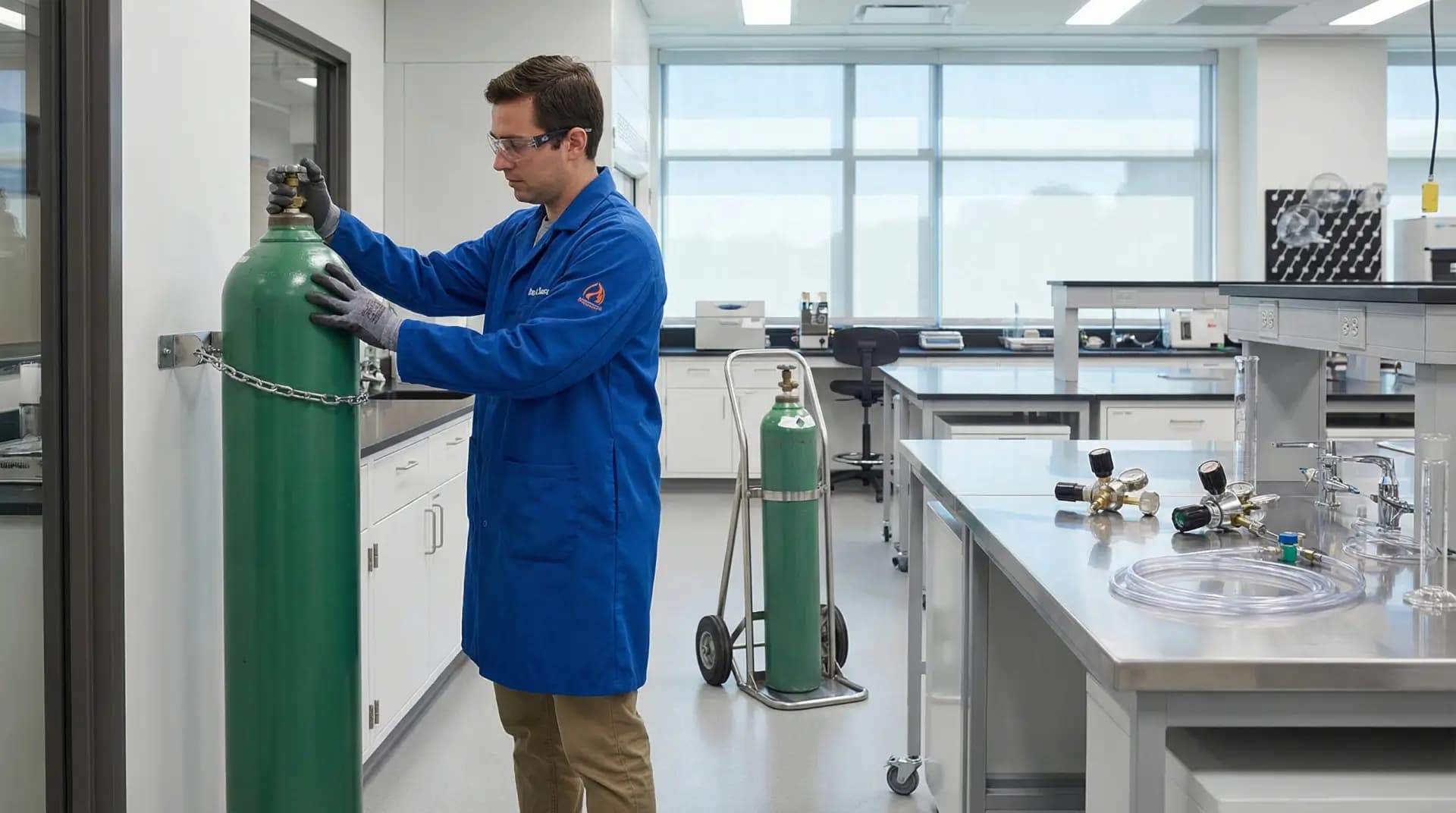
  • Secure every cylinder: Keep cylinders upright and restrained with chains or straps at all times unless designed otherwise.

  • Separate by hazard: Store oxidizers, flammables, and toxic gases by compatibility, not by convenience.

  • Move them correctly: Use a cylinder trolley, fit the valve cap, and never roll or drag cylinders.

  • Check before use: Inspect labels, regulators, hoses, leaks, and test setup before opening any valve.

  • Treat “empty” as hazardous: Residual pressure, contamination, and wrong storage of empties still cause incidents.

I stopped a lab setup during a late afternoon inspection when I saw two nitrogen cylinders standing free beside an analytical bench, one with no cap and the regulator already fitted. A few meters away, a hydrogen cylinder sat beside an oxidizer bank because the team wanted “shorter tubing runs.” Nothing had failed yet, but the conditions for a serious event were already there.

That is why compressed gas cylinders in laboratories need disciplined control. Poor cylinder management creates fire, explosion, asphyxiation, toxic exposure, pressure release, and projectile hazards in spaces where people work close to benches, instruments, and enclosed rooms. This article explains how to manage compressed gas cylinders in labs, how incidents develop in real operations, and what controls actually hold up during inspections and audits.

What Compressed Gas Cylinder Management in Labs Actually Means

Compressed gas cylinder management in labs means controlling the full life cycle of the cylinder: selection, receipt, labeling, storage, segregation, transport, connection, use, leak checking, emergency response, and return. If any one of those steps is weak, the cylinder becomes a high-energy hazard rather than a controlled utility source.

In practice, laboratory cylinder management is not just about “keeping bottles tidy.” It is about preventing pressure energy release, incompatible gas interaction, oxygen displacement, and exposure to gases that may be flammable, oxidizing, corrosive, pyrophoric, or acutely toxic.

The controls I expect to see during a lab inspection are straightforward, and when they are missing, the same patterns appear repeatedly:

  • Positive identification: Every cylinder must have a legible supplier label showing gas contents and hazard class.

  • Secure storage: Cylinders must be upright and restrained to prevent tipping or valve damage.

  • Compatibility segregation: Oxidizers, flammables, inert gases, and toxic gases need separation based on hazard.

  • Approved equipment: Regulators, tubing, flashback arrestors, and fittings must match the gas and pressure.

  • Controlled use: Valves are opened correctly, leaks are checked, and cylinders are shut when not in use.

  • Emergency readiness: Staff know what to do for leaks, fire, exposure, or damaged valves.

A compressed gas cylinder is not just a container. In a lab, it is stored pressure, chemical hazard, and ignition potential combined in one steel package.

Once that principle is understood, the storage and handling rules stop looking excessive and start looking necessary.

Why Compressed Gas Cylinders Are Dangerous in Laboratory Environments

Laboratories make cylinder risks worse because the work is done indoors, often in small rooms, with multiple ignition sources, instruments, and people focused on experiments rather than utilities. I have seen well-run labs still miss basic gas hazards because the cylinder sat outside the immediate test area and no one “owned” it properly.

The danger changes with the gas, but the common consequences are predictable:

  • Projectile hazard: A broken valve can turn a cylinder into a missile with enough force to cross a room or breach partitions.

  • Fire and explosion: Flammable gases such as hydrogen can ignite from static, electrical equipment, hot surfaces, or poor purging practices.

  • Oxidizer intensification: Oxygen and oxidizing gases make ordinary combustibles burn faster and more violently.

  • Asphyxiation: Nitrogen, argon, helium, and carbon dioxide can displace oxygen without obvious warning.

  • Toxic exposure: Gases such as chlorine, ammonia, hydrogen sulfide, or specialty calibration gases can cause acute health effects quickly.

  • Corrosion and equipment failure: Corrosive gases attack regulators, valves, tubing, and nearby surfaces if materials are incompatible.

  • Cold burn and frost injury: Rapid gas release can chill fittings and skin on contact.

In one investigation, a “minor” carbon dioxide release from a poorly tightened connection did not trigger panic because the gas had no strong odor. The first sign was a worker feeling dizzy near floor level in a small prep room. The event stayed small only because another technician noticed the symptom early and shut the supply.

That is the problem with laboratory gas incidents. They often begin quietly, then accelerate fast.

How Compressed Gas Cylinder Incidents Happen in Labs

Most cylinder events do not start with dramatic failure. They start with shortcuts that look harmless during a busy shift. By the time the hazard is visible, the control barrier has already been lost.

The most common failure points I find during inspections and incident reviews are these:

  • Unsecured cylinders: A free-standing cylinder gets knocked by a cart, chair, bench door, or another cylinder.

  • Wrong regulator selection: Staff fit a regulator not rated or not compatible for the gas service.

  • Improvised connections: Adapters, tape, mixed fittings, or non-approved tubing are used to “make it work.”

  • Poor segregation: Fuel gas and oxidizer cylinders are stored side by side without barrier or distance control.

  • Valve damage during movement: Cylinders are moved without caps, dragged, or rolled horizontally.

  • Leak testing skipped: Connections are made and used immediately without checking with an approved leak detection method.

  • Inadequate ventilation: Cylinders are used in rooms where released gas can accumulate.

  • Empty cylinder complacency: “Empty” cylinders are left connected, unlabeled, or mixed with full stock.

These failures usually combine. A poor storage arrangement leads to rough handling. Rough handling damages the valve or regulator. Then a leak develops in a room with weak ventilation and no gas detection. That chain is far more common than a sudden random failure.

Common laboratory conditions that increase risk

Some labs carry higher cylinder risk because of their layout or work pattern. When I assess gas safety, I look beyond the cylinder itself and check whether the room design is helping or worsening the hazard.

  • Small enclosed rooms: Oxygen depletion or toxic buildup happens faster where air volume is limited.

  • High cylinder turnover: Frequent deliveries and change-outs increase handling damage and labeling errors.

  • Shared workspaces: Multiple users connect and disconnect cylinders with uneven competence.

  • Heat-producing equipment: Ovens, hot plates, furnaces, and electrical panels raise ignition risk.

  • After-hours operation: Leaks can continue unnoticed when occupancy is low.

  • Poor housekeeping: Clutter blocks access, damages hoses, and delays emergency isolation.

Those conditions drive the storage and use controls that come next.

Practical Storage Rules to Manage Compressed Gas Cylinders in Labs

Storage is where most labs either control the hazard early or create problems that show up later at the bench. A clean storage area with clear segregation, restraint, and inventory discipline prevents a large share of cylinder incidents before the gas is ever connected.

These are the storage controls I enforce on site:

  • Store upright: Keep cylinders vertical unless the cylinder is specifically designed for another position.

  • Restrain individually or in stable groups: Use chains or straps fixed to a wall, rack, or bench support.

  • Keep valve protection caps fitted: Caps stay on when cylinders are not connected for use.

  • Segregate incompatible gases: Separate flammables from oxidizers and isolate toxic or corrosive gases as required.

  • Protect from heat and impact: Keep cylinders away from direct sunlight, hot equipment, and traffic routes.

  • Control access: Limit storage to trained personnel and prevent casual relocation by untrained staff.

  • Maintain clear identification: Mark full, in-use, and empty status so stock does not get mixed.

  • Keep exits and emergency equipment clear: Do not store cylinders where they obstruct escape routes, extinguishers, or shutoffs.

Where flammable gases or toxic gases are involved, I expect the storage arrangement to reflect the hazard severity, not just available floor space. That may mean ventilated cabinets, dedicated gas rooms, or external storage with piped supply into the lab.

Segregation by gas type

Compatibility is one of the first things I check because labs often group cylinders by department rather than by hazard. That is how you end up with oxygen beside hydrogen, or corrosive gas beside a regulator cabinet full of mixed metals.

Gas Category

Main Hazard

Storage Expectation

Common Mistake

Flammable gases

Fire and explosion

Separate from oxidizers and ignition sources; good ventilation

Storing near hot plates or electrical panels

Oxidizing gases

Intensifies combustion

Segregate from fuels, oils, grease, and combustibles

Keeping oxygen beside hydrogen or solvent stock

Inert gases

Asphyxiation

Ventilated area; oxygen depletion risk assessed

Assuming “non-toxic” means low risk

Toxic gases

Acute exposure

Dedicated control, leak detection, restricted access

Using in general lab areas without emergency planning

Corrosive gases

Burns, corrosion, material attack

Compatible materials, controlled environment, inspection focus

Using standard fittings that degrade in service

Pro Tip: If a lab cannot explain why two cylinder types are stored side by side, I treat that as a segregation failure until proven otherwise.

OSHA 29 CFR 1910.101 requires compressed gases to be handled, stored, and used in accordance with Compressed Gas Association guidance. In practice, that means the cylinder management system must match the gas hazard, not just the room available.

Good storage reduces the chance of a release. Safe movement prevents the next set of failures.

Safe Handling and Transport of Laboratory Gas Cylinders

I have seen more valve damage from poor movement than from poor storage. The reason is simple: people underestimate the weight and instability of cylinders, especially in labs where movement distances are short and staff think a trolley is unnecessary.

Before any cylinder is moved, the handling method should be controlled through simple, repeatable rules:

  • Use a proper cylinder trolley: Move cylinders only with equipment designed to restrain the load.

  • Fit the valve cap: Protect the valve before transport unless the cylinder design does not use a cap.

  • Keep the cylinder upright during movement: Do not roll it horizontally or carry it by hand.

  • Do not drag or slide: Floor impact damages the base, paint, label, and valve assembly.

  • Clear the route first: Remove trip hazards, open doors, and avoid congested corridors.

  • Use trained personnel: Cylinder movement is not a task for unbriefed students or temporary staff.

  • Control lifts and stairs: Use approved mechanical means and site rules; never improvise on stairs.

Where cylinders move between stores, labs, and waste return points, I expect a defined route and local handling rules. In one facility, repeated dents at the shoulder of cylinders traced back to a service lift threshold. That kind of damage looks cosmetic until it affects stability or valve protection.

Step-by-step cylinder movement sequence

A short movement task still needs a sequence. When staff follow the same steps every time, dropped cylinders and valve strikes fall sharply.

  1. Verify identity and destination: Confirm the gas, status, and receiving location before touching the cylinder.

  2. Inspect the cylinder: Check label, cap, visible damage, leaks, and test status markings if applicable.

  3. Remove connected equipment: Take off regulator and accessories unless approved otherwise for the move.

  4. Fit the valve cap: Protect the valve from impact during transport.

  5. Secure to trolley: Strap or chain the cylinder to the cart before moving.

  6. Move slowly on a clear route: Keep control at corners, doors, and ramps.

  7. Resecure at destination: Chain or strap the cylinder immediately before any other task starts.

Pro Tip: The move is not finished when the trolley stops. It is finished when the cylinder is restrained in its new position.

How to Use Compressed Gas Cylinders Safely at the Lab Bench

Connection and use are where technical mistakes show up fast. A cylinder can be perfectly stored and still become dangerous if the wrong regulator, tubing, purge method, or valve-opening practice is used at the point of work.

These are the minimum controls I want in place before a cylinder is put into service:

  • Match regulator to gas and pressure: Use only equipment designed for that gas service and cylinder connection.

  • Check material compatibility: Confirm seals, tubing, and regulator internals suit corrosive, oxidizing, or specialty gases.

  • Secure the cylinder before connection: Never connect a free-standing cylinder.

  • Open valves correctly: Open slowly, using the correct position and body placement away from the outlet path.

  • Leak test after connection: Use an approved leak detection solution or instrument, not guesswork.

  • Keep valves closed when not in use: Do not rely on the regulator alone for isolation.

  • Use flashback protection where required: Fuel gas systems need the right arrestors and backflow controls.

  • Keep incompatible lubricants away: Oil and grease must never contaminate oxygen service components.

One of the worst habits in labs is using adapters and mixed fittings to solve a supply problem quickly. I have removed makeshift assemblies built from spare parts that bypassed the safety built into dedicated connections. If a fitting does not match, the answer is not force. The answer is stop and get the correct equipment.

Bench-use checks before opening the valve

Pre-use checks catch the small defects that become leaks under pressure. I prefer a short checklist that technicians can complete in under two minutes.

  • Label confirmed: The cylinder contents match the experiment or instrument demand.

  • Restraint confirmed: Chain or strap is tight and secure.

  • Regulator condition checked: No visible damage, contamination, or missing gauges.

  • Hose and tubing checked: No cracks, kinks, abrasion, or wrong material type.

  • Valve outlet inspected: Clean, undamaged, and free from oil or debris.

  • Ventilation confirmed: Fume hood, extraction, or room ventilation is operating as intended.

  • Emergency controls known: Staff know the shutoff point and response actions for a leak.

That leads directly to the next issue, because even a well-connected cylinder can create a serious exposure if the room cannot handle a release.

Ventilation, Gas Detection, and Exposure Control in Laboratories

When I review compressed gas cylinder safety in labs, I do not treat ventilation as a background engineering issue. It is a primary control. A leak from an inert gas can drop oxygen levels without smell or irritation, and a toxic gas can exceed safe exposure limits before anyone understands what is happening.

The exposure controls should match the gas hazard and room conditions:

  • Use local exhaust where appropriate: Gas cabinets, exhausted enclosures, or fume hoods may be needed depending on the gas and process.

  • Assess room ventilation capacity: General ventilation must prevent dangerous accumulation from credible leaks.

  • Install gas detection where justified: Oxygen deficiency, flammable gas, or toxic gas monitors should be based on risk assessment.

  • Place sensors correctly: Detector location depends on gas density and release behavior.

  • Connect alarms to response actions: An alarm without a defined shutdown and evacuation plan is weak control.

  • Test and calibrate detectors: Monitoring devices need inspection, bump testing, and maintenance.

  • Control enclosed spaces: Small prep rooms, instrument rooms, and basement labs need special attention.

For oxygen-deficient atmosphere risk, the stricter approach should drive the control strategy. OSHA treats atmospheres with oxygen below 19.5% as oxygen-deficient. In practical lab safety management, I use that threshold as the action point for assessment, alarms, and emergency planning, especially where inert gas cylinders are used indoors.

An inert gas release does not need toxicity to injure people. It only needs enough volume, enough time, and a room that cannot dilute it.

Pro Tip: If a lab uses multiple nitrogen or carbon dioxide cylinders in a small room, ask one question first: “What happens to oxygen here if the largest connection fails after hours?” If no one can answer, the assessment is incomplete.

Inspection, Maintenance, and Housekeeping for Cylinder Safety

Most labs do not need a complicated inspection system. They need a disciplined one. The purpose is to catch drift: loose restraints, damaged regulators, expired detector calibration, blocked exits, mixed empties, and unlabeled cylinders.

I usually break the inspection focus into visible field checks that supervisors and technicians can complete consistently:

  • Cylinder condition: No severe corrosion, dents, burn marks, or tampering.

  • Label integrity: Supplier label present and readable; no unidentified cylinders.

  • Restraint condition: Chains, straps, anchors, and racks intact and correctly positioned.

  • Valve protection: Caps fitted on stored cylinders not in use.

  • Regulator and hose condition: No leaks, damage, contamination, or incompatible repairs.

  • Segregation maintained: Hazard classes still separated as designed.

  • Storage environment: No heat exposure, obstruction, or poor housekeeping around cylinders.

  • Status control: Full, in-use, and empty cylinders clearly identified.

Housekeeping matters more than people think. I have traced hose failure to cylinders wedged behind boxes, and delayed emergency isolation to cylinders hidden by temporary storage. A good gas setup remains visible, accessible, and easy to isolate under stress.

Simple inspection frequency model

The frequency should reflect the hazard and usage rate. A specialty toxic gas setup needs closer attention than a low-turnover inert gas cylinder in a ventilated area.

Inspection Item

Typical Frequency

Purpose

Operator pre-use check

Before each use

Catch setup defects before pressurizing

Area supervisor visual inspection

Weekly

Verify restraint, segregation, labels, and housekeeping

Formal lab safety inspection

Monthly

Review trends, equipment condition, and compliance gaps

Gas detector function checks

Per manufacturer and site procedure

Confirm alarm reliability

Regulator and accessory review

Scheduled preventive basis

Replace degraded or unsuitable equipment

The inspection system only works if people know what bad looks like, which brings training into the picture.

Training and Supervision Requirements for Compressed Gas Cylinders in Labs

In labs, the gap is rarely a complete lack of awareness. The gap is partial knowledge. A technician may know how to connect a regulator but not how to segregate oxidizers. A researcher may understand the process gas but not the consequences of moving a cylinder without a cap.

Training should focus on the tasks people actually perform:

  • Hazard recognition: Staff must understand pressure, fire, oxidizer, toxic, and asphyxiation risks.

  • Cylinder identification: Training must emphasize labels, not cylinder colour alone.

  • Storage and segregation rules: Personnel need clear local requirements for each gas class.

  • Safe movement: Demonstrate trolley use, cap fitting, and route control.

  • Connection and leak testing: Staff must use the correct regulator and approved leak check method.

  • Emergency actions: Evacuation, isolation, alarm response, and reporting must be practiced.

  • Waste and return handling: Empty cylinders and defective cylinders need controlled return arrangements.

Supervision matters most where students, new starters, contractors, or visiting researchers use gas systems. I do not accept “they are experienced in another lab” as proof of competence. Cylinder safety is local. The layout, gases, cabinets, alarms, and emergency rules differ from one facility to another.

A short authorization system often works better than broad generic training. If someone is not authorized to change out a cylinder or connect a regulator, they should not do it.

Emergency Response for Leaks, Fire, and Damaged Cylinders

When a cylinder incident starts, hesitation causes harm. The response plan has to be simple enough that people can execute it under stress. I have seen staff waste critical time trying to identify a leak source up close when the right action was immediate evacuation and specialist support.

The first decision is whether the situation is minor and controllable or beyond safe intervention. That decision depends on gas type, leak size, ventilation, ignition risk, and responder competence.

For most laboratory teams, the emergency response sequence should be this:

  1. Stop work immediately: Suspend the experiment and warn everyone in the area.

  2. Isolate if safe to do so: Close the cylinder valve only if the leak can be approached without exposure or ignition risk.

  3. Evacuate the area: Remove personnel promptly, especially from enclosed rooms.

  4. Raise the alarm: Activate site emergency procedures and notify the responsible response team.

  5. Control access: Keep others out until the atmosphere is confirmed safe.

  6. Support responders with information: Provide gas identity, cylinder location, and any observed damage.

  7. Do not reuse the cylinder: Tag and isolate damaged or leaking cylinders for supplier or specialist handling.

Fire involving cylinders needs a conservative approach. If a flammable gas cylinder is exposed to fire, the situation can escalate beyond laboratory firefighting capability. The priority becomes evacuation, area isolation, and escalation to trained emergency responders under site procedure.

  • Do not fight a fire blindly: Know the gas involved before selecting any response.

  • Cool exposures only if trained and safe: Uncontrolled fire exposure can weaken cylinders and fittings.

  • Assume toxic products may be present: Combustion and decomposition can create secondary hazards.

  • Account for nearby cylinders: Adjacent stock may become involved even if not initially leaking.

If the gas is unknown, the leak is significant, or the room is enclosed, distance is a control. Do not spend people to save equipment.

Response planning also has to cover what happens after the event, because many labs correct the leak and forget the learning.

Common Mistakes I Keep Finding During Lab Audits

Audit findings around compressed gas cylinders are repetitive because the same assumptions keep coming back. People think short duration means low risk, or that a clean laboratory automatically means a safe gas system. It does not.

These are the recurring mistakes I document most often:

  • Relying on cylinder colour: Colour coding varies and should never replace the supplier label.

  • Leaving cylinders unsecured “for a minute”: Temporary free-standing cylinders become permanent until someone knocks them.

  • Using domestic or improvised storage areas: Corridors, under-benches, and shared utility rooms create uncontrolled risk.

  • Mixing full and empty cylinders: This causes confusion, delays, and wrong-cylinder use.

  • Keeping regulators attached during transport: This increases valve damage risk.

  • Ignoring ventilation assumptions: Staff assume room air conditioning equals safe dilution.

  • Failing to close valves after use: The system stays pressurized longer than necessary.

  • Using incompatible materials: Wrong tubing, seals, or fittings degrade and leak.

  • Poor ownership: No one knows who inspects, authorizes, or removes redundant cylinders.

The corrective action is rarely expensive. It is usually management discipline, clear assignment of responsibility, and a local standard that people actually follow.

Building a Reliable Lab Cylinder Management System

If you want compressed gas cylinder safety to hold over time, do not depend on memory or individual caution. Build a simple management system that covers procurement to return, with clear ownership and visible checks.

The framework I use in labs includes these elements:

  • Approved gas inventory: Keep only the cylinders and quantities the lab genuinely needs.

  • Defined storage standard: Set local rules for restraint, segregation, signage, and location.

  • Authorized users only: Limit connection and change-out tasks to trained personnel.

  • Pre-use and inspection checklists: Keep checks short, specific, and auditable.

  • Engineering controls: Use cabinets, ventilation, alarms, and shutoffs where risk justifies them.

  • Incident and near-miss review: Investigate leaks, damaged fittings, and alarm activations before they repeat.

  • Supplier return control: Remove empties and defective cylinders promptly.

  • Periodic audit: Verify that the written rules still match the actual lab setup.

In one research facility, the most effective improvement was not a new cabinet. It was assigning one competent owner for every gas system. Once someone had clear accountability, unsecured cylinders, mixed regulators, and overdue detector checks dropped quickly.

That is the point of management: making safe practice routine, not optional.

Conclusion

To manage compressed gas cylinders in labs properly, you have to control the basics without compromise: correct identification, secure storage, hazard segregation, safe movement, compatible equipment, leak checking, ventilation, and a response plan that people can execute under pressure. Most serious cylinder incidents are not freak events. They are ordinary failures that were visible earlier and left uncorrected.

Laboratory work often focuses on the experiment, the instrument, or the result. The cylinder in the corner gets treated like background equipment until it leaks, falls, feeds a fire, or strips oxygen from the room. That is why compressed gas cylinder management in labs needs ownership, routine inspection, and local rules that survive busy days and staff turnover.

On site, I judge a lab’s safety culture quickly by how it handles its gas cylinders. If the cylinders are controlled, the lab usually understands risk. If they are not, the paperwork means very little. Pressure does not respect good intentions, and a cylinder will punish a weak system without warning.

Responses (0)

    More from author

    Badar Javed

    How to Communicate With Lone Workers

    Effective communication with lone workers is not just about checking in. It is about building a reliable contact system, clear escalation rules, and practical site controls that still work when a worker is tired, distracted, out of signal, or facing an emergency alone.

    19 min read13 views
    Badar Javed

    Emergency Assembly Points Selection and Management

    Emergency assembly points only work when they are selected from a real hazard picture, clearly marked, accessible, and actively managed. I have seen evacuations fail because the muster area looked acceptable on paper but was unsafe once smoke, wind, traffic, or secondary hazards developed.

    18 min read31 views
    Badar Javed

    Contractor Safety Orientation and Induction Guide

    A field-based contractor safety orientation and induction guide for supervisors, HSE teams, and project managers. It covers what induction must include, where sites fail, and how to turn a briefing into a real control against incidents, permit breaches, and contractor non-compliance.

    19 min read4 views
    Badar Javed

    How to Segregate Waste in the Workplace

    Waste segregation in the workplace fails when bins, labels, training, and supervision do not match the actual waste stream. This guide explains how to separate waste correctly, prevent contamination, and build a practical system that crews will follow on site.

    18 min read7 views