

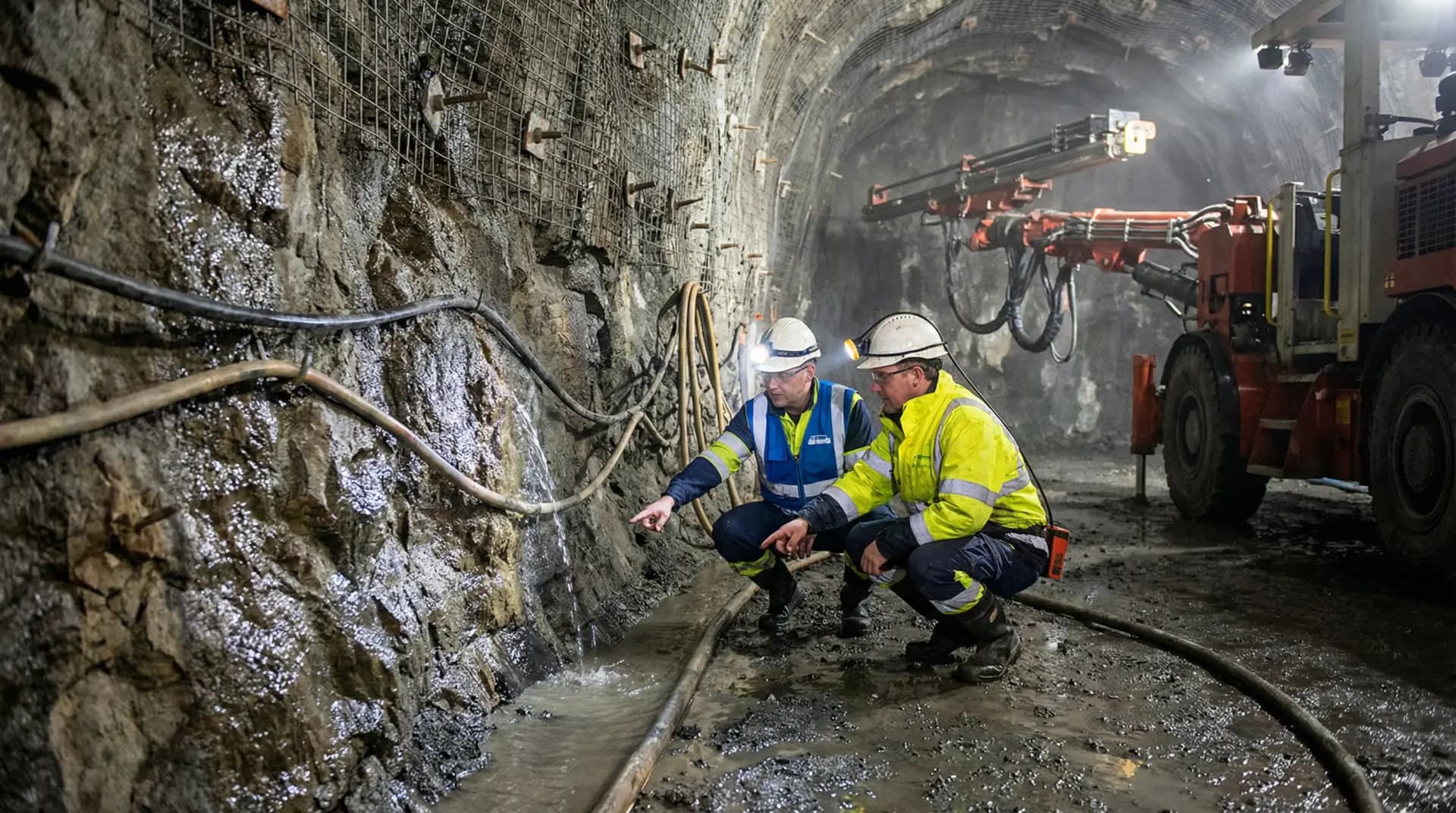
Preventing flooding in underground mines depends on one clear principle: water must be treated as a major hazard, not as a routine housekeeping issue. A safe mine does not rely only on pumps after water appears. It identifies where water can enter, verifies old workings and aquifers before mining advances, controls surface water before storms, maintains drainage and pumping capacity, and prepares workers to evacuate before an inflow becomes uncontrollable.
In my HSE practice, I look at underground mine flooding through three layers of control:
Prevent water from entering the mine.
Detect abnormal inflow early.
Protect people if prevention fails.
That means mine flooding prevention must combine geology, surveying, engineering, maintenance, supervision, emergency planning, and disciplined permit-to-work control.
Understanding Flooding Hazards in Underground Mines
Underground mine flooding may happen gradually through seepage, or suddenly through an inrush of water, slurry, mud, or water-bearing material. The sudden event is usually the more dangerous one because it can block travel roads, damage ventilation, trap workers, affect electrical systems, and turn escape routes into water channels.
The main sources of underground mine flooding include:
Flooding source | Typical risk pathway | Main prevention focus |
|---|---|---|
Surface water | Heavy rain, rivers, ponds, open pits, subsidence cracks, shafts, adits, portals | Diversion, bunding, sealing, stormwater planning |
Old workings | Abandoned flooded mines, poorly mapped headings, sealed areas | Survey verification, probe drilling, barrier pillars |
Aquifers and water-bearing strata | Mining below lakes, streams, saturated formations, fractured rock | Hydrogeological studies, permits, monitoring |
Mine impoundments | Failure of slurry ponds, tailings dams, process water ponds | Dam integrity, exclusion zones, emergency triggers |
Internal water systems | Damaged pipes, sumps, blocked drains, failed pumps | Maintenance, inspections, redundancy |
Backfill or loose material | Saturated fill, mud, fines, wet waste material | Inrush risk assessment, drainage, barricading |
The important point is that flooding rarely starts as a “water problem” only. It is usually connected to a weak control somewhere else: poor mapping, inadequate inspection, blocked drainage, mining too close to old workings, failure to manage stormwater, or continuing work after warning signs appear.
Build a Mine Water Risk Management Plan
A mine water risk management plan should be part of the site’s health and safety management system, not a document kept for audits. It should clearly define where water hazards exist, who owns each control, how controls are verified, and when work must stop.
A practical plan should include:
Surface water catchments, storm paths, nearby rivers, lakes, ponds, dams, and drainage lines
Known and suspected old workings, including uncertainty zones
Aquifers, faults, dykes, fractured zones, permeable strata, and water-bearing formations
Shaft, portal, adit, borehole, and decline locations
Sumps, pumps, rising mains, valves, electrical supply, backup power, and discharge routes
Trigger action response plans for rainfall, water level rise, abnormal seepage, pump failure, or probe-hole water flow
Emergency evacuation arrangements for water inrush or mine inundation
Inspection frequency before, during, and after high-risk weather or high-risk mining activities
For legal compliance, the exact requirements depend on jurisdiction. For example, MSHA requirements in the United States apply to underground coal mines and underground metal/nonmetal mines, while HSE guidance and mining regulations apply in Great Britain. Mine operators must follow the legal requirements of the country, state, or region where the mine operates. A generic plan is not enough where local law requires approved mine maps, permits for mining under bodies of water, emergency evacuation procedures, or principal hazard management plans.
HSE trust note: Flooding controls should be reviewed by competent mining, geotechnical, hydrogeological, survey, electrical, and emergency response personnel. A supervisor alone should not be expected to judge water inrush risk without technical support.
Keep Mine Plans Accurate and Verify Old Workings
Accurate mine plans are one of the strongest flood prevention controls in underground mining. Many serious inrush risks arise when active development approaches old, abandoned, poorly surveyed, or water-filled workings.
A reliable mapping system should show:
Active workings
Abandoned workings
Worked-out areas
Sealed areas
Adjacent mines
Boreholes and drill holes
Shafts, adits, slopes, and portals
Water bodies and surface drainage features
Faults, dykes, fractured zones, and known water-bearing structures
Barrier pillars and restricted mining zones
Escapeways, refuge locations, and emergency routes
The common mistake is treating old mine plans as precise when they may not be. Older records may be incomplete, distorted, or based on survey practices that do not meet modern expectations. Where uncertainty exists, the safe approach is to assume that the hazard may be closer than shown until proven otherwise.
Before mining near old workings, the mine should use controls such as:
Historical record review
Check old plans, abandonment records, adjacent mine information, borehole logs, hydrological records, and previous water incidents.Survey reconciliation
Compare surface and underground survey data, update coordinates, and identify areas where plan accuracy is questionable.Barrier pillar design
Maintain engineered separation from flooded workings, water bodies, and water-bearing structures. The barrier should be based on competent technical assessment, not convenience of production.Probe drilling ahead of development
Drill small-diameter probe holes in advance where there is credible risk of water, gas, slurry, or wet material.Controlled depressurization where required
If water is detected, manage pressure and flow through engineered methods before exposing the area.Formal permission to advance
Do not allow normal mining to continue into a defined water hazard zone without documented technical clearance.
A strong rule for supervisors is simple: if the plan is uncertain, the ground is uncertain. Uncertainty must increase control, not reduce it.
Control Surface Water Before It Reaches the Mine
Surface water is often underestimated because it is visible and familiar. In underground mines, heavy rainfall or flooding at surface can enter through portals, shafts, cracks, subsidence zones, boreholes, open cuts, drainage channels, and poorly sealed old openings.
Effective surface water control should begin before the rainy season or storm period, not during it.
Key controls include:
Diversion drains around portals, shafts, workshops, and critical infrastructure
Bunds, berms, and cut-off drains above mine entries
Proper grading so runoff flows away from openings
Sealed or protected boreholes and old shafts
Drainage maintenance around subsidence zones and cracks
Regular cleaning of culverts, sumps, drains, and sediment traps
Flood protection for pump stations, substations, communication rooms, and backup power
Inspection of tailings dams, water ponds, sediment ponds, and impoundments
Rainfall monitoring with clear action triggers
Suspension of underground work where surface flooding can compromise escape or ventilation
A practical surface water inspection should ask:
Inspection question | Why it matters |
|---|---|
Can water reach any mine opening? | Prevents direct inflow |
Are drains blocked by silt, vegetation, rock, or waste? | Prevents overflow into entries |
Are old shafts or boreholes sealed and marked? | Prevents hidden water pathways |
Are pumps and generators above flood level? | Maintains emergency dewatering |
Are roads and escape routes likely to wash out? | Protects evacuation and rescue access |
Are ponds or impoundments close to underground workings? | Reduces inrush and breakthrough risk |
In my view, the most useful stormwater control is a trigger-based checklist. When rainfall reaches a defined level, the mine should not depend on individual judgment. It should automatically activate inspection, pumping checks, management notification, and, where necessary, withdrawal of personnel from vulnerable areas.
Design Drainage, Pumping, and Dewatering for Failure Conditions
Pumps are essential, but they are not the full answer. A mine that depends on a single pump, single power source, single discharge line, or single sump has a fragile flood control system.
A good underground mine dewatering system should include:
Sumps located at planned low points
Settling capacity to reduce silt load before water reaches pumps
Pump capacity based on expected inflow plus emergency margin
Standby pumps ready for immediate use
Backup power or alternative power supply
Non-return valves and isolation valves
Protected electrical installations
Clear discharge routes that do not send water back toward the mine
Flow meters or practical methods to observe abnormal inflow
Routine inspection and testing
Critical spares for pumps, hoses, cables, valves, starters, and sensors
The system must also account for dirty water. In mines, floodwater often carries mud, coal fines, rock particles, slurry, timber, cable fragments, and other debris. Pumps that perform well in clean water may fail quickly in silted mine water. Sump design and pump selection must reflect actual mine conditions.
Pumping controls that should be verified regularly
Pump start and stop functions
Automatic level controls
Manual override
Standby pump readiness
Power supply and backup power
Cable condition and protection
Valve position and labeling
Discharge line leaks or blockages
Sump capacity and sediment level
Alarm function and communication to surface control
A useful maintenance question is: “If the main pump fails at the worst time, what happens next?” If the answer is unclear, the dewatering system is not yet resilient.
Use Monitoring and Early Warning Systems
Flood prevention improves when the mine can detect changes before workers are exposed. Monitoring does not replace inspections, but it gives supervisors earlier warning and better decision-making.
Depending on mine complexity, monitoring may include:
Rain gauges and weather alerts
Surface water level monitoring
Sump level sensors
Pump status alarms
Flow rate monitoring
Groundwater pressure monitoring
Piezometers
Probe-hole water observations
Turbidity or sediment changes
Remote cameras at critical drains or portals
Communication alarms to surface control rooms
Warning signs of possible flooding or inrush include:
Sudden increase in seepage
Water becoming muddy or pressurized
New water flow from roof, ribs, floor, or boreholes
Unusual ground noise near suspected water-bearing zones
Sloughing, softening, or wet material flowing from the face
Rising sump levels despite normal pumping
Pump cycling more frequently than usual
Blocked drains or unexpected pooling on travel roads
Water appearing in areas previously dry
Cracking or subsidence at surface above underground workings
Workers should be trained to report these signs immediately. The reporting culture matters. A miner who notices new water at the face should not feel pressure to “keep going until the end of the cut.” Water is a stop-and-check condition.
Control Work Near Water Hazards With Permit Discipline
Mining near water hazards should be treated as high-risk work. It requires planning, authorization, monitoring, and clear stopping rules.
A permit or authorization process should be used when work involves:
Advancing toward old workings
Mining below or near water bodies
Working near aquifers or water-bearing strata
Developing below ponds, impoundments, rivers, lakes, or flooded pits
Drilling into suspected wet ground
Reopening sealed or abandoned areas
Working near known barrier pillars
Conducting blasting where water-bearing structures may be affected
Pumping or draining old workings
The permit should define:
Permit element | Required control |
|---|---|
Hazard source | What water, slurry, gas, or wet material may be encountered |
Technical basis | Survey, geological, and hydrogeological information used |
Exclusion limits | Where work is allowed and where it is prohibited |
Probe drilling | Hole pattern, length, angle, pressure controls, and response actions |
Communication | Who must be informed before, during, and after the work |
Monitoring | Water flow, pressure, gas, ground condition, and pump status |
Emergency readiness | Escape routes, refuge, alarms, and withdrawal criteria |
Stop-work triggers | Conditions requiring immediate withdrawal or reassessment |
The permit should not be a paperwork exercise. It should be briefed to the crew at the workplace, understood by the supervisor, and verified by a competent person.
Practical judgment call: When probe drilling identifies water under pressure, the response should not be improvised at the face. Work should stop, the area should be secured, and technical personnel should assess depressurization, drainage, barrier integrity, and evacuation risk.
Prepare for Emergency Evacuation and Rescue
Even with strong prevention controls, underground mines must prepare for flooding emergencies. The emergency plan should assume that water may block the normal route, affect power, damage communication, and reduce visibility.
A mine flooding emergency plan should include:
Alarm activation for water inrush or rapid inflow
Immediate withdrawal procedure
Primary and secondary escapeways
Escapeway inspection and maintenance
Refuge strategy where escape is not possible
Surface control room responsibilities
Worker accounting system
Mine rescue notification
Pumping escalation plan
Communication backup
Emergency transport availability
Isolation of electrical equipment where required
Post-event re-entry controls
Training should cover realistic scenarios, not only classroom definitions. Workers should know what to do if water appears behind them, if one escapeway is blocked, if communication fails, or if a supervisor is not nearby.
Emergency drills should verify:
Can workers recognize the water hazard quickly?
Can the alarm be raised from underground?
Does the surface team know who is underground and where?
Are escapeways clearly marked, passable, and separate?
Are pumps and backup systems functional?
Can mine rescue teams access current plans?
Are decision-makers clear on when to withdraw and when not to re-enter?
Re-entry after flooding is a separate high-risk activity. It should only occur after competent assessment of ground stability, ventilation, oxygen deficiency, electrical hazards, contamination, water depth, flow, and secondary inrush potential.
Conclusion
Preventing flooding in underground mines requires more than installing pumps. The strongest protection comes from understanding where water can enter, keeping mine plans accurate, controlling surface water, maintaining engineered barriers, using probe drilling where uncertainty exists, designing resilient dewatering systems, and training workers to respond before water cuts off escape.
As an HSE professional, I do not treat underground mine water as a background condition. I treat it as a major hazard that can change quickly and punish weak assumptions. The safest mines are the ones that question old plans, inspect drains before storms, test pumps before they are needed, stop work when warning signs appear, and make evacuation decisions early.
Flood prevention is not one control. It is a chain. If mapping, engineering, monitoring, maintenance, supervision, and emergency planning all work together, the risk of underground mine flooding can be reduced to a controlled and defensible level.

Responses