

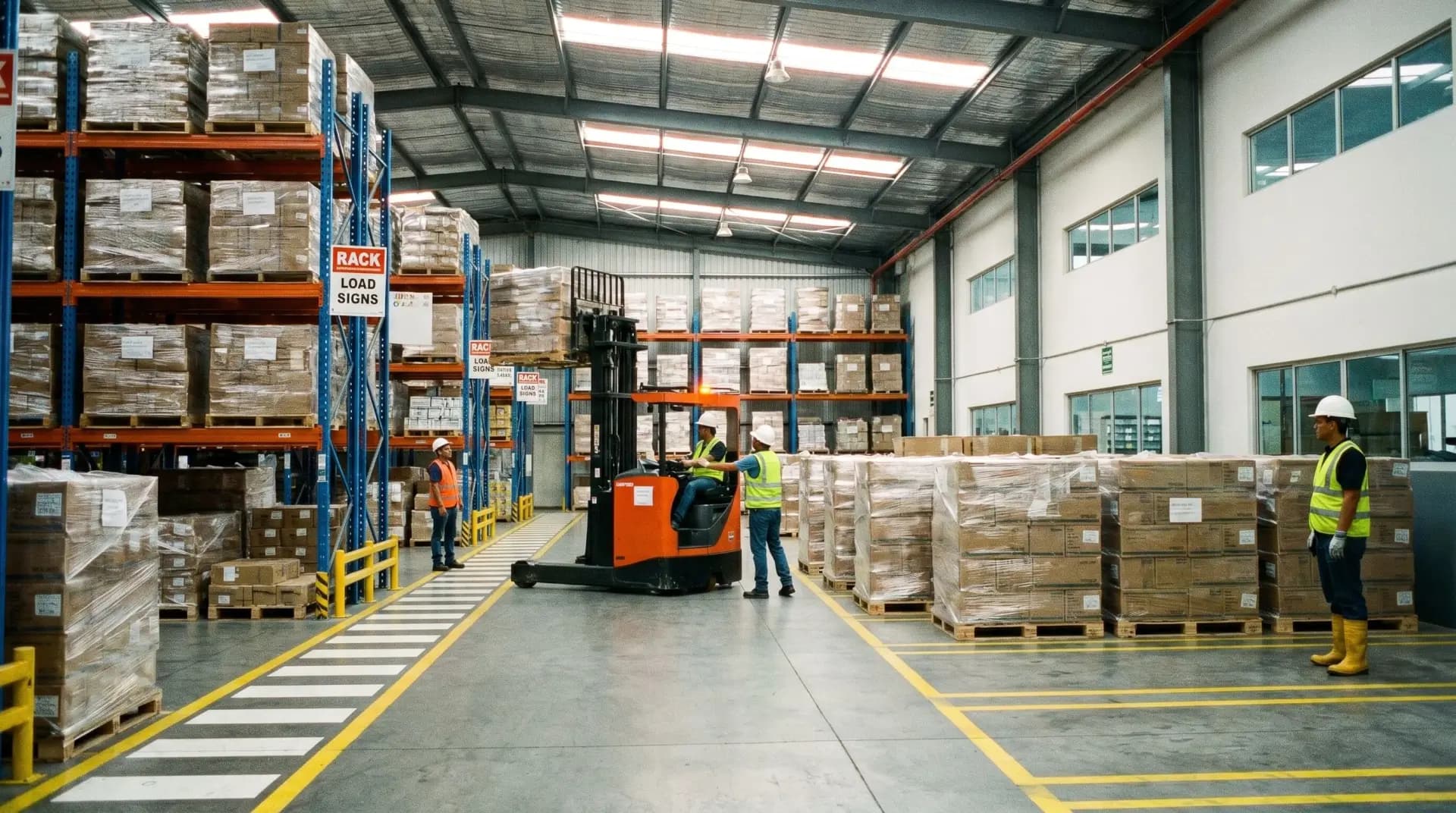
Safe stacking means arranging materials so they remain stable, accessible, and protected from collapse, sliding, falling, crushing, or creating fire and access hazards. In practical HSE terms, a stack is safe only when the base is sound, the load is compatible, the height is controlled, the weight is understood, and people are kept away from the line of fire.
What Safe Stacking Practices Require
Safe stacking is not just “keeping materials neat.” It is a controlled storage activity. Before any material is stacked, the workplace should confirm:
The floor or ground can support the load.
The surface is level, firm, and dry.
The material type is suitable for stacking.
The stack height is limited and stable.
Heavier items are placed at the bottom.
Damaged pallets, boxes, containers, or racks are removed.
Access routes, emergency exits, fire equipment, and walkways remain clear.
From my HSE practice, most stacking failures come from routine shortcuts: mixed materials, poor housekeeping, damaged pallets, over-height stacking, and forklift operators placing loads where no storage plan exists.
Identify the Material Before Stacking
Different materials behave differently under load. A safe method for boxed goods may be unsafe for pipes, drums, bags, timber, sheets, cylinders, or irregular equipment.
Before stacking, classify the material by:
Material factor | Why it matters |
|---|---|
Weight | Prevents floor overload and manual handling injuries |
Shape | Determines whether blocking, chocking, or racking is needed |
Fragility | Prevents collapse from crushed lower layers |
Surface condition | Slippery or uneven surfaces increase movement |
Chemical properties | Incompatible substances must not be stored together |
Access frequency | Fast-moving items should be easier and safer to retrieve |
A simple rule I use is this: if the material cannot stand securely without assistance, it needs engineered support, not just careful placement.
Build the Stack on a Stable Base
The base controls the stack. If the bottom layer is weak, uneven, or overloaded, the entire stack becomes unreliable.
Good practice includes:
Clear the area before stacking.
Check the floor for cracks, slopes, spills, or soft ground.
Use pallets, stillages, racks, chocks, or dunnage where needed.
Keep the first layer square, level, and aligned.
Never stack on damaged pallets or unstable packaging.
Keep stacks away from edges, excavations, doors, traffic routes, and unprotected openings.
For palletized loads, pallets should be inspected before use. Broken deck boards, protruding nails, missing blocks, or visible distortion are enough reason to reject the pallet.
Control Stack Height, Weight, and Stability
A stack should never be built higher than its stability allows. “It has not fallen before” is not a control measure.
Use these controls:
Place heavy materials at the bottom.
Keep loads vertical and aligned.
Avoid leaning stacks.
Interlock compatible boxes or bags where suitable.
Use banding, wrapping, strapping, or containment when required.
Do not exceed rack, shelf, pallet, or floor load limits.
Display safe working loads on storage racks.
Keep irregular loads lower and more restrained.
A practical HSE judgment is to stop stacking when retrieval becomes unsafe. If workers need to climb, stretch, pull, or disturb other materials to access an item, the stack design has already failed.
Separate People from Stacking Hazards
Safe stacking depends heavily on traffic control. Forklifts, pallet trucks, pedestrians, and stored materials should not compete for the same space without clear controls.
Effective controls include:
Marked storage zones
Defined pedestrian walkways
Clear forklift routes
Barriers or guardrails near high-risk stacks
Exclusion zones during loading and unloading
Adequate lighting
Good housekeeping
Clear emergency access
No one should stand beside, behind, or below a load being stacked or retrieved. Falling objects rarely give enough warning for a person to react.
Use Racking and Mechanical Equipment Correctly
Racking must be treated as load-bearing equipment, not as general shelving. It should be installed, loaded, inspected, and maintained according to manufacturer instructions and local legal requirements.
Key controls include:
Do not overload racks.
Do not climb on racking.
Protect uprights from vehicle impact.
Report damaged beams, braces, anchors, or frames.
Remove unsafe bays from service.
Train forklift operators on correct placement and retrieval.
Keep load notices visible and readable.
Mechanical handling equipment should match the load. Using the wrong forklift attachment, pallet truck, sling, or lifting aid can make a stable load unstable within seconds.
Train Workers and Inspect Stacking Areas
Training should be practical and task-specific. Workers need to know what unsafe stacking looks like, when to stop work, and who to report hazards to.
Training should cover:
Stack height limits
Manual handling risks
Pallet inspection
Rack load limits
Safe retrieval methods
Falling-object hazards
Housekeeping requirements
Emergency access rules
Reporting damaged storage systems
Inspection should be routine, not occasional. Supervisors should check storage areas during normal operations, especially after deliveries, shift changes, forklift impacts, bad weather, or layout changes.
Conclusion
Safe stacking practices are implemented by controlling the base, the load, the height, the storage method, and the movement of people and equipment around the stack. A safe stack is stable, accessible, inspected, and suited to the material being stored.
The strongest safety improvement is usually simple: stop treating stacking as housekeeping and start treating it as a planned material storage activity. When storage areas are designed, load limits are respected, damaged items are removed, and workers are trained to challenge unstable stacks, the risk of collapse, falling objects, manual handling injury, and blocked access drops significantly.


Responses