

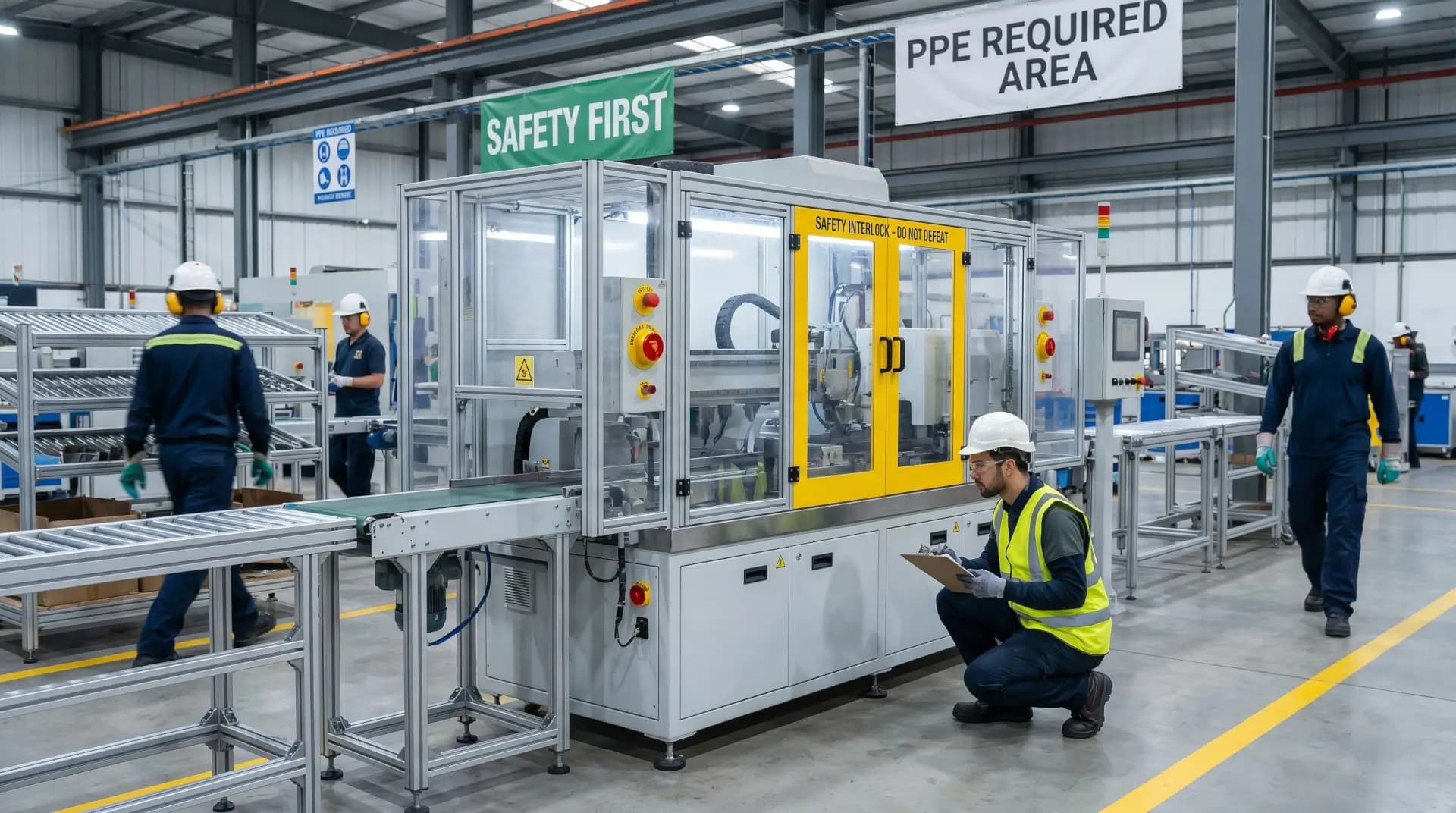
A machine guarding program is implemented by identifying every machine hazard, selecting suitable safeguards, verifying that guards work as intended, training employees, controlling bypass risks, and auditing the system continuously. The program must not stop at installing physical guards. It must define ownership, inspection frequency, maintenance rules, change control, and corrective action so that guarding remains effective during normal operation, cleaning, adjustment, troubleshooting, and maintenance.
What a Machine Guarding Program Must Achieve
A good machine guarding program prevents contact with dangerous moving parts before injury is possible. It should control hazards such as:
Point of operation hazards
Rotating shafts, couplings, pulleys, gears, belts, and chains
In-running nip points
Reciprocating and transverse motion
Flying chips, sparks, particles, or broken tooling
Unexpected start-up during cleaning or maintenance
Access to hazardous zones during jams or adjustments
In practical HSE terms, the program must answer five questions for every machine:
Question | Program Requirement |
|---|---|
What can injure someone? | Machine-specific hazard identification |
Who can be exposed? | Operator, helper, cleaner, technician, contractor |
How is access prevented? | Fixed guard, interlocked guard, presence-sensing device, two-hand control, enclosure, safe distance |
How do we know it works? | Verification, inspection, testing, and validation |
How do we keep it working? | Training, maintenance, audits, and management of change |
Step 1: Build a Complete Machine Inventory
Start with a controlled machine register. Without a reliable inventory, guarding gaps remain hidden.
Your inventory should include:
Machine name and identification number
Location and department
Manufacturer, model, and year where available
Energy sources
Operating modes
Existing guards and safety devices
Known tasks such as operation, cleaning, setup, tool change, lubrication, clearing jams, and maintenance
Responsible owner
Risk assessment status
Corrective action status
I prefer separating machines into risk groups: high-risk production equipment, workshop machines, portable or bench-mounted machines, automated equipment, and legacy machines. Older machines often need deeper review because their original design may not meet current safeguarding expectations.
Step 2: Conduct Machine-Specific Risk Assessments
Machine guarding cannot be managed by generic checklists alone. Each machine needs a task-based risk assessment.
Review the full machine lifecycle:
Normal operation
Loading and unloading
Setup and adjustment
Cleaning
Jam clearing
Tool change
Inspection and testing
Maintenance
Decommissioning or relocation
For each task, identify where the body can enter a danger zone. Hands and fingers are the obvious concern, but do not miss hair, loose clothing, gloves, arms, face, and whole-body access into automated cells.
Assess severity, frequency of exposure, possibility of avoidance, and the reliability of existing controls. Where a person can reach a hazardous part during operation, the guarding decision should be treated as a critical control decision, not a housekeeping issue.
Step 3: Select the Right Safeguarding Method
The strongest approach is to eliminate access to the hazard. When that is not possible, reduce risk through engineered safeguards before relying on procedures.
Common guarding options include:
Safeguard Type | Best Use | Key Caution |
|---|---|---|
Fixed guard | Permanent access prevention | Must require tools to remove |
Interlocked guard | Access doors, covers, movable panels | Must stop hazardous motion before access |
Adjustable guard | Variable material sizes | Often misused if not adjusted correctly |
Self-adjusting guard | Saws and similar equipment | Must return to safe position |
Light curtain or scanner | Automated loading zones | Must be correctly positioned and validated |
Two-hand control | Certain press or cycle-start tasks | Must prevent one-hand or bypass operation |
Enclosure | Flying particles, sparks, fragments | Must contain ejection hazards |
Safe distance guarding | Perimeter protection | Must prevent reach-over, reach-under, and reach-through access |
A guard should not create a new hazard. Sharp edges, pinch points, poor visibility, excessive manual handling effort, and blocked emergency access are common examples of poor guarding design.
Step 4: Define Guarding Standards and Acceptance Criteria
A machine guarding program needs clear acceptance rules. Otherwise, different supervisors, engineers, and contractors will apply different standards.
Set written criteria for:
Minimum guarding requirements
Fixed guard fastening methods
Interlock selection and testing
Emergency stop interface expectations
Safe distance and reach prevention
Guard material strength and visibility
Access requirements for cleaning and maintenance
Signage and warning labels
Requirements for contractor-built guards
Approval before removing, modifying, or bypassing guards
For legal alignment, always check the applicable jurisdiction. For example, OSHA in the United States addresses machinery and machine guarding under 29 CFR 1910 Subpart O, including general machine guarding requirements in 1910.212. In Great Britain, PUWER requires measures to prevent access to dangerous parts of machinery or stop movement before access to danger zones. ISO 12100 provides a recognized framework for machinery risk assessment and risk reduction.
Step 5: Install, Verify, and Validate Safeguards
Installation is not the end point. Every safeguard must be verified before the machine is released for use.
Verification should confirm:
The guard is installed as designed
Hazardous parts cannot be reached
Fasteners are secure
Interlocks function correctly
Stopping time is suitable for the access distance
The machine cannot restart unexpectedly after guard closure
Emergency stops work as intended
Operators can perform tasks without defeating the guard
Cleaning and maintenance tasks are controlled
For complex safeguards, especially interlocks, light curtains, scanners, and automated cells, validation should involve competent engineering support. A guard that looks correct but fails under real operating conditions is a serious weakness.
Step 6: Train Employees on Use, Limits, and Bypass Control
Training must be practical and machine-specific. General awareness is useful, but it does not replace hands-on instruction at the equipment.
Operators should understand:
What hazards the guard controls
Which guards must be in place before operation
How to inspect guards before use
What defects must be reported
Why bypassing is prohibited
What to do if production cannot continue safely
Which tasks require lockout or isolation
Who is authorized to remove guards
One misconception I regularly correct is the idea that experienced operators are less exposed. In reality, familiarity can increase risk when people become comfortable reaching near moving parts, clearing jams quickly, or operating with missing covers because “it has always been done that way.”
Step 7: Control Maintenance, Cleaning, and Non-Routine Work
Many serious machine incidents happen outside normal production. A guarding program must connect directly with lockout/tagout or isolation procedures.
Set clear rules for:
Guard removal
Jam clearing
Lubrication
Blade or tooling change
Troubleshooting
Cleaning inside guarded zones
Temporary guarding during repairs
Restart after maintenance
No guard should be removed unless the task is authorized, the energy is controlled, and the machine is returned to a safe condition before restart. After maintenance, guards should be checked as part of handover, not left to the next operator to discover.
Step 8: Inspect, Audit, and Improve the Program
A machine guarding program needs routine monitoring. Guards get damaged, removed, modified, loosened, bypassed, or made ineffective by process changes.
Use three inspection levels:
Inspection Type | Frequency | Responsible Person |
|---|---|---|
Pre-use check | Before operation or shift start | Operator |
Formal machine inspection | Scheduled | Supervisor, HSE, maintenance |
Program audit | Periodic | HSE, engineering, management |
Track leading indicators such as missing guards, bypass attempts, overdue corrective actions, repeated defects, and unauthorized modifications. Treat recurring guard damage as a design or process problem, not simply an operator discipline issue.
Common Machine Guarding Program Failures
The most common failures I see are not technical; they are management-system failures.
These include:
No complete machine inventory
Generic risk assessments
Guards installed without validation
Maintenance teams removing guards without reinstatement checks
Operators bypassing guards because they block the task
Interlocks not tested
Poor control over machine modifications
No clear owner for corrective actions
Reliance on warning signs instead of engineered protection
Treating guarding as a one-time compliance project
A strong program prevents these failures by assigning ownership, checking effectiveness, and correcting root causes.
Machine Guarding Program Checklist
Use this checklist to test whether your program is functional:
Machine inventory is complete and current
Each machine has a task-based risk assessment
Safeguards are selected using a hierarchy of control approach
Guarding standards are written and approved
Guards are verified before machine release
Safety devices are tested and documented
Operators are trained on machine-specific hazards
Maintenance and cleaning tasks are controlled
Guard removal requires authorization
Bypass and defeat risks are actively managed
Defects are reported and corrected
Changes trigger reassessment
Audits are performed and tracked to closure
Conclusion
Implementing a machine guarding program is not just a compliance exercise. It is a structured risk control system that protects people from dangerous machine motion during every stage of work. The most effective programs combine engineering controls, competent risk assessment, clear ownership, practical training, disciplined maintenance control, and routine verification.
In my professional view, the strongest machine guarding programs are the ones that make safe operation easier than unsafe operation. When guarding supports the task, operators trust it. When inspection and maintenance keep it reliable, the organization can depend on it. That is the standard every HSE team should work toward.



Responses