

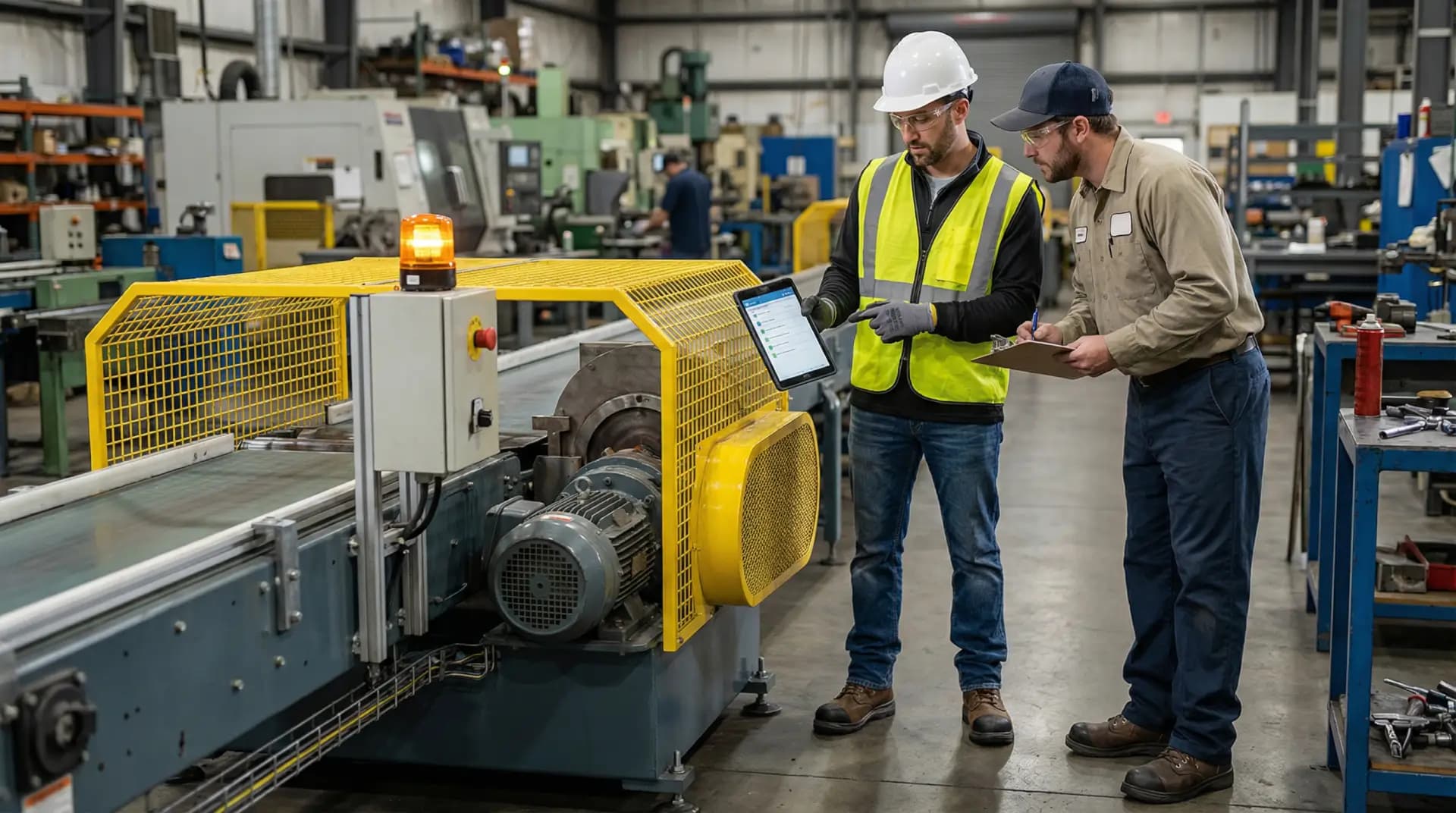
A machine risk assessment is a structured review of how a machine can harm people, how likely that harm is, how severe it could be, and what safeguards are needed before the machine is used, modified, maintained, or returned to service. I conduct it by defining the machine limits, identifying hazards across all operating modes, estimating risk, selecting controls in the right order, checking residual risk, and documenting the final decision clearly enough that another competent person can understand it.
The aim is not to complete a form. The aim is to prevent contact with dangerous movement, unexpected start-up, stored energy, ejected material, electrical hazards, heat, noise, poor ergonomics, and foreseeable misuse. A good machine risk assessment must lead to practical engineering and administrative controls, not just a risk score.
What Is a Machine Risk Assessment?
A machine risk assessment is the process of identifying machinery hazards and deciding what must be done to reduce risk to an acceptable level. It applies to new machines, existing machines, modified machines, automated systems, production lines, temporary installations, and equipment used during maintenance or cleaning.
In practical HSE work, I treat machine risk assessment as a bridge between engineering, operations, maintenance, and safety. It should answer five questions:
What can go wrong?
Who can be harmed?
How can the harm occur?
What prevents it now?
What more must be done before the machine is considered safe for use?
Machine risk assessment is commonly aligned with recognised machinery safety principles such as ISO 12100 for risk assessment and risk reduction. Legal duties vary by jurisdiction. For example, OSHA requirements in the United States include machine guarding provisions under 29 CFR 1910.212 and hazardous energy control under 29 CFR 1910.147. In Great Britain, PUWER requires work equipment to be suitable, maintained, inspected where necessary, and protected against access to dangerous parts. In the European Union, machinery placed on the market must meet applicable machinery safety requirements, including design risk reduction.
The exact regulation may differ, but the safety logic remains the same: eliminate hazards where possible, guard dangerous parts, control hazardous energy, verify safeguards, train users, and manage residual risk.
Step 1: Define the Machine and Its Limits
Before identifying hazards, define what machine you are assessing. This sounds simple, but it is where many weak assessments fail. A press, conveyor, robot cell, mixer, saw, packing machine, or CNC machine may be part of a larger system. If the boundary is unclear, important hazards are missed.
I normally define the machine limits under four headings:
Limit Type | What to Confirm | Example Questions |
|---|---|---|
Use limits | Intended use and foreseeable misuse | What is the machine designed to do? How do operators actually use it? |
Space limits | Physical boundaries and access points | Where can people reach, stand, climb, enter, or pass through? |
Time limits | Life-cycle stages | Is the assessment for installation, operation, cleaning, maintenance, or decommissioning? |
Energy limits | Energy sources and stored energy | Is there electrical, pneumatic, hydraulic, gravitational, thermal, mechanical, or residual pressure energy? |
Do not assess only normal production. Machines often become most dangerous during clearing jams, cleaning, adjustment, blade changes, tool changes, lubrication, fault finding, and maintenance. These non-routine tasks must be included because they often require people to get closer to danger zones.
Step 2: Identify Machine Hazards
Hazard identification should be done at the machine, not only from a desk. Review drawings and manuals first, but physically observe the machine where possible. Speak with operators, setters, maintenance technicians, supervisors, and engineers. They often know the real failure points, shortcuts, and abnormal tasks better than anyone else.
Common machine hazards include:
Crushing between moving and fixed parts
Shearing at closing edges
Cutting from blades, tools, cutters, and sharp workpieces
Entanglement with rotating shafts, rollers, drills, belts, or spindles
Drawing-in at in-running nip points
Impact from moving parts, robots, ejectors, or indexing tables
Ejection of material, swarf, broken tools, or pressurised components
Electrical shock or arc hazards
Burns from hot surfaces, steam, molten material, or friction heat
Noise, vibration, dust, fumes, or process emissions
Slips, trips, and falls around access platforms or loading areas
Manual handling and ergonomic strain
Unexpected start-up during intervention
Failure of safety devices, interlocks, sensors, or control systems
A useful technique is to assess the machine by task and mode:
Machine Mode | Typical Hazards to Check |
|---|---|
Normal operation | Contact with moving parts, access to danger zones, ejected material |
Start-up and shutdown | Unexpected movement, alarms, reset sequence, visibility |
Loading and unloading | Trapping, lifting strain, forklift interface, stored energy |
Cleaning | Guard removal, wet surfaces, chemical exposure, sharp edges |
Maintenance | Lockout, isolation, stored pressure, elevated work, test runs |
Fault clearing | Bypassed guards, reaching into danger zones, time pressure |
Tool or product changeover | Adjustment hazards, manual handling, pinch points |
Emergency conditions | Stop function, escape routes, rescue access, restart prevention |
The key is to consider foreseeable human behaviour. If a guard is difficult to open, people may defeat it. If a jam happens every hour, someone may reach in. If a reset button is far from the danger zone, the operator may not see who is inside. These are not “operator problems” only; they are design and management problems that the risk assessment must capture.
Step 3: Estimate and Evaluate the Risk
Once hazards are identified, estimate the risk for each hazardous situation. Risk is usually judged by severity of harm and likelihood of occurrence. Some methods also consider frequency of exposure, possibility of avoidance, and number of people exposed.
A simple risk matrix can help, but I never allow the matrix to replace judgment. Machine hazards with high severity, such as amputation, fatal crushing, or electrocution, require serious attention even when the probability appears low.
A practical risk evaluation should consider:
How severe the injury could be
How often people are exposed
How close people must get to the hazard
How fast the hazardous movement occurs
Whether the person can avoid harm
Whether the hazard is visible or hidden
Whether the task is routine or abnormal
Whether existing safeguards are reliable
Whether safety depends too heavily on behaviour
Here is a simple example format:
Hazardous Situation | Possible Harm | Existing Control | Initial Risk | Further Action Needed |
|---|---|---|---|---|
Operator reaches near rotating rollers during cleaning | Entanglement, crushing | Fixed guard fitted during production only | High | Provide isolation procedure, interlocked access, cleaning tool, training |
Conveyor nip point exposed at transfer end | Finger or hand injury | Warning sign only | High | Install fixed guard or nip guard |
Maintenance work under raised machine part | Crushing from gravity fall | Informal blocking practice | High | Provide engineered support, isolation, written procedure |
Ejected particles during cutting | Eye or face injury | Safety glasses | Medium | Add enclosure or screen; verify extraction and PPE |
Warning signs and PPE are not enough for serious machine hazards where engineering controls are reasonably practicable. If a person can easily reach a dangerous moving part, the assessment should not be closed simply because the operator has been trained.
Step 4: Select Risk Controls in the Right Order
Machine risk reduction should follow a clear control order. The strongest controls remove the hazard or prevent access to it by design. The weakest controls rely on people remembering rules under pressure.
I use this order when reviewing machine safeguards:
Eliminate the hazard by design
Remove the dangerous movement, automate the feed, reduce force, change the process, or design out access to the danger zone.Substitute or reduce the hazard
Use lower energy, slower speed where justified, safer tooling, reduced temperature, or less hazardous process conditions.Apply engineering safeguards
Use fixed guards, interlocked guards, presence-sensing devices, two-hand controls, light curtains, pressure-sensitive mats, emergency stops, safe distance guarding, and fail-safe control systems.Control hazardous energy
Provide lockout/tagout or equivalent isolation, dissipate stored energy, block mechanical movement, verify zero energy, and prevent unexpected restart.Use administrative controls
Provide safe operating procedures, permit systems for high-risk interventions, inspection schedules, supervision, signage, and competency requirements.Use PPE as the final layer
PPE may be necessary for residual hazards such as noise, heat, impact, or sharp edges, but it should not be the main control for access to dangerous moving parts.
Fixed Guards
Fixed guards are usually preferred where access is not frequently required. They should be strong, securely attached, difficult to remove without tools, and designed so they do not create new hazards such as sharp edges or trapping points.
Interlocked Guards
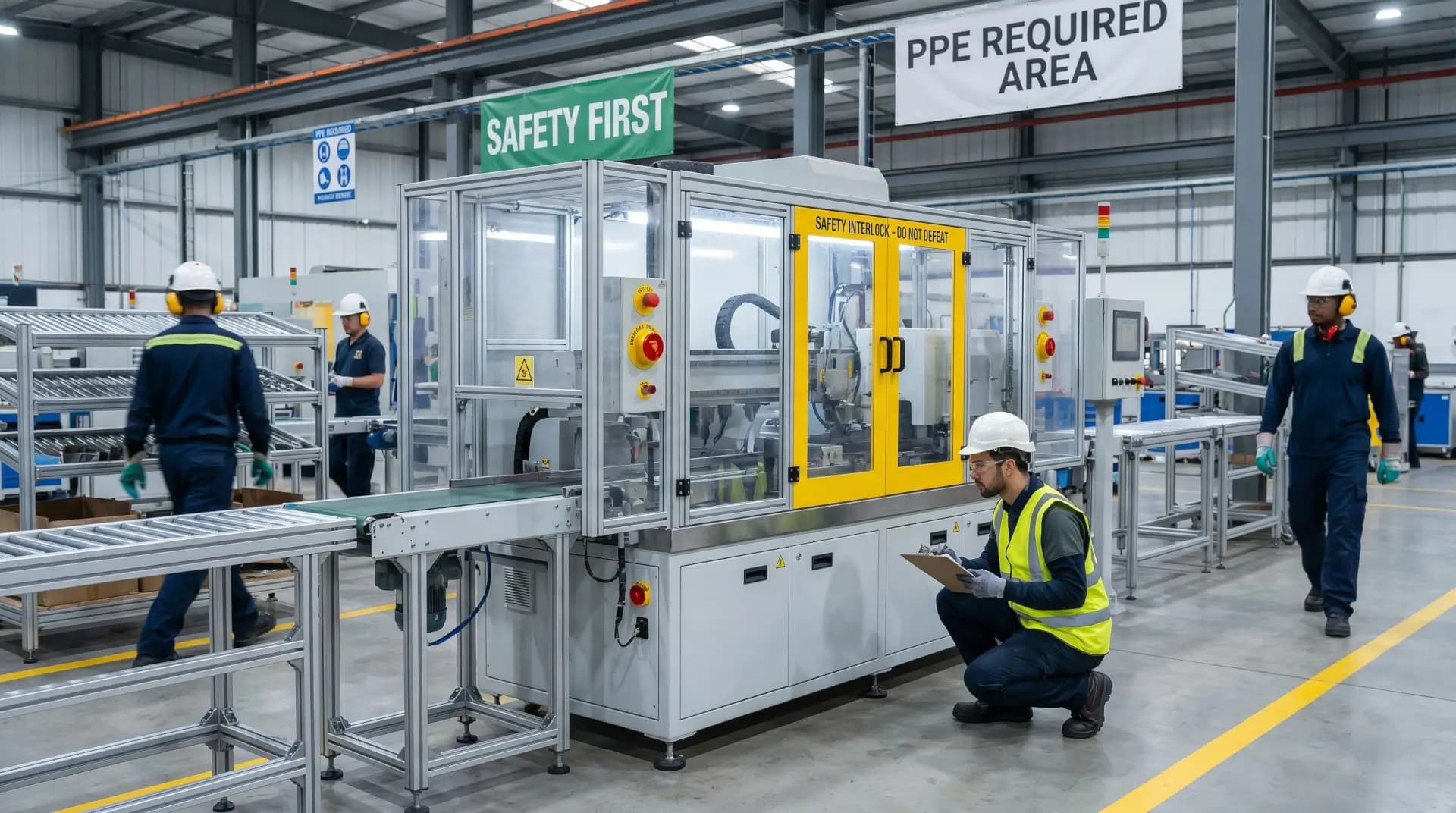
Interlocked guards are used where access is needed more often. Opening the guard should stop hazardous movement before a person can reach the danger zone. For higher-risk machines, guard locking may be needed so the guard remains locked until the hazard has stopped.
Presence-Sensing Devices
Light curtains, scanners, and pressure-sensitive mats can be effective, but only when correctly selected, positioned, tested, and integrated into the safety control system. They are not suitable where material can be ejected through the sensing field or where stopping time is too long for safe access.
Emergency Stops
Emergency stops are important, but they are not a substitute for guarding. They reduce harm after something has gone wrong; they do not prevent exposure in the first place.
Lockout and Isolation
Any machine risk assessment must address servicing, cleaning, unblocking, and maintenance. Isolation should cover all hazardous energy sources, including electrical, pneumatic, hydraulic, thermal, gravitational, spring, and stored pressure energy. The procedure should require verification, not assumption.
Step 5: Assess Residual Risk and Verify Controls
After selecting controls, reassess the residual risk. This is where the assessment becomes more than paperwork. Ask whether the new control actually reduces risk in real operation.
Verification should include:
Guard dimensions and openings
Safe distance from danger zones
Stop time and reach time
Interlock function
Emergency stop function
Isolation points and lockability
Stored energy release
Restart prevention
Control reliability
Access for cleaning and maintenance
Operator visibility and ergonomics
Actual use during production conditions
A common mistake is to install a guard that makes the task difficult, then assume the risk is controlled. If the guard blocks cleaning, slows necessary adjustment, or causes frequent stoppages, it may be bypassed. Safeguards must be practical enough to remain in use.
Residual risk should be communicated to users. This may include machine markings, operating instructions, training, maintenance requirements, inspection checks, and restrictions on who may perform certain tasks.
Step 6: Document the Machine Risk Assessment
A strong machine risk assessment should be clear, traceable, and specific. It should not contain vague actions such as “be careful,” “use PPE,” or “follow procedure” without explaining the actual control.
At minimum, document:
Machine name, location, asset number, and description
Assessment scope and boundaries
Assessment team and competence
Date of assessment and review date
Applicable legal or company requirements
Tasks and operating modes assessed
Hazards identified
Persons at risk
Existing controls
Risk estimation method
Additional controls required
Action owner and target date
Residual risk after controls
Verification evidence
Approval for use
Change history
A practical risk assessment form should allow enough detail to understand the decision. For complex machines, attach photographs, layout drawings, safety circuit information, stop-time measurements, guard inspection records, and validation results.
When to Review a Machine Risk Assessment
Machine risk assessment is not a one-time exercise. It should be reviewed when something changes or when evidence shows the existing assessment may no longer be valid.
Review the assessment when:
A new machine is installed
A machine is modified or relocated
Guards, interlocks, controls, or software are changed
Production material, speed, tooling, or process conditions change
A new task is introduced
A near miss, injury, fault, or unsafe condition occurs
Operators report difficulty using safeguards
Maintenance methods change
Legal, standard, or company requirements change
Periodic inspection identifies deterioration
I also recommend reviewing high-risk machines through planned inspections, especially where guards can be removed, interlocks can be defeated, or operators frequently interact with moving parts.
Competence, Legal Caution, and Practical Judgment
Machine risk assessment should be led or reviewed by competent people who understand machinery hazards, safeguarding principles, maintenance tasks, and applicable legal duties. For simple machines, this may be an experienced HSE professional working with operations and maintenance. For complex automated systems, robotics, safety-rated controls, or major modifications, specialist machine safety engineering support may be required.
This article provides general HSE guidance and does not replace jurisdiction-specific legal advice, manufacturer instructions, or competent engineering design. Always check the laws, standards, and approved codes that apply where the machine is designed, supplied, installed, and used.
The most reliable assessments are team-based. Operators understand real use. Maintenance technicians understand failure and intervention. Engineers understand design limits. HSE professionals challenge assumptions and ensure risk controls are suitable. When these voices are combined, the result is much stronger than a checklist completed by one person alone.
Conclusion
To conduct a machine risk assessment properly, start by defining the machine and its limits, then identify hazards across every mode of use, including cleaning, maintenance, fault clearing, and foreseeable misuse. Estimate the risk, apply controls in the correct order, verify that safeguards work, assess residual risk, and document the decision clearly.
In my experience, the strongest machine risk assessments are practical, specific, and task-based. They do not hide behind a risk score. They show exactly where harm can occur, how people are exposed, what controls are required, and how those controls will be checked. That is the difference between a paper exercise and a machine that can be operated, cleaned, maintained, and repaired with confidence.

Responses