
An ergonomics program is implemented by identifying work tasks that expose people to musculoskeletal risk, involving workers in the assessment, controlling the hazards through design and work-process changes, training the workforce, supporting early reporting, and reviewing whether the controls actually reduce strain. It should not be treated as a one-time office-chair exercise. A proper ergonomics program is a continuing part of the health and safety management system, focused on fitting the job to the person rather than forcing the person to adapt to poor work design. OSHA describes ergonomics as fitting a job to a person and identifies management support, worker involvement, training, problem identification, and control measures as key parts of an ergonomic process.
The purpose is simple: prevent work-related musculoskeletal disorders before they become injuries, absence, restricted work, compensation claims, or permanent capability problems. NIOSH describes ergonomics programs as practical systems for identifying and correcting ergonomic deficiencies across different workplace settings.
Start With a Clear Ergonomics Program Scope
I always begin an ergonomics program by defining where the risk is likely to exist, not by buying equipment. Poorly scoped programs waste time on visible but low-risk issues while high-exposure tasks continue unchanged.
A practical ergonomics program should cover:
Manual handling, lifting, lowering, carrying, pushing, and pulling
Repetitive upper-limb work
Awkward postures, overreaching, bending, kneeling, and twisting
Forceful gripping, vibration, and contact stress
Prolonged sitting, standing, or constrained postures
Work pace, recovery time, task rotation, and production pressure
Tool, workstation, machine, and layout design
Office, field, warehouse, manufacturing, healthcare, maintenance, logistics, and laboratory tasks
The first document I create is a short program scope statement. It should explain which departments, jobs, contractors, and task types are included. It should also define the aim of the program: to identify ergonomic risk factors, reduce exposure, improve work design, and support early reporting of discomfort.
A good scope statement prevents the program from becoming vague. “Improve ergonomics” is not enough. “Reduce high-risk manual handling and repetitive upper-limb exposure in packing, loading, maintenance, and office display screen work” is much stronger.
Build Management Ownership and Worker Involvement
An ergonomics program fails when it is owned only by the HSE department. It succeeds when operations, maintenance, procurement, supervision, occupational health, human resources, and workers share responsibility.
Management must provide three things:
Authority to change workstations, tools, layout, staffing, or work methods
Resources for engineering improvements, lifting aids, adjustable equipment, and training
Accountability through measurable objectives and follow-up reviews
Worker involvement is equally important. Operators understand the task better than anyone reviewing it from a checklist. They know where the awkward reach happens, which handle causes wrist strain, which lift becomes difficult near the end of the shift, and which “light” task becomes a problem because it is repeated hundreds of times.
HSE UK specifically advises consulting and involving the workforce during manual handling risk assessment because workers and their representatives often know the risks and practical solutions.
A practical ergonomics team may include:
Role | Ergonomics Program Responsibility |
|---|---|
Senior manager | Approves objectives, resources, and accountability |
HSE professional | Leads risk assessment method and program governance |
Line supervisor | Ensures controls are applied during daily work |
Worker representative | Provides task knowledge and feedback |
Maintenance/engineering | Designs or modifies equipment and layouts |
Procurement | Prevents purchase of unsuitable tools or furniture |
Occupational health | Supports symptom reporting, restrictions, and recovery |
The key is not to create a committee that only meets. The key is to create a decision-making structure that removes ergonomic hazards.
Identify Ergonomic Risk Factors Before Injuries Occur
The most common mistake is waiting for injury records to reveal ergonomic problems. Injury data is useful, but it is late evidence. A mature ergonomics program uses proactive risk identification.
I normally use four sources of information:
1. Task observation
Observe the work as it is actually performed, not as the procedure says it should be performed. Look for:
Repeated bending, twisting, reaching, squatting, or overhead work
High force during lifting, pulling, pushing, gripping, or pressing
Repetitive movements with limited variation
Static posture or long periods without recovery
Poor workstation height or tool positioning
Loads handled far from the body
Work performed in cramped or poorly lit areas
Workers shaking hands, stretching backs, changing grip, or avoiding certain tasks
2. Worker feedback
Use short discomfort surveys, interviews, toolbox discussions, and near-miss style reporting. Early discomfort is valuable information. A worker reporting shoulder fatigue today may help prevent a recordable injury later.
3. Existing records
Review injury logs, first-aid cases, restricted duty cases, absenteeism patterns, maintenance requests, quality defects, overtime peaks, and complaints about tools or workstations.
4. Formal ergonomic assessment tools
Use structured tools when risk is not obvious or when decisions need stronger evidence. HSE UK lists assessment tools such as the MAC tool for lifting, carrying and team handling, RAPP for pushing and pulling, and ART for repetitive upper-limb tasks.
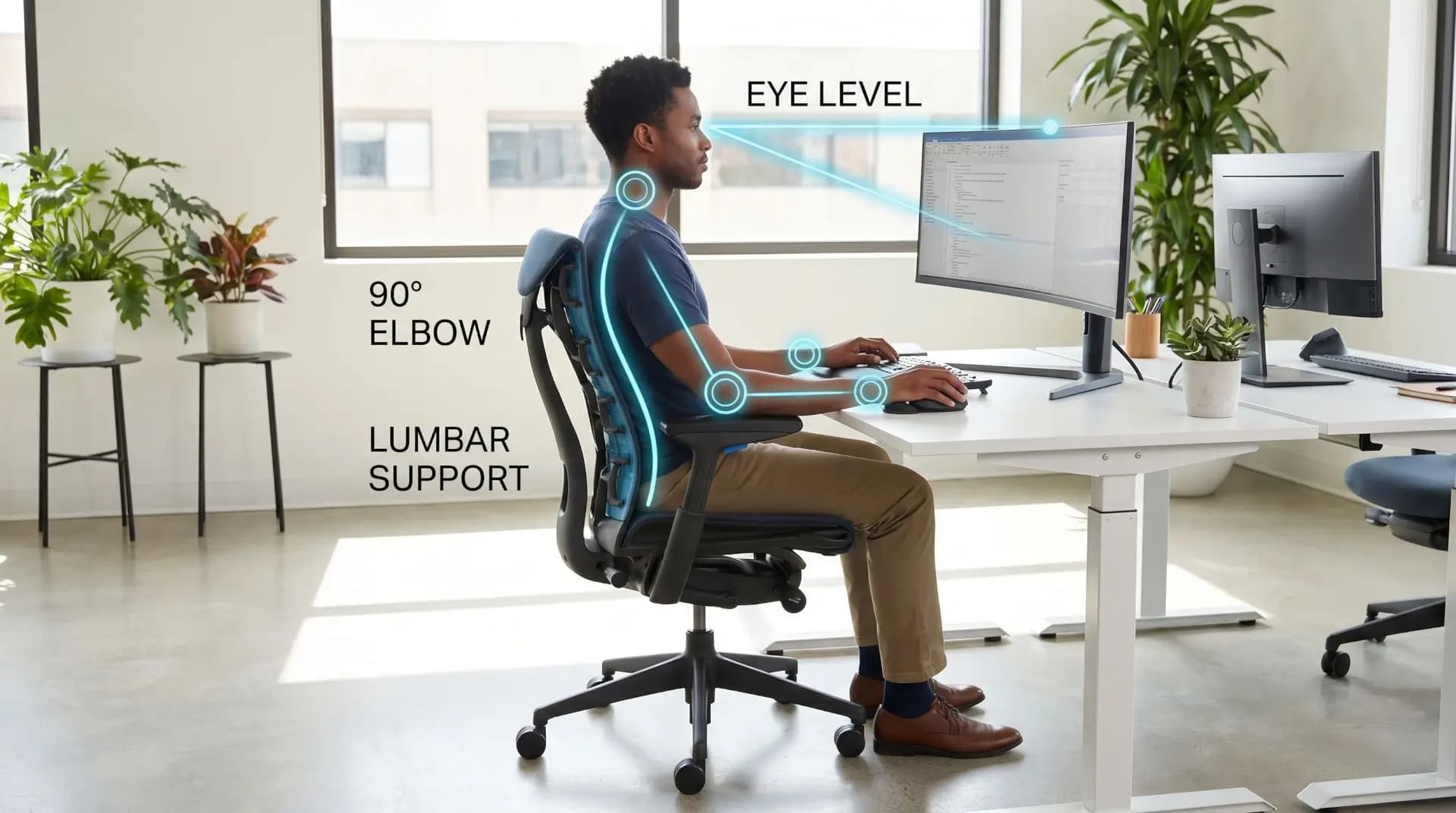
For lifting tasks, the NIOSH lifting equation may be useful where it is applicable. For office and display screen work, use a workstation assessment that covers chair setup, screen height, keyboard and mouse position, lighting, reach distance, posture, and work breaks.
The important point is this: do not assess only the weight of the load. HSE UK notes that manual handling assessment should consider the task, load, working environment, and individual capability, including posture, distance, frequency, load nature, floor condition, lighting, temperature, and worker factors.
Prioritize Ergonomic Risks With a Practical Rating Method
Not every ergonomic issue has the same urgency. A chair adjustment and a repeated heavy lift from floor level should not compete equally for resources.
I recommend rating ergonomic tasks against five practical factors:
Risk Factor | What to Check |
|---|---|
Force | How much effort is needed to lift, push, pull, grip, or operate? |
Posture | Is the body bent, twisted, stretched, or constrained? |
Repetition | How often is the same movement repeated? |
Duration | How long does exposure continue without recovery? |
Environment | Are space, lighting, temperature, flooring, vibration, or layout increasing strain? |
Then classify the task:
High risk: Immediate action required; exposure is significant or already causing symptoms.
Medium risk: Controls required with a defined action plan.
Low risk: Monitor, maintain good practice, and reassess if conditions change.
A reliable prioritization method should also consider vulnerable conditions such as new workers, temporary workers, pregnant workers, workers returning after injury, older workers, workers with previous musculoskeletal issues, and tasks affected by overtime or production peaks.
This does not mean lowering standards for one person only. It means designing work so a wider range of people can perform it safely.
Control Ergonomic Hazards at the Source
Training people to “lift properly” is not a complete ergonomics program. Training matters, but it is weak when the job design is poor. The priority should be to remove or reduce the physical demand of the task.
Use this control sequence:
1. Eliminate the hazardous task
Ask whether the lift, carry, reach, or repetitive action is needed at all. Can the material be delivered closer to the point of use? Can a process step be removed? Can packaging be changed?
2. Use engineering controls
Engineering controls are usually the strongest ergonomic improvements because they change the task itself. Examples include:
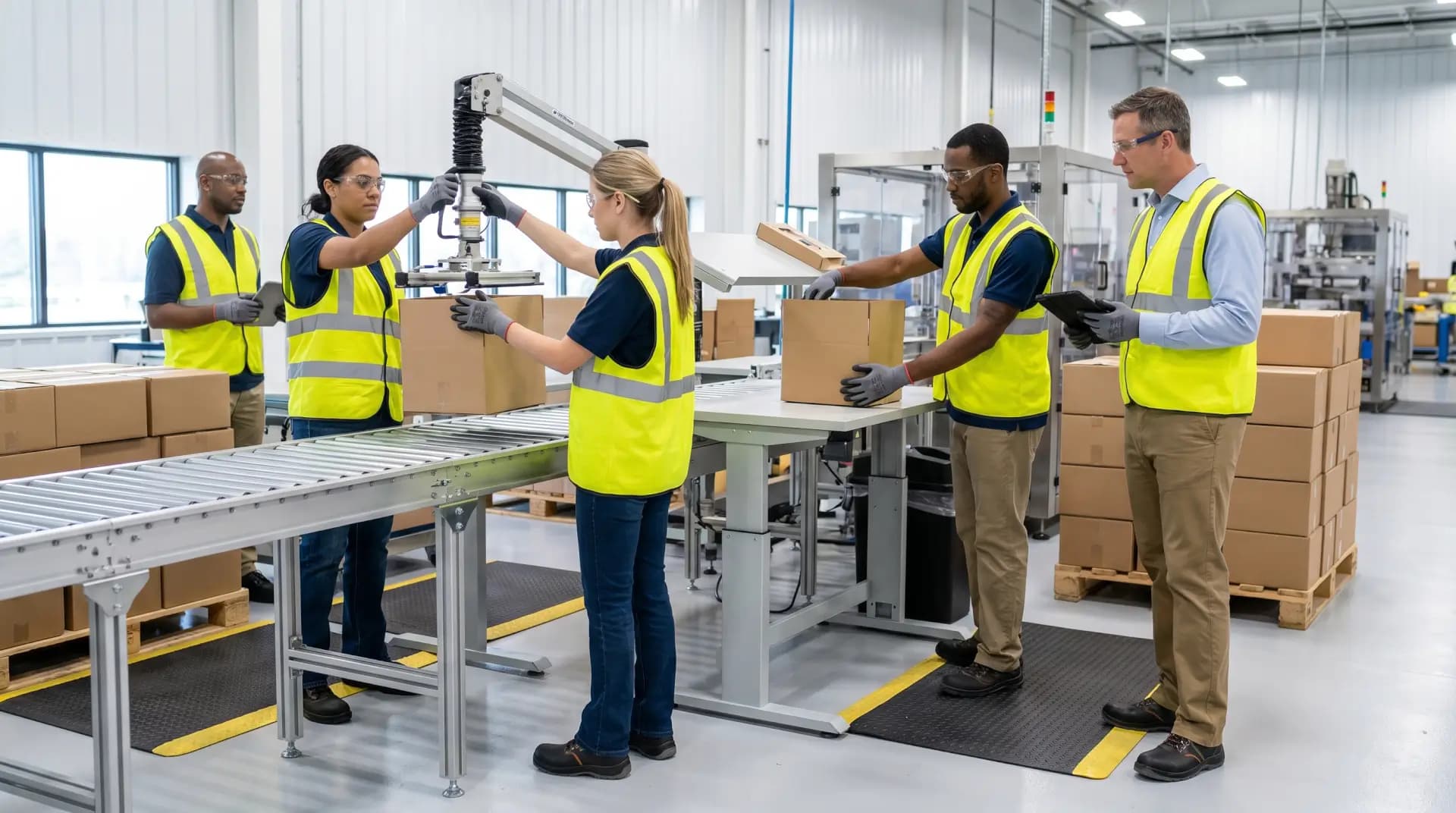
Lift tables, hoists, vacuum lifters, conveyors, pallet positioners, and trolleys
Adjustable workstations and height-adjustable benches
Tool balancers and low-vibration tools
Redesigned handles, grips, and fixtures
Improved layout to reduce carrying distance and twisting
Mechanical assists for pushing, pulling, or positioning loads
Better lighting, flooring, access, and clearance
HSE UK advises providing mechanical help where possible for hazardous manual handling that cannot be avoided, and then changing the task, load, or working environment where mechanical help is not reasonably practicable.
3. Apply administrative controls
Administrative controls reduce exposure but do not remove the hazard. They include:
Job rotation designed around different muscle groups
Work-rest scheduling
Limits on task duration or repetition
Staffing changes for peak loads
Planned micro-breaks for repetitive work
Maintenance schedules for tools, wheels, handles, and assistive devices
Clear reporting routes for early discomfort
Job rotation must be designed carefully. Rotating a worker from one shoulder-intensive task to another shoulder-intensive task is not a control. It only spreads fatigue across the shift.
4. Use training and behavior controls
Training should explain:
What musculoskeletal disorders are
Which risk factors exist in the job
How to recognize early symptoms
How to report discomfort without fear
How to adjust equipment correctly
How to use lifting aids, tools, and workstations
What the approved work method is
Why shortcuts increase risk
Training should be task-specific. A generic slideshow on ergonomics rarely changes exposure on the shop floor.
Create an Early Reporting and Health Support Process
An ergonomics program must encourage early reporting. Workers often delay reporting discomfort because they fear blame, job restriction, or being seen as weak. That delay turns manageable discomfort into a more serious condition.
The reporting process should be simple:
Worker notices discomfort, fatigue, numbness, tingling, weakness, or pain.
Worker reports it to the supervisor or HSE/occupational health contact.
The task is reviewed promptly.
Temporary controls are applied if needed.
Occupational health or medical referral is arranged where appropriate.
Root causes are corrected through ergonomic controls.
The worker is followed up after changes are made.
This is a YMYL-sensitive area. An HSE professional should not diagnose medical conditions. Symptoms such as persistent pain, numbness, tingling, loss of strength, swelling, radiating pain, or reduced function should be referred to a qualified healthcare or occupational health professional. The ergonomics program should support medical confidentiality, suitable work restrictions, and safe return-to-work planning.
Regulatory duties also vary by jurisdiction. In the United States, OSHA states that employers may still have obligations under the General Duty Clause for recognized serious ergonomic hazards even where no industry-specific ergonomics guideline exists. In Great Britain, HSE guidance explains that employers must avoid hazardous manual handling where reasonably practicable, assess unavoidable hazardous manual handling, and reduce injury risk as far as reasonably practicable under the manual handling framework.
Measure Whether the Ergonomics Program Is Working
An ergonomics program must be measured by exposure reduction, not by paperwork completion. A completed checklist does not protect anyone if the task remains unchanged.
Use both leading and lagging indicators.
Indicator Type | Examples |
|---|---|
Leading indicators | Number of high-risk tasks assessed, corrective actions closed, worker reports reviewed, workstation improvements completed, lifting aids installed, employees trained |
Lagging indicators | MSD cases, restricted work cases, lost time cases, repeat discomfort reports, compensation claims, absence linked to musculoskeletal issues |
I also recommend reviewing before-and-after evidence for each major improvement:
Was force reduced?
Was reach distance shortened?
Was twisting removed?
Was the load lowered or lifted mechanically?
Was repetition reduced?
Did workers confirm the task feels better?
Did symptoms reduce after implementation?
Are controls still being used after several weeks?
The last question matters. I have seen lifting aids installed and ignored because they were slow, poorly located, badly maintained, or unsuitable for the actual task. A control that workers avoid is usually a design failure, not a worker attitude problem.
Keep the Program Alive Through Change Management
Ergonomic risk changes whenever work changes. New equipment, new packaging, new production targets, new products, new software, new furniture, new tools, new staffing levels, and new shift patterns can all create new exposure.
Build ergonomics into:
Procurement specifications
Management of change reviews
Workplace design and layout reviews
New process approvals
Contractor work planning
Incident investigations
Return-to-work planning
Preventive maintenance
Safety inspections
Supervisor training
Worker consultation meetings
The best ergonomics programs prevent poor design from entering the workplace. Procurement should not buy chairs, tools, machinery, workbenches, carts, or packaging based only on price. HSE and end users should be involved before purchase.
Practical Implementation Checklist
Use this checklist to move from intention to action:
Define the ergonomics program scope.
Assign ownership to management, HSE, supervisors, workers, engineering, and occupational health.
Identify high-risk jobs and departments.
Collect worker feedback and discomfort reports.
Observe tasks under normal working conditions.
Use suitable ergonomic assessment tools.
Prioritize tasks by force, posture, repetition, duration, and environment.
Select controls using elimination and engineering controls first.
Train workers and supervisors on task-specific risks and controls.
Encourage early reporting of symptoms.
Track corrective actions to closure.
Verify that controls reduce exposure.
Review the program after process, equipment, or workload changes.
Report performance to management regularly.
Keep improving the design of work.
Conclusion
An ergonomics program is not a furniture upgrade, a training session, or a checklist campaign. It is a structured method for designing work so people are not repeatedly exposed to unnecessary force, awkward posture, repetition, vibration, contact stress, or prolonged static positions.
The strongest programs are practical. They involve workers, identify real task demands, prioritize the highest-risk exposures, control hazards through design, support early reporting, and measure whether strain has actually been reduced. When ergonomics is integrated into daily operations, procurement, supervision, engineering, and occupational health, it becomes part of how work is planned rather than a reaction after injuries occur.
For me, the simplest test is this: after the program is implemented, can workers complete the task with less force, better posture, fewer repetitions, shorter exposure, and more control over their work pace? If the answer is yes, the ergonomics program is doing its job.



Responses