

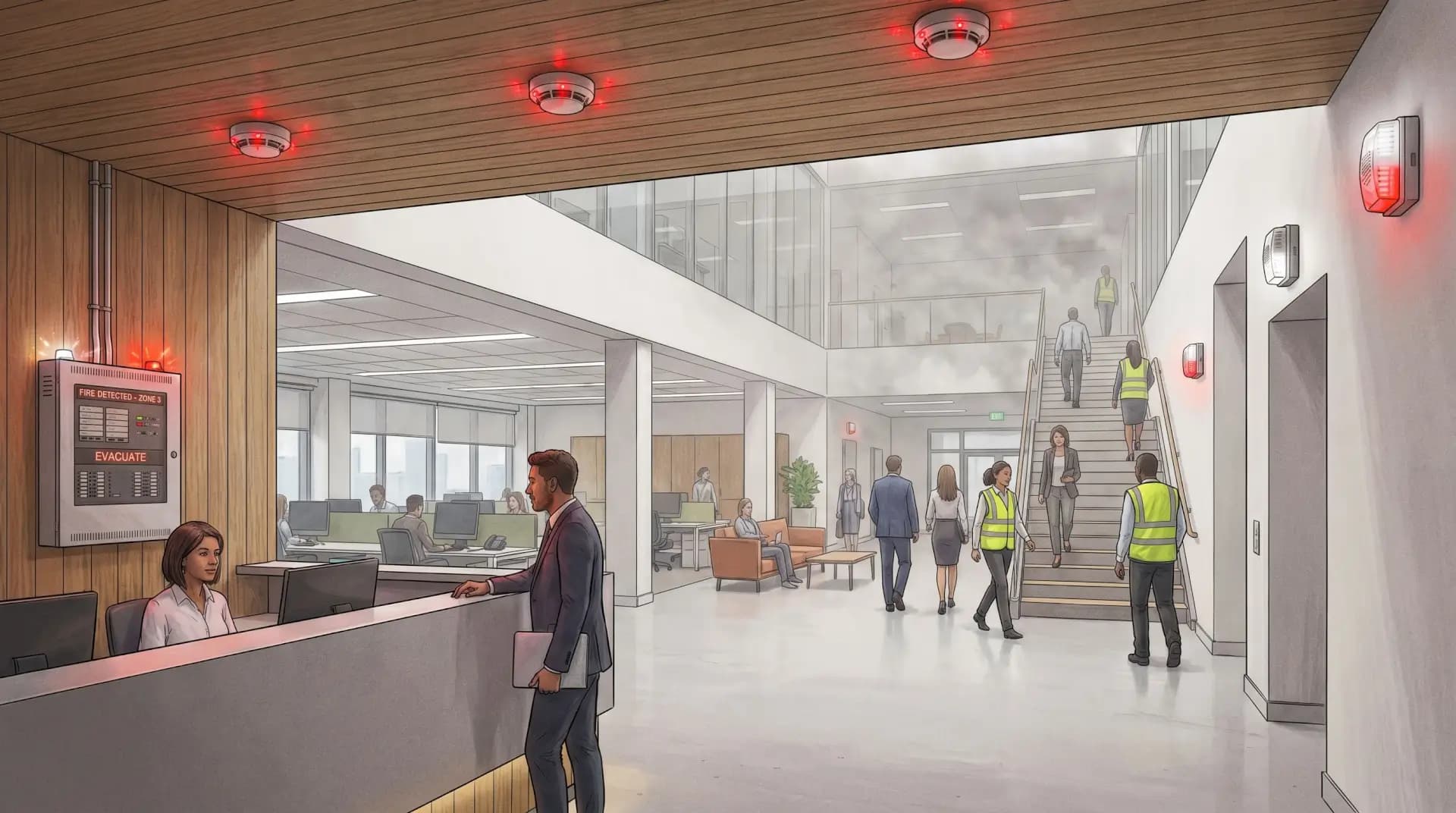
Fire alarm systems work by continuously monitoring an environment for signs of fire—primarily smoke, heat, or flame—and triggering an immediate warning when those indicators exceed safe thresholds. The system detects the hazard, processes the signal through a control panel, and activates audible and visual alarms to alert occupants. In many cases, it also initiates automatic safety responses such as shutting down ventilation systems or notifying emergency services. Their importance lies in early detection, which directly reduces response time, limits fire growth, and protects lives and assets.
The Core Components of a Fire Alarm System
Every fire alarm system, regardless of complexity, operates through a set of integrated components. Understanding these helps clarify how detection turns into action.
1. Detection Devices
These are the system’s “sensors,” responsible for identifying fire indicators:
Smoke detectors: Sense airborne particles from combustion
Heat detectors: Activate when temperature rises beyond a preset limit
Flame detectors: Identify infrared or ultraviolet radiation from flames
Each type is selected based on the risk profile of the area. For example, heat detectors are often used in dusty environments where smoke detectors may produce false alarms.
2. Fire Alarm Control Panel (FACP)
This is the system’s brain. It receives signals from detectors and decides what action to take. It:
Processes inputs from multiple zones
Differentiates between alarm, fault, and supervisory signals
Activates outputs like alarms and suppression systems
3. Notification Appliances
Once a fire is detected, alerts must be clear and immediate:
Sirens or horns for audible warning
Flashing strobes for visual alerts
Voice evacuation systems in larger or complex buildings
4. Power Supply
Fire alarm systems require reliability even during outages:
Primary power from the building supply
Backup batteries to maintain operation during failures
How Fire Alarm Systems Detect Fire
Fire detection is not random—it is based on predictable fire behavior. Most fires follow a progression: incipient stage (invisible particles), smoldering stage (visible smoke), and flaming stage (heat and flames).
Detection Mechanisms Explained
Ionization smoke detectors respond quickly to fast-flaming fires
Photoelectric detectors are more sensitive to smoldering fires
Rate-of-rise heat detectors activate when temperature increases rapidly
In practice, system designers often combine these technologies to improve detection accuracy and reduce blind spots.
What Happens When an Alarm Is Triggered
Once a detector senses a fire condition, a sequence of actions begins almost instantly:
Signal Transmission
The detector sends a signal to the control panel.Signal Processing
The panel verifies the input and determines if it meets alarm conditions.Alarm Activation
Audible and visual devices are triggered throughout the building.System Integration Actions
Depending on the setup:Fire doors may close automatically
Elevators may return to a safe floor
HVAC systems may shut down to prevent smoke spread
Emergency Notification
In monitored systems, signals are sent to a remote monitoring station or emergency services.
This entire process typically occurs within seconds, which is critical in fire scenarios where conditions can deteriorate rapidly.
Types of Fire Alarm Systems
Different environments require different system designs. The three main categories are:
Conventional Systems
Divide a building into zones
Identify the general area of a fire, not the exact device
Suitable for smaller facilities
Addressable Systems
Each device has a unique identifier
Pinpoints the exact location of a fire
Preferred for large or complex buildings
Hybrid Systems
Combine features of both conventional and addressable systems
Used where upgrading older systems is necessary without full replacement
From an HSE perspective, addressable systems offer superior situational awareness, which improves emergency response efficiency.
Why Fire Alarm Systems Matter in HSE
Fire alarm systems are not just regulatory requirements—they are critical risk control measures. Their value becomes clear when considering fire dynamics and human response behavior.
1. Early Warning Saves Lives
Occupants need time to recognize danger and evacuate safely. Without early detection, smoke inhalation becomes the primary cause of fatalities long before flames spread.
2. Property and Asset Protection
Early alarms allow firefighting measures to begin sooner, reducing damage and operational downtime.
3. Regulatory Compliance
Most jurisdictions mandate fire alarm systems under building and occupational safety regulations. Non-compliance can result in penalties, shutdowns, or liability exposure.
4. Business Continuity
A functioning fire alarm system can mean the difference between a controlled incident and a catastrophic loss.
Common Failures and Misconceptions
In my professional observation, fire alarm systems often fail not because of design flaws, but due to poor management practices.
Frequent Issues
Disabled detectors due to nuisance alarms
Lack of regular testing and maintenance
Obstructed or improperly installed devices
Misconceptions
“If there’s no fire, the system doesn’t matter.”
In reality, system readiness is only proven during an emergency.“All detectors work the same.”
Incorrect—choosing the wrong type can delay detection significantly.
Effective HSE management treats fire alarm systems as active safety controls, not passive installations.
Maintenance and Testing: A Non-Negotiable Requirement
Fire alarm systems must be regularly inspected and tested to remain reliable. Best practices typically include:
Weekly or monthly visual checks
Quarterly functional testing
Annual full system inspection
Battery health, detector sensitivity, and panel functionality must all be verified. Neglecting maintenance can render even the most advanced system ineffective.
Conclusion
Fire alarm systems function as an integrated network designed to detect, process, and respond to fire hazards within seconds. Their importance extends far beyond compliance—they are fundamental to life safety, asset protection, and operational resilience. From my experience in HSE practice, the effectiveness of these systems depends not only on their design but on consistent maintenance, correct application, and organizational awareness. When properly implemented and managed, a fire alarm system becomes one of the most reliable safeguards in any environment.


Responses