

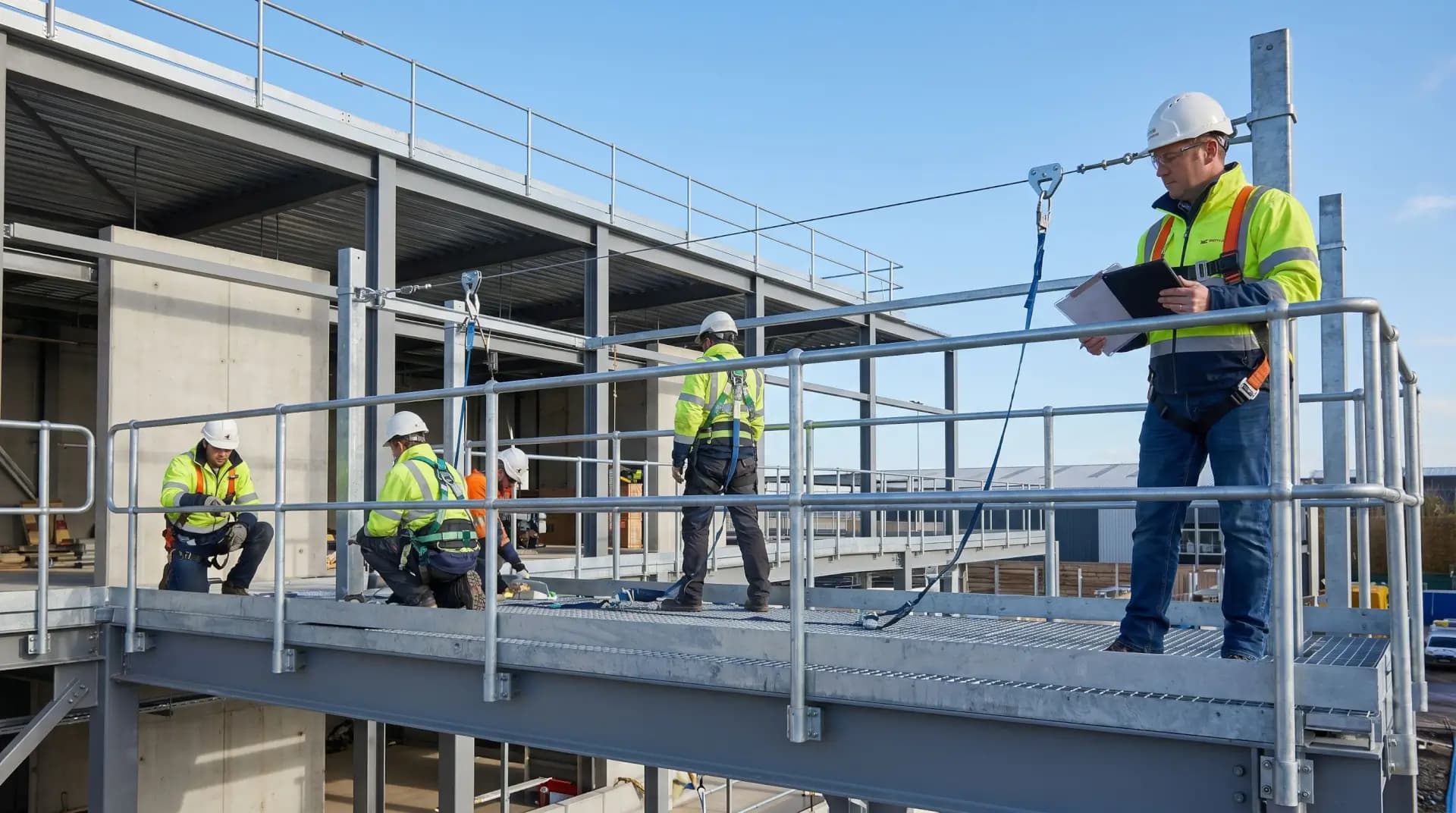
Fall protection systems are the controls used to stop workers from falling, prevent them from reaching a fall edge, or reduce injury if a fall occurs. In practical HSE terms, the best fall protection system is not always a harness. The best system is the one that controls the fall hazard at the highest possible level: eliminate the work at height where possible, prevent the fall with collective protection, and only then rely on personal fall arrest equipment.
A complete fall protection program must cover hazard assessment, system selection, equipment inspection, worker training, rescue planning, and supervision. Missing any one of these elements can turn good equipment into false confidence.
What Is a Fall Protection System?
A fall protection system is any planned arrangement of equipment, procedures, and controls used to protect people working at height. It applies to roofs, scaffolds, ladders, platforms, mezzanines, leading edges, loading bays, fragile surfaces, towers, tanks, and any work area where a person could fall from one level to another.
In my HSE practice, I separate fall protection into three simple categories:
Category | Purpose | Examples |
|---|---|---|
Fall prevention | Stops the fall from happening | Guardrails, covers, scaffolds, mobile elevated work platforms |
Fall restraint | Stops the worker from reaching the edge | Restraint lanyard, fixed anchor, travel restraint line |
Fall arrest | Stops the worker after a fall has started | Full-body harness, shock-absorbing lanyard, self-retracting lifeline, safety net |
The key judgment is this: prevention is stronger than arrest. Fall arrest may save life, but it still allows a fall event, body loading, swing risk, suspension trauma, and rescue dependency.
Fall Protection Hierarchy of Controls
The fall protection hierarchy should guide every decision before equipment is issued.
1. Avoid Work at Height
The safest fall is the one that never becomes possible. Before approving work at height, ask:
Can the task be done from ground level?
Can components be pre-assembled before lifting?
Can inspection be done using cameras, drones, or fixed access?
Can valves, gauges, or controls be relocated?
This step is often skipped because teams jump directly to harnesses. That is poor planning.
2. Prevent the Fall
If work at height cannot be avoided, use systems that physically prevent a fall. These are usually collective controls because they protect everyone in the area.
Common examples include:
Guardrail systems
Proper working platforms
Scaffold platforms with toe boards and access
Fixed barriers around openings
Secure covers over holes
Mobile elevated work platforms used correctly
Collective protection is usually preferred because it does not rely heavily on individual worker behavior.
3. Restrain the Worker
Fall restraint systems allow movement but prevent access to the fall edge. A restraint system must be designed so the worker cannot physically reach the hazard.
This requires correct anchor location, lanyard length, edge distance, and supervision. A restraint lanyard that is too long becomes a fall arrest system by mistake.
4. Arrest the Fall
Fall arrest systems are used when prevention or restraint is not reasonably achievable. These systems must limit fall distance, reduce arresting force, and leave enough clearance below the worker.
A personal fall arrest system normally includes:
Full-body harness
Suitable anchorage point
Connector
Shock-absorbing lanyard or self-retracting lifeline
Rescue plan
A harness without a rescue plan is not a complete fall protection system.
Main Types of Fall Protection Systems
Guardrail Systems
Guardrails are among the most reliable fall prevention controls. They provide continuous edge protection and do not require every worker to connect and disconnect equipment.
A proper guardrail system normally includes a top rail, mid rail, and toe board where falling objects are a concern. It must be strong, continuous, correctly installed, and maintained.
Safety Net Systems
Safety nets are fall arrest systems used below a work area to catch a falling worker. They are useful where personal fall arrest is difficult, such as some structural steel or bridge work.
Safety nets must be installed close enough to the working surface, tested or certified, inspected regularly, and kept clear of debris.
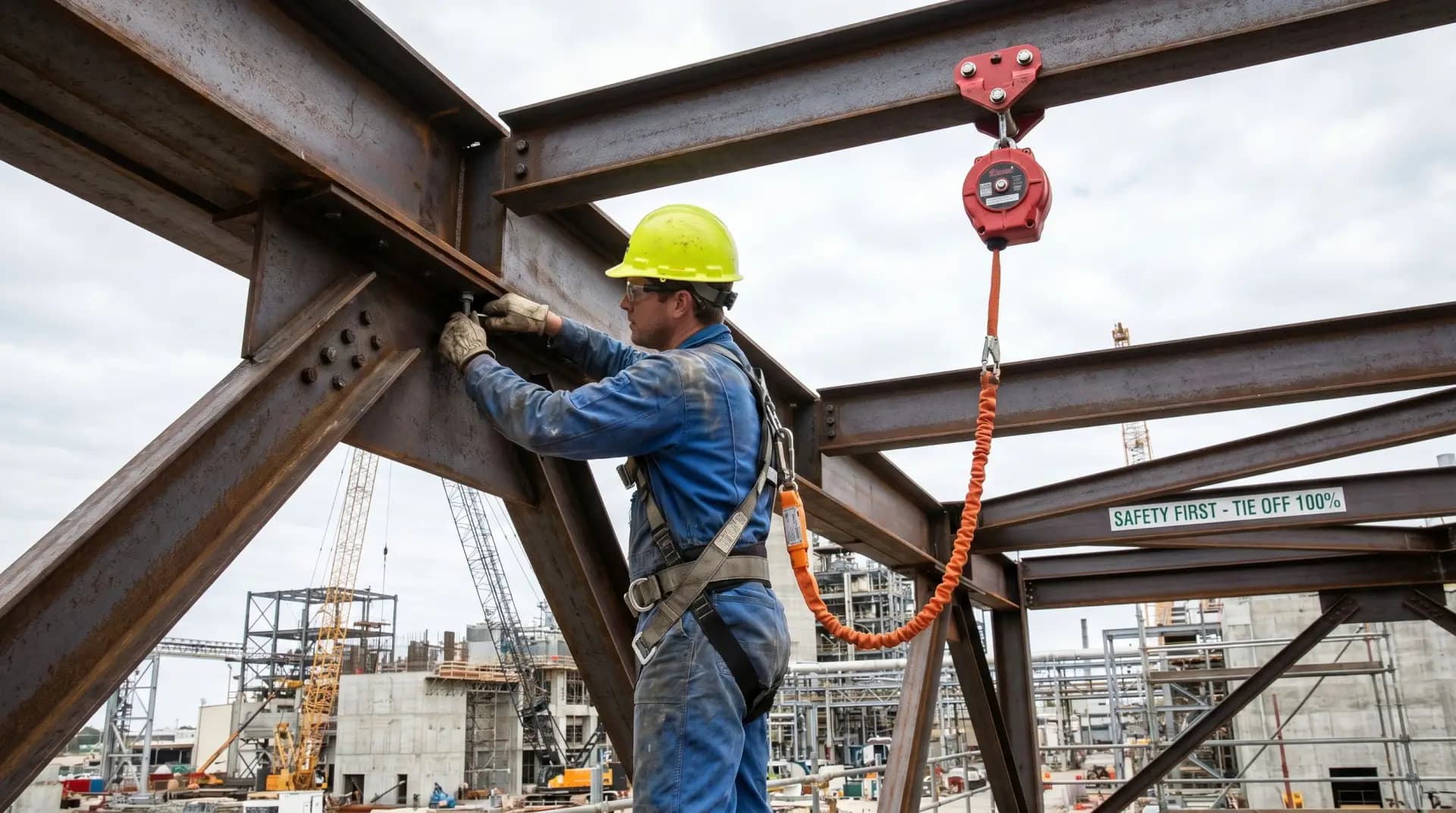
Personal Fall Arrest Systems
Personal fall arrest systems are widely used but often misunderstood. Their purpose is not to stop workers from falling; their purpose is to stop them from hitting a lower level after they fall.
Critical checks include:
Anchor strength and suitability
Harness size and fit
Lanyard type and length
Free-fall distance
Total fall clearance
Swing fall risk
Compatibility of connectors
Rescue arrangements
A common mistake is attaching to a convenient point instead of a verified anchor. Convenience is not engineering.
Fall Restraint Systems
Fall restraint is safer than fall arrest when properly designed. It keeps the worker away from the edge.
However, it must be calculated carefully. The lanyard, anchor, and working radius should make it impossible to reach the fall hazard.
Positioning Systems
Positioning systems support a worker in place, often allowing both hands to remain free. They are common in tower, pole, and structural work.
Positioning systems should not be treated as a substitute for fall arrest unless the arrangement is specifically designed and approved for that purpose.
Warning Line and Controlled Access Systems
Warning lines and controlled access zones are administrative or limited physical controls used in specific work situations. They require strict planning, competent supervision, and clear boundaries.
They should never become a casual substitute for proper edge protection.
How to Select the Right Fall Protection System
Choosing the right system starts with the task, not the equipment store.
Use this practical sequence:
Identify all fall hazards.
Confirm the height, surface condition, and edge exposure.
Check for fragile surfaces, openings, slopes, weather, and access routes.
Decide whether work at height can be avoided.
Select collective fall prevention where possible.
Use restraint before arrest where practical.
Use personal fall arrest only with verified anchorage and rescue planning.
Train workers before exposure.
Inspect equipment before use.
Supervise the work and stop unsafe changes.
The wrong system is often selected when teams ask, “Which harness should we use?” before asking, “Why are we working at height this way?”
Inspection, Maintenance, and Training Requirements
Fall protection equipment must be inspected before use and at suitable planned intervals by competent persons. Damaged, expired, altered, or impact-loaded equipment must be removed from service.
Check harnesses for:
Cuts, burns, chemical damage, or fraying
Damaged stitching
Distorted D-rings
Defective buckles
Missing labels
Evidence of fall loading
Check lanyards and lifelines for:
Shock absorber deployment
Abrasion or cuts
Damaged hooks
Weak or loose stitching
Corrosion
Contamination
Training must cover more than wearing a harness. Workers should understand fall hazards, system limits, inspection steps, anchor use, clearance, rescue response, and stop-work authority.
Rescue Planning for Fall Protection
Rescue planning is where many fall protection programs are weakest. After a fall, a suspended worker may not be able to self-rescue. Waiting for an unplanned response can create serious medical risk.
A rescue plan should define:
Who performs the rescue
What equipment will be used
How fast rescue can begin
How communication will work
How the area will be controlled
How emergency medical support will be contacted
How rescuers will be protected from falling
The rescue method must match the site. A plan that works on a scaffold may not work on a roof, tank, tower, or suspended platform.
Common Fall Protection Mistakes
The most common failures I see are not always equipment failures. They are planning failures.
Typical mistakes include:
Treating a harness as the first control
Using unverified anchor points
Ignoring fall clearance
Allowing swing fall exposure
Using restraint equipment as fall arrest equipment
Poor scaffold access
Missing covers on floor openings
No rescue plan
Inadequate supervision
Continuing work during unsafe weather
Failing to remove damaged equipment from service
Fall protection must be managed as a system. Equipment alone does not control the risk.
Conclusion
A complete fall protection system is built on planning, hierarchy of controls, competent equipment selection, inspection, training, supervision, and rescue readiness. The safest approach is always to avoid work at height where possible, then prevent falls with collective controls, then use restraint, and only rely on fall arrest when stronger controls are not practical.
In HSE practice, I treat fall protection as a life-critical control. That means no assumptions about anchors, no casual harness use, no work at height without rescue planning, and no acceptance of shortcuts near an edge. Falls are predictable, and because they are predictable, they must be controlled before the work starts.

Responses