

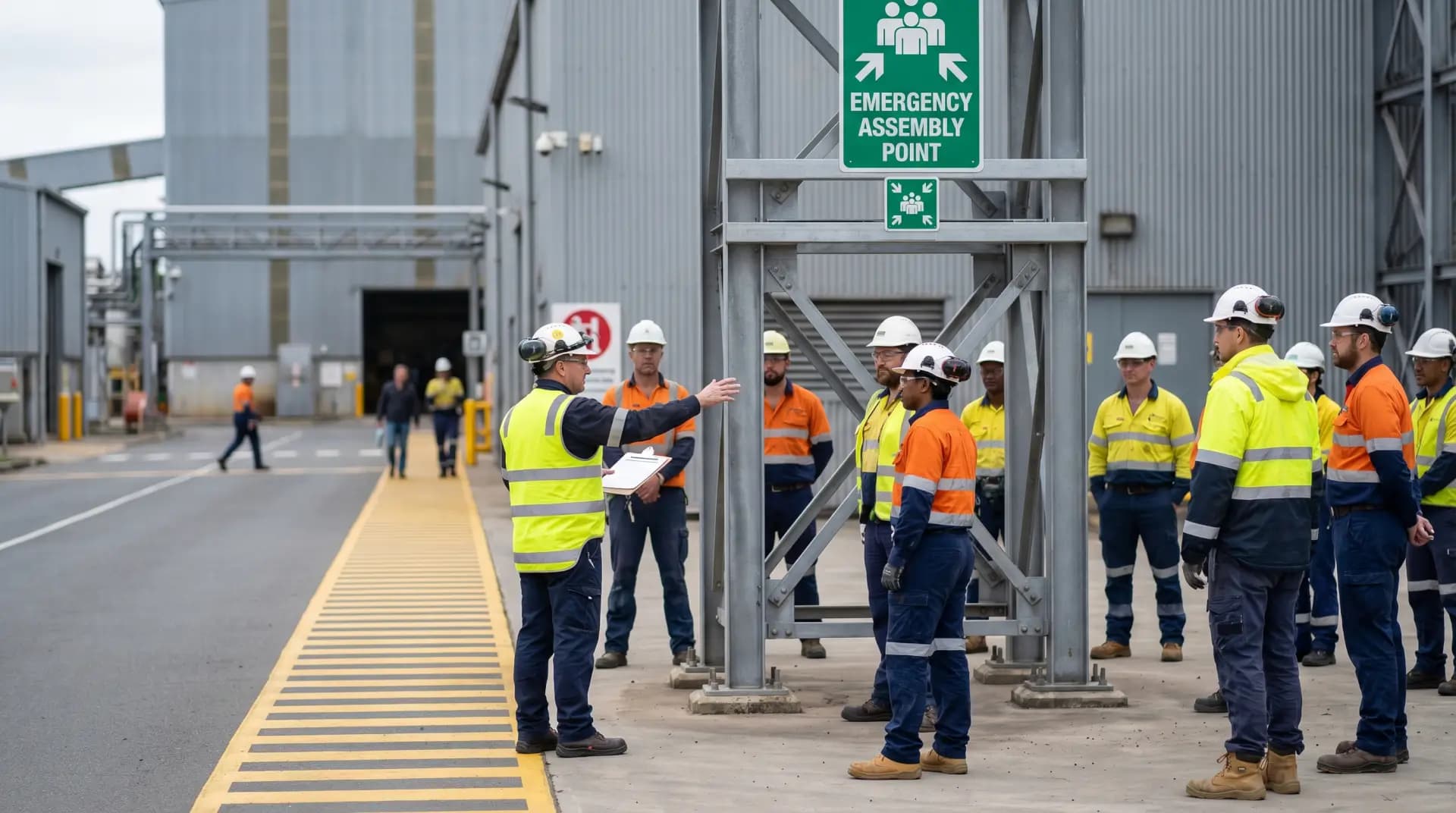
An emergency assembly point is a pre-selected safe location where people gather after evacuation so the organization can account for everyone, keep evacuees away from danger, and give clear instructions before re-entry or relocation. A good assembly point is not simply an open space with a sign. It must be far enough from foreseeable hazards, large enough for the expected population, accessible to all occupants, clear of emergency response routes, and supported by a practical headcount and communication system.
In my HSE practice, I treat assembly points as part of the emergency control system, not as a symbol on an evacuation map. If the location is unsafe, poorly marked, too small, exposed to traffic, or unmanaged during a real alarm, the evacuation can shift people from one risk area to another.
What Is an Emergency Assembly Point?
An emergency assembly point, also called a muster point or safe meeting point, is a designated location where employees, contractors, visitors, and other occupants report after leaving a building, work area, plant, warehouse, construction zone, or facility during an emergency.
Its main purposes are to:
Move people away from the immediate danger area
Support fast and reliable accountability
Prevent people from returning to the hazard zone
Give emergency coordinators a known place to communicate instructions
Help identify missing persons without sending untrained people back inside
Keep evacuees clear of emergency vehicles and response operations
Emergency assembly points are commonly included in emergency action plans, fire evacuation plans, and emergency preparedness procedures. In the United States, OSHA 29 CFR 1910.38 requires emergency action plans to include evacuation procedures and procedures to account for employees after evacuation. In Great Britain, workplace fire safety arrangements must include suitable evacuation planning and a safe meeting point. ISO 45001 also expects organizations to establish, implement, and maintain emergency preparedness and response processes under Clause 8.2.
The regulation may differ by country, but the practical principle is the same: people must know where to go, supervisors must know how to account for them, and emergency leaders must know when the area is no longer safe.
How to Select an Emergency Assembly Point
The best assembly point is selected through risk assessment, not convenience. A car park may be suitable for one facility and completely unsuitable for another if it exposes people to vehicle movement, smoke travel, chemical release, overhead power lines, or emergency vehicle access routes.
When selecting an emergency assembly point, assess the following factors.
Selection Factor | What to Check | Practical HSE Judgment |
|---|---|---|
Distance from hazards | Fire, explosion, smoke, toxic release, falling debris, pressure systems, stored energy | Avoid fixed “one-size” distances; base distance on site hazards and emergency scenarios |
Capacity | Number of employees, contractors, visitors, shift overlap, peak occupancy | The point must hold people without crowding into roads, gates, or response areas |
Accessibility | Mobility needs, wheelchair access, uneven ground, stairs, lighting | Everyone should be able to reach the point safely or have an assisted evacuation arrangement |
Emergency vehicle access | Fire tenders, ambulances, rescue teams, hydrants, gates, turning areas | Evacuees must not block responders |
Visibility and signage | Clear route markings, assembly point sign, map reference | People should find it quickly under stress, smoke, darkness, or poor weather |
Environmental exposure | Heat, cold, rain, flood risk, wind direction, lightning, dust | Long waits may require shaded, covered, or secondary relocation areas |
Security and crowd control | Public access, hostile threat, perimeter control, nearby traffic | A visible crowd outside the site may create additional risk in some scenarios |
Communication | Public address, radios, mobile coverage, wardens, megaphones | Emergency instructions must reach the assembly point clearly |
Alternative locations | Wind shift, blocked route, external hazard, nearby fire | At least one secondary assembly point should be available |
A common mistake is choosing the nearest open space. The nearest location may be easy to reach, but it may also be downwind of a chemical release, too close to glass façades, exposed to radiant heat, or directly beside the route needed by the fire service.
Primary and Secondary Assembly Points
Every facility should consider both primary and secondary assembly points. A primary point is the normal location used during routine evacuation drills and most alarms. A secondary point is used when the primary location is unsafe, blocked, overcrowded, or affected by the emergency.
Secondary points are especially important where the site has:
Flammable or explosive materials
Chemical storage or process areas
Gas cylinders or bulk fuel systems
Warehouses with heavy fire loads
High-rise buildings
Multi-tenant premises
Large construction areas
Severe weather exposure
Security threat potential
Multiple shifts and high visitor numbers
Complex access routes or shared roads
The emergency plan should clearly state who has authority to move people from the primary assembly point to the secondary location. This decision should not be left to informal judgment during confusion. Fire wardens, emergency coordinators, security teams, and incident controllers should know the trigger points for relocation.
For example, relocation may be needed when smoke moves toward the assembly point, emergency responders require the area, wind direction changes, a bomb threat affects the external area, or a chemical release makes outdoor assembly unsafe.
Managing People at the Assembly Point
Selection is only half the job. A well-selected assembly point can still fail if people arrive and no one manages them.
The assembly point management system should cover four basic controls: accountability, communication, discipline, and escalation.
1. Accountability
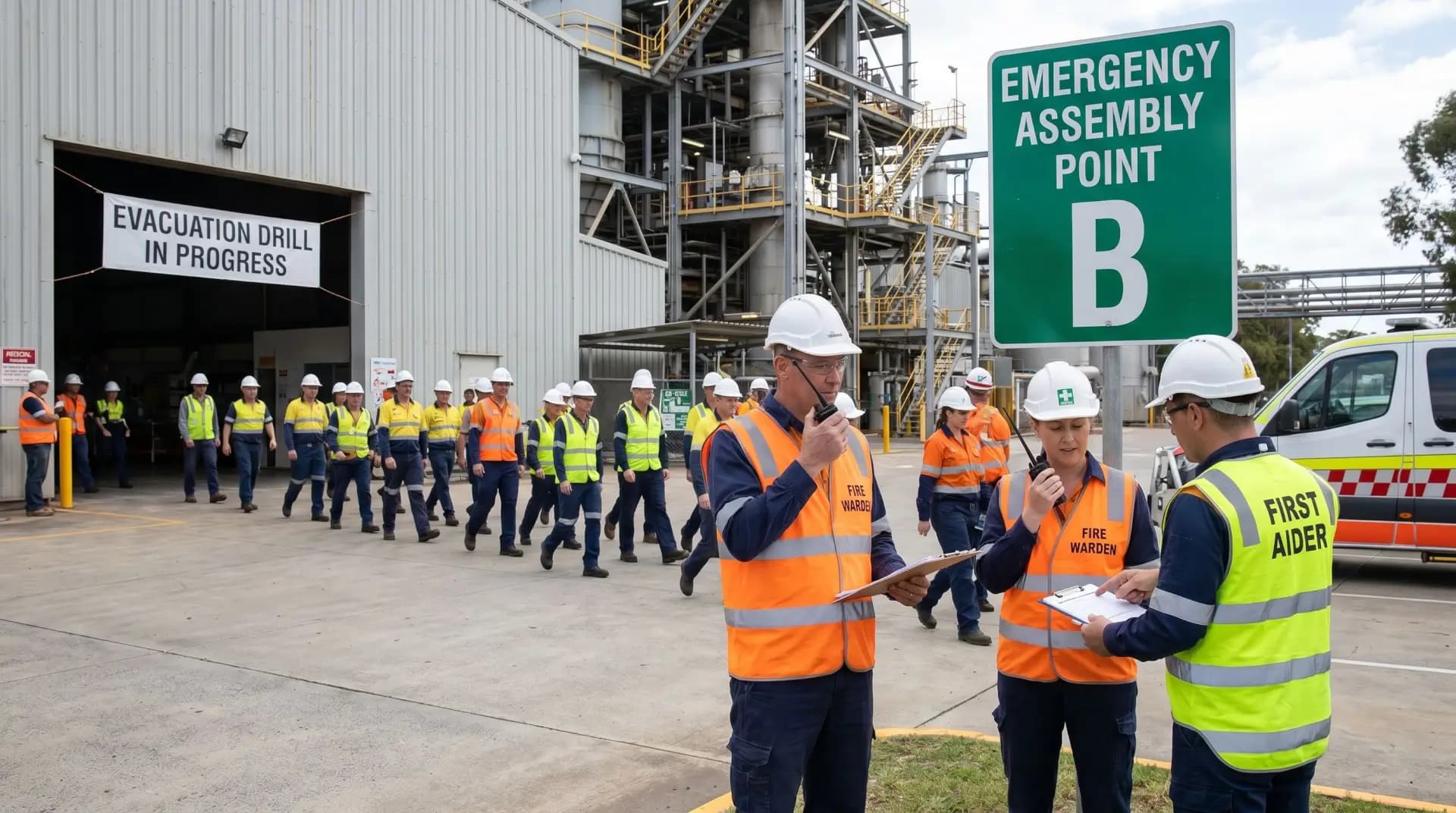
After evacuation, supervisors, fire wardens, department leads, or assigned roll-call personnel should account for people under their control. This includes employees, contractors, visitors, delivery drivers, temporary workers, cleaners, and anyone else who may have been on site.
A reliable accountability system may include:
Shift attendance lists
Visitor logs
Contractor permits or access records
Electronic access control reports
Department roll-call sheets
Muster cards or badge scanning
Manual headcount confirmation by area wardens
No one should be sent back into the building to look for missing persons. If someone is unaccounted for, the information must be passed to emergency responders or the incident controller, including the person’s last known location if available.
2. Communication
People at the assembly point need instructions. Silence creates uncertainty, and uncertainty leads to people leaving the area, making phone calls without control, or trying to return for personal belongings.
Communication should answer:
What has happened, if it can be shared safely
Whether people should remain, relocate, or disperse
Whether first aid or welfare support is required
Who is missing or unaccounted for
When re-entry is permitted
Who has authority to give the all-clear
Only an authorized person should announce re-entry. The alarm stopping does not automatically mean the building is safe.
3. Crowd Control
Assembly points must be managed so people do not drift into roads, gates, emergency vehicle routes, loading bays, or hazardous areas. Wardens should keep groups organized by department, work zone, floor, contractor company, or shift team.
Good crowd control includes:
Keeping access routes open
Preventing smoking near flammable areas
Stopping people from taking shortcuts back into the site
Keeping visitors with their host or designated warden
Separating injured persons for first aid support
Maintaining clear space for responders and equipment
4. Escalation
The assembly point should have a clear escalation process when something is wrong. This includes missing persons, injured evacuees, panic, exposure to smoke or chemicals, medical emergencies, crowding, or unsafe weather conditions.
The escalation route should be simple: warden to chief warden or emergency coordinator, then to the incident controller or emergency services as required.
Signage, Maps, and Route Planning
Assembly points must be visible and easy to understand. A sign alone is not enough if people cannot find the route during an actual evacuation.
Effective assembly point communication includes:
Evacuation maps showing primary and secondary assembly points
Directional signs from exit discharge points
Standard emergency assembly point symbols where applicable
Clear wording for visitors and contractors
Marked pedestrian routes where vehicle movement is present
Lighting for night shifts or low-light areas
Route plans that avoid reversing vehicles, loading zones, and process hazards
Information in induction, toolbox talks, and emergency drills
In larger facilities, numbering or naming assembly points is useful. For example, “Assembly Point A – North Car Park” is clearer than “main gate area.” The name used on signs, maps, training material, and radio communication should be the same.
For multi-building sites, each building may need its own assembly point. For shared workplaces, tenants and employers should coordinate their arrangements so different groups do not overcrowd the same location or block each other’s escape routes.
Special Considerations for Different Emergencies
Not every emergency requires people to gather outside. This is one of the most important points in assembly point management. The plan must distinguish between evacuation, shelter-in-place, lockdown, and relocation.
Fire and Smoke
For fire emergencies, the assembly point should be far enough from the building to avoid smoke, heat, falling glass, falling façade material, and firefighting operations. It should also be positioned so evacuees do not stand under overhead hazards or beside fire hydrants, fire lanes, or access gates needed by responders.
Chemical Release or Gas Leak
For chemical release, toxic gas, or flammable vapor, wind direction becomes critical. A fixed assembly point may be unsafe if it is downwind of the release. Facilities with chemical or gas hazards should identify upwind or crosswind options and ensure emergency leaders understand when to use them.
Explosion Risk
Where explosion risk exists, assembly points should not be close to pressure vessels, gas storage, fuel tanks, process buildings, cylinder storage, or areas with potential fragment projection. The emergency plan should consider blast direction, escalation potential, and emergency service advice.
Severe Weather
During lightning, storms, extreme heat, freezing conditions, or flooding, outdoor assembly may create additional harm. A protected internal refuge, alternate building, or controlled relocation area may be needed, depending on the emergency and local emergency instructions.
Security Threats
For hostile threats, suspicious packages, civil disturbance, or violence, gathering everyone in a predictable outdoor location may not be safe. Security-related emergency plans should define when to evacuate, when to lockdown, when to disperse, and when to move to a concealed or protected location.
Training, Drills, and Review
An assembly point only works when people know it before the emergency. Training should be practical and repeated enough that employees, contractors, and visitors understand what to do without waiting for detailed instructions.
Training should cover:
Alarm recognition
Nearest safe exit routes
Primary and secondary assembly points
What not to take during evacuation
How to assist visitors
What to do if the normal route is blocked
How to report to a warden or supervisor
Why no one may re-enter without authorization
Arrangements for people who need evacuation assistance
Drills should test more than movement time. They should test accountability, communication, route suitability, warden performance, visitor control, and whether the assembly point remains safe under realistic conditions.
After each drill or real evacuation, review:
Review Question | Why It Matters |
|---|---|
Did everyone know where to go? | Confusion indicates weak signage, induction, or training |
Was the route safe and unobstructed? | Blocked or hazardous routes can fail during real events |
Was the assembly point large enough? | Crowding can push people into traffic or response areas |
Was the headcount accurate? | Poor accountability delays emergency decisions |
Were visitors and contractors controlled? | Non-employees are often missed in weak plans |
Could instructions be heard? | Poor communication leads to unsafe movement |
Did emergency vehicles have clear access? | Evacuation must not interfere with response |
Was a secondary point needed? | Conditions may expose flaws in the primary location |
Review the assembly point arrangement whenever there is a site layout change, building modification, road change, new process hazard, change in workforce numbers, new shift pattern, construction work, incident, near miss, or drill finding.
Documentation and Legal Caution
Emergency assembly points should be documented in the emergency plan, fire evacuation plan, site map, induction system, and drill records. The documentation should be specific enough that a new supervisor, contractor manager, or emergency warden can understand the arrangement without relying on informal knowledge.
At minimum, document:
Assembly point name and location
Buildings, departments, or zones assigned to it
Primary and secondary routes
Maximum expected occupancy
Accountability method
Responsible wardens or supervisors
Communication method
Alternative assembly point
Conditions requiring relocation
Arrangements for visitors and contractors
Arrangements for people needing assistance
Review date and approval authority
This article provides general HSE guidance and does not replace local legal advice, fire authority requirements, civil defense instructions, building code obligations, insurance requirements, or site-specific emergency planning by competent persons. Always verify the emergency planning rules that apply in the jurisdiction where the workplace operates.
Conclusion
Emergency assembly points must be selected and managed with the same seriousness as alarms, exits, extinguishers, and emergency response roles. The right location keeps people away from danger, supports fast accountability, protects emergency access, and gives the incident controller reliable information.
In my experience, poor assembly point planning usually shows itself during the first real alarm: people gather too close, supervisors cannot account for contractors, visitors are missed, emergency vehicles are blocked, or the chosen point becomes unsafe because of smoke, wind, traffic, or crowding. These weaknesses are preventable.
A strong system defines primary and secondary assembly points, trains people clearly, tests the arrangement through drills, manages headcount properly, and reviews the location whenever risks change. The goal is simple: when evacuation is necessary, every person knows where to go, every responsible person knows what to do, and no one is placed in a new danger while trying to escape the first one.



Responses