

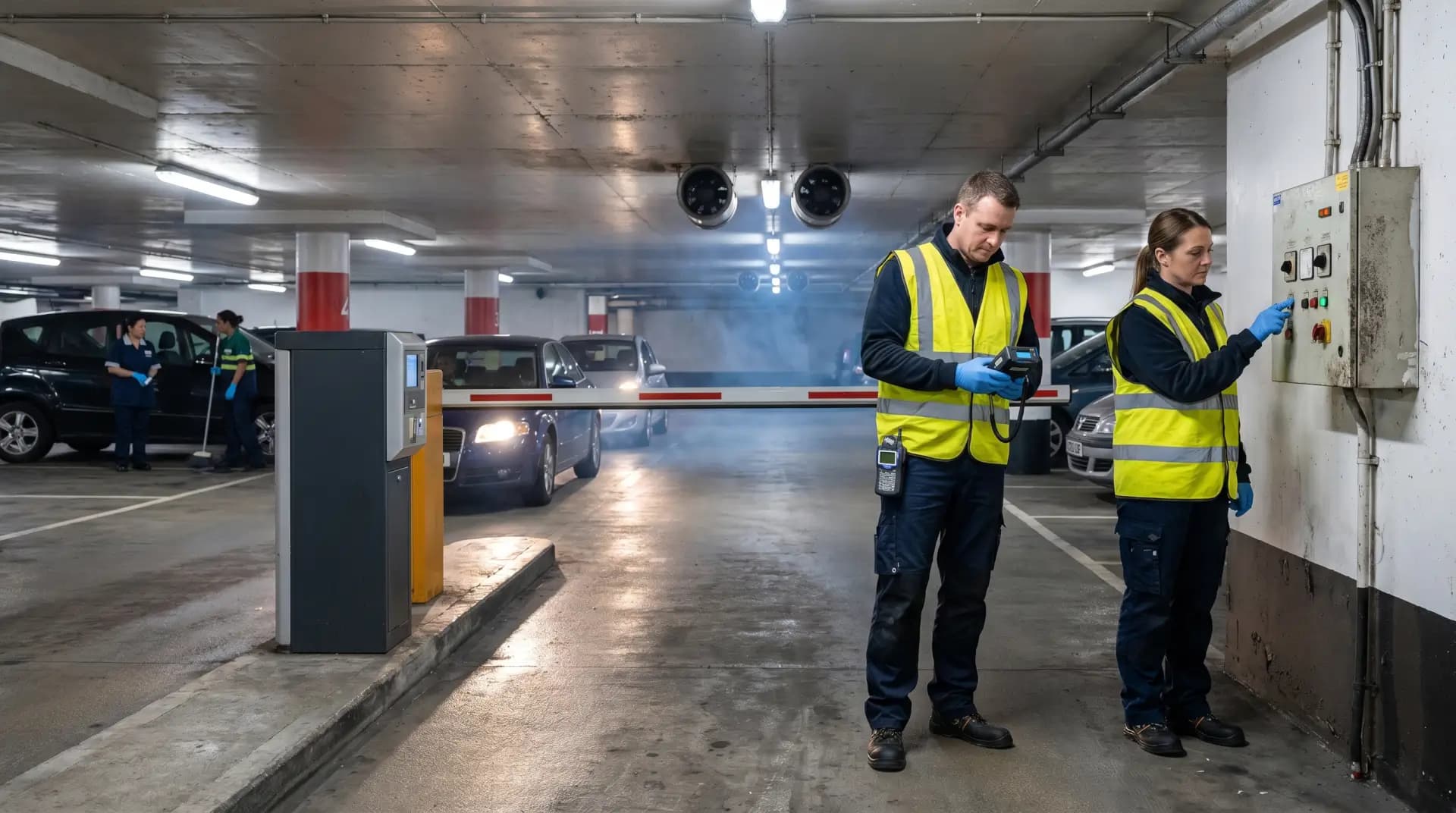
Managing air quality in enclosed parking areas means controlling vehicle exhaust before it becomes a health, compliance, or operational problem. The practical approach is straightforward: understand the pollutants, provide effective mechanical ventilation, use reliable gas detection, maintain airflow paths, restrict unsafe vehicle behavior, and verify performance through inspections, testing, and records.
In enclosed or underground parking areas, the main concern is not ordinary “stale air.” It is the accumulation of exhaust contaminants, especially carbon monoxide and nitrogen dioxide, in a space where natural dilution is limited. Carbon monoxide is particularly dangerous because it is colorless, odorless, and non-irritating, so people may not recognize exposure until symptoms appear.
Understand the Main Air Quality Hazards
The first mistake I often see in parking-area risk assessments is treating air quality as a comfort issue only. In reality, enclosed parking areas sit between building ventilation, occupational hygiene, fire-life safety, and traffic management.
The key contaminants include:
Contaminant | Main source | Why it matters |
|---|---|---|
Carbon monoxide | Petrol, diesel, and other combustion engines | Reduces the blood’s ability to carry oxygen; symptoms may include headache, dizziness, weakness, nausea, confusion, and chest pain |
Nitrogen dioxide | Vehicle exhaust, especially diesel engines | Irritates the eyes, throat, and respiratory tract; can aggravate asthma and other respiratory conditions |
Particulate matter | Diesel exhaust, tyre and brake wear, dust resuspension | Can affect respiratory health and create visible staining or nuisance dust |
Volatile organic compounds | Fuel vapors, exhaust, leaks, poor housekeeping | May contribute to odor complaints and indoor air quality concerns |
Heat and humidity | Engine heat, poor airflow, building conditions | Can worsen discomfort and reduce perceived air quality |
For workplace control purposes, carbon monoxide is usually the lead indicator because it can build up rapidly and has defined occupational exposure limits in many jurisdictions. OSHA in the United States lists a carbon monoxide permissible exposure limit of 50 ppm as an 8-hour time-weighted average, while NIOSH recommends 35 ppm as a time-weighted average and 200 ppm as a ceiling limit.
The United Kingdom manages workplace exposure limits through EH40 under COSHH, and those limits are legally binding in Great Britain where they apply.
HSE judgment point: Legal limits are not design targets. A well-managed enclosed parking area should aim to prevent routine exposure from approaching occupational limits, especially where security staff, cleaners, maintenance teams, valet teams, or attendants spend extended time in the area.
Design Ventilation Around Risk, Not Guesswork
Ventilation is the primary engineering control for enclosed parking areas. The goal is to remove contaminated air and bring in sufficient fresh air without leaving dead zones where exhaust can accumulate.
A competent ventilation design should consider:
Parking area size, volume, layout, and number of levels
Expected traffic flow during peak entry and exit times
Ramp locations, blind corners, and low-air-movement zones
Whether the area is fully enclosed, partially open, or underground
Fan capacity, fan staging, exhaust points, and make-up air routes
Local building code, fire code, and mechanical code requirements
Emergency smoke control interfaces, where applicable
ASHRAE Standard 62.1 is widely used for nonresidential ventilation guidance, and public ASHRAE interpretation material has referenced 0.75 cfm per square foot as the minimum exhaust requirement for parking garages in Standard 62.1-2016.
In practice, I do not treat a design airflow rate as proof that air quality is safe. A garage can look compliant on drawings and still perform poorly if supply air short-circuits directly to exhaust, jet fans are poorly aimed, sensors are badly located, dampers are stuck, or exhaust grilles are blocked.
Practical ventilation controls
A reliable system should include:
Mechanical exhaust sized for the approved design basis
The exhaust system must be capable of handling peak vehicle movement, not just normal low-traffic periods.Effective make-up air
Exhaust cannot work properly if replacement air is restricted. Poor make-up air causes weak extraction, pressure imbalance, door issues, and stagnant pockets.Air distribution control
Jet fans, impulse fans, supply openings, and exhaust points should move air across occupied and vehicle travel zones, not only around the fan room.Avoidance of recirculation into occupied buildings
Exhaust discharge should not re-enter lobbies, offices, apartments, retail spaces, air intakes, or stairwells.Fan duty verification
Fan nameplate capacity is not enough. Actual airflow, damper position, belt condition, variable-speed drive settings, and control logic must be checked.
Use Gas Detection as a Control System, Not Decoration
Gas detection is essential where ventilation is controlled automatically. A sensor on the wall is not a safety system unless it is correctly selected, located, calibrated, alarmed, maintained, and connected to effective ventilation response.
Modern code practice in many jurisdictions allows enclosed parking garage ventilation to operate continuously or automatically using gas detection. Some versions of the International Mechanical Code require automatic operation through carbon monoxide detectors used with nitrogen dioxide detectors when intermittent ventilation is used. Local adoption varies, so the applicable code edition and authority having jurisdiction must always be confirmed.
Where sensors commonly fail in practice
I pay close attention to these weak points:
Sensors installed too close to fresh air openings
Sensors placed where vehicles never idle or queue
Sensors hidden behind columns, signage, storage, or parked vehicles
Too few sensors for a large or irregular floor plate
Detectors installed at the wrong height for the contaminant and application
Calibration records missing or overdue
Alarm setpoints changed without risk review
Fans running in manual mode while automatic control is assumed
Building management system alarms acknowledged but not investigated
Gas detection should activate a defined response, such as staged fan operation, high-speed ventilation, local alarm, control-room notification, or maintenance escalation. The response should be tested, not assumed.
Suggested monitoring logic
A practical control philosophy may include:
Condition | Control response |
|---|---|
Normal readings | Fans operate at minimum approved speed or scheduled mode |
Rising CO or NO₂ trend | Fans stage up automatically |
High-level alarm | Full ventilation, local notification, and investigation |
Persistent high reading | Restrict entry, stop idling, investigate source, verify sensors and airflow |
Sensor fault | Alarm to responsible team and apply fail-safe ventilation logic |
The exact setpoints must be selected according to local code, design standard, occupational exposure requirements, manufacturer guidance, and competent engineering assessment.
Control Vehicle Behavior and Pollution Sources
Ventilation cannot compensate for poor operational discipline. The simplest source-control rule is also one of the most important: do not allow unnecessary idling.
EPA public health guidance warns against running vehicles inside garages because carbon monoxide can build to dangerous levels even when a garage door is open.
For enclosed parking areas, I recommend clear rules for:
No extended idling
No vehicle warm-up inside enclosed areas
No engine testing unless the area is designed and authorized for it
No use of generators, pressure washers, or fuel-powered tools without a separate permit and ventilation assessment
No blocked exhaust grilles, fan inlets, dampers, or air pathways
No storage of chemicals, fuel containers, waste, or combustible materials in parking zones
Immediate reporting of strong exhaust odor, visible smoke, alarms, or symptoms
Traffic management also matters. Long queues at exits, poor payment-machine layout, tight turning areas, delivery congestion, and ride-share waiting zones can all increase emissions in localized areas. A good HSE review looks at how vehicles actually move, not only how the garage was designed.
Inspect, Test, and Maintain the System
Air quality management fails slowly before it fails suddenly. Fans degrade, belts loosen, dampers stick, grilles clog, sensors drift, and control settings get overridden. This is why enclosed parking areas need a planned inspection and maintenance program.
Recommended inspection checklist
Item | What to check | Typical evidence |
|---|---|---|
Exhaust fans | Running condition, vibration, noise, belts, bearings, VFD status | Maintenance log, inspection sheet |
Make-up air | Louvers open, no blockage, no short-circuiting | Visual inspection, airflow check |
Dampers | Correct position and movement | Functional test |
Gas sensors | Calibration date, fault status, display readings | Calibration certificate |
Alarm response | BMS signal, local alarm, fan staging | Test record |
Airflow paths | No storage, signage, or barriers blocking flow | Walkthrough record |
Housekeeping | Dust, oil, waste, fuel odors | Inspection report |
Traffic behavior | Idling, queuing, delivery congestion | Observation notes |
Emergency interface | Fire/smoke control coordination where applicable | Commissioning or test record |
For higher-risk facilities, such as large underground garages, mixed-use buildings, hospitals, hotels, shopping centers, transport hubs, or workplaces with parking attendants, periodic occupational hygiene monitoring should be considered. This may include spot checks, trend logging, personal exposure monitoring for exposed workers, or independent ventilation performance testing.
Protect Workers and Building Occupants
The people most at risk are not always the drivers. Drivers usually pass through quickly. Workers may remain in the area for long periods.
Higher-exposure groups may include:
Security guards
Valet parking staff
Parking attendants
Cleaners
Maintenance technicians
Delivery coordinators
Traffic marshals
Waste-handling teams
Contractors working in plant rooms or service areas connected to the garage
Carbon monoxide symptoms can resemble common illness, including headache, dizziness, weakness, nausea, chest pain, and confusion. CDC guidance describes common symptoms of carbon monoxide poisoning as flu-like, and severe exposure can lead to loss of consciousness or death.
Worker protection controls
A responsible management system should include:
Training on CO and NO₂ hazards
Clear reporting routes for symptoms, alarms, odors, or ventilation failure
Defined evacuation or restriction criteria
Work permits for non-routine activities
Portable gas monitoring for higher-risk tasks
Medical escalation guidance for suspected exposure
Contractor induction covering garage-specific air quality rules
Shift planning to avoid unnecessary time in high-traffic zones
Professional boundary: Suspected carbon monoxide exposure is a medical matter, not only an HSE observation. Anyone with symptoms after possible exposure should be moved to fresh air and assessed through the site emergency process or local medical services.
Build an Air Quality Management Plan
A good enclosed parking air quality plan does not need to be complicated, but it must be owned. The plan should define who checks the system, what limits apply, what alarms mean, who responds, and how performance is verified.
Core elements of the plan
Risk assessment
Identify vehicle activity, worker exposure, vulnerable adjacent areas, ventilation design, and previous complaints or alarms.Regulatory review
Confirm the applicable occupational exposure limits, building code, fire code, mechanical code, and local authority requirements.Ventilation design basis
Keep approved drawings, calculations, commissioning reports, fan schedules, and control philosophy available.Gas detection register
List detector type, location, serial number, calibration frequency, alarm setpoints, and maintenance history.Inspection schedule
Include daily visual checks where needed, routine maintenance, functional testing, and periodic performance verification.Alarm response procedure
Define what happens at warning, high alarm, persistent alarm, and sensor fault conditions.Training and communication
Train workers, contractors, security teams, facility teams, and control-room operators.Management review
Review alarm trends, complaints, maintenance defects, sensor failures, and changes in parking demand.
Simple performance indicators
Useful indicators include:
Number of gas alarms per month
Repeated alarms at the same location
Fan faults or control overrides
Overdue sensor calibrations
Air quality complaints
Idling violations
Ventilation defects not closed on time
Worker symptom reports linked to parking areas
These indicators help separate a one-time issue from a pattern. In my view, patterns are where the real value of HSE management appears.
Conclusion
Air quality in enclosed parking areas is managed through disciplined control of exhaust contaminants, not guesswork or occasional fan operation. The strongest system combines proper mechanical ventilation, reliable CO and NO₂ detection, source control, traffic discipline, preventive maintenance, worker training, and documented response procedures.
The practical standard I use is simple: people should not depend on smell, luck, or symptoms to know whether the air is safe. If a parking area is enclosed, the air quality controls must be designed, tested, maintained, and reviewed as a live safety system.


Responses