

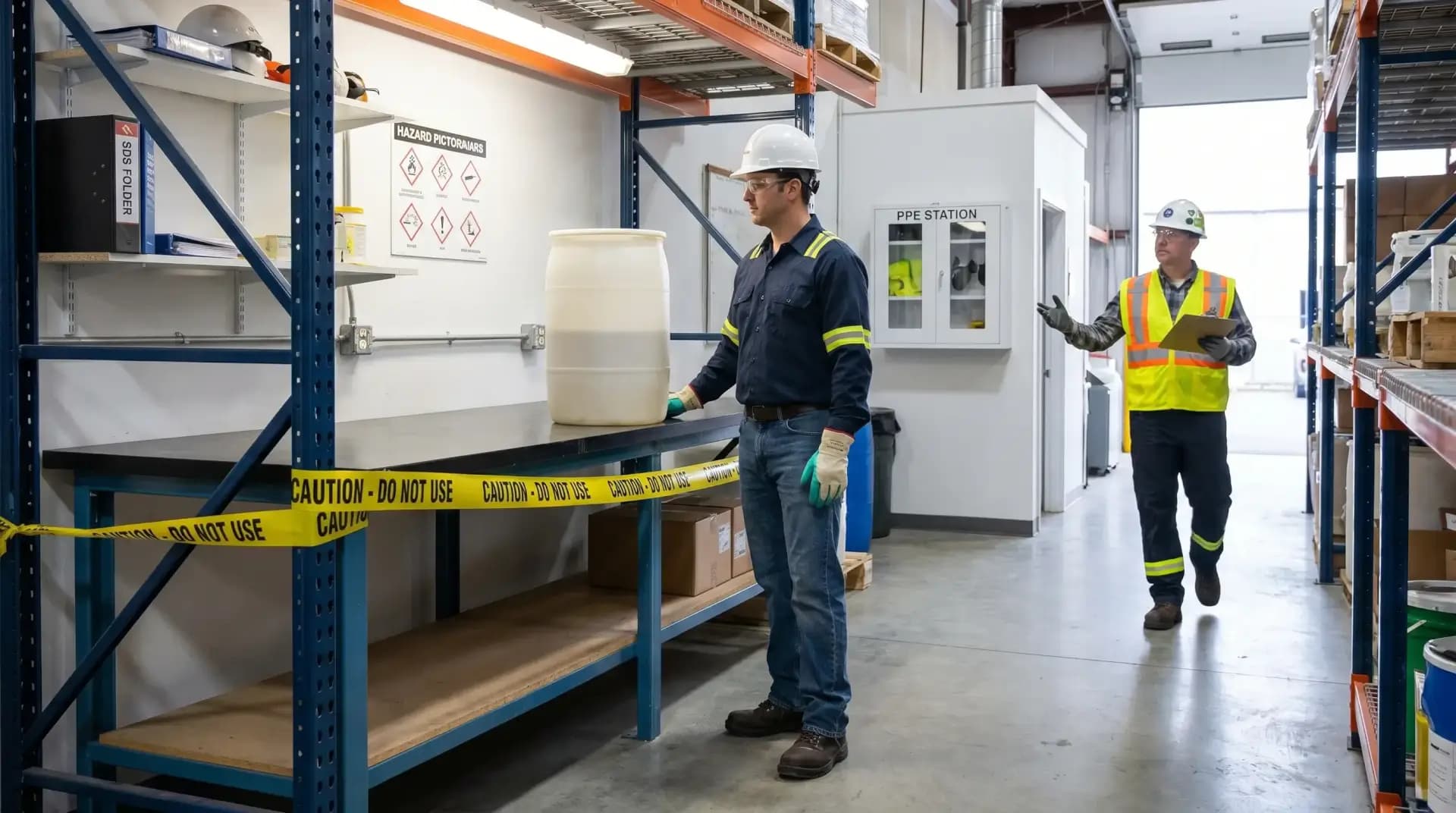
Unlabeled chemicals at work must be treated as unknown hazardous substances until they are positively identified, assessed, labeled, and either returned to controlled use or disposed of safely. No employee should smell, taste, mix, pour, use, or move an unlabeled chemical casually. The safest immediate action is to stop work around the container, isolate the area if needed, notify the supervisor or HSE representative, and verify the chemical through records, Safety Data Sheets, supplier information, inventory logs, or competent testing.
In practical HSE terms, an unlabeled bottle, drum, jar, spray container, or process vessel is not just a housekeeping issue. It is a breakdown in hazard communication. Workers cannot choose the right gloves, ventilation, first aid response, spill control method, fire protection, or storage compatibility if the identity and hazards of the substance are unknown. OSHA’s Hazard Communication Standard requires employers to maintain chemical hazard information through labels, Safety Data Sheets, and employee training; it also requires that labels on incoming containers are not removed or defaced.
Why Unlabeled Chemicals Are a Serious Workplace Hazard
An unlabeled chemical creates risk because the person handling it must make decisions without reliable hazard information. That is where incidents begin: wrong storage, wrong PPE, wrong spill response, wrong disposal route, or accidental mixing with incompatible substances.
The main risks include:
Chemical exposure: Skin contact, inhalation, eye injury, ingestion, or injection can occur before anyone understands the hazard.
Fire and explosion: A clear liquid may be water, solvent, acid, fuel, oxidizer, or reactive material.
Incompatible storage: Unknown chemicals may be placed near substances that react violently with them.
Incorrect emergency response: First aid, firefighting, spill control, and evacuation decisions depend on chemical identity.
Regulatory non-compliance: Missing labels indicate failure in chemical management, hazard communication, or COSHH-type control systems depending on jurisdiction.
Waste disposal problems: Unknown chemical waste is harder and often more expensive to classify and dispose of safely.
A common mistake I correct during workplace inspections is treating small secondary containers as low risk. A small spray bottle, sample jar, dosing cup, or cleaning container can still contain corrosive, flammable, toxic, sensitizing, or reactive material. Size does not remove the duty to identify the hazard.
Immediate Steps to Take When You Find an Unlabeled Chemical
The first response should be controlled and simple. Do not turn the situation into an investigation at the workbench or production line.
1. Stop using the chemical immediately
Do not continue the job using an unlabeled container. Even if workers believe they “know what it is,” the container must be verified before use. Memory, color, smell, and location are not reliable controls.
2. Do not open, smell, taste, or mix it
Never identify a chemical by odor, appearance, or informal testing. Opening the container may release vapors, pressure, dust, or fumes. Mixing it with water, neutralizer, detergent, or another chemical can create heat, toxic gas, fire, or splashing.
3. Keep people away from the container
Move people away from the immediate area if there is leakage, vapor, damage, swelling, pressure, corrosion, crystallization, or any sign of reaction. If the container appears stable and there is no release, restrict handling and prevent accidental use.
4. Notify the supervisor, HSE team, or competent person
Unlabeled chemicals should be handled through the workplace chemical safety procedure, not by individual judgment. The responsible person should decide whether the container can be identified, relabeled, quarantined, or disposed of as unknown chemical waste.
5. Check available records
Useful identification sources include:
Chemical inventory lists
Purchase records
Batch sheets
Process logs
Laboratory notebooks
Store issue records
Safety Data Sheets
Supplier delivery documents
Waste transfer records
Previous container labels
Area-specific chemical lists
Safety Data Sheets are especially important because they describe chemical properties, health and physical hazards, protective measures, and precautions for handling, storage, and transport. OSHA describes the SDS as a 16-section document containing this type of hazard and control information.
6. Quarantine the container if identity is not confirmed
If the chemical cannot be positively identified, place it in a designated quarantine area suitable for chemical containment. Use secondary containment where appropriate. The container should be marked clearly as “Unidentified Chemical – Do Not Use” while the investigation is ongoing.
7. Arrange safe disposal if identification is not possible
If no reliable identification can be made, the chemical should be managed as unknown hazardous waste through a qualified waste contractor or competent hazardous materials specialist. Disposal should follow local environmental, waste, and occupational safety requirements.
How to Identify an Unlabeled Chemical Safely
Identification must be evidence-based. The aim is not to guess the name of the chemical; the aim is to establish reliable enough information to control the risk.
Start with location and process context
Ask where the container was found and what chemicals are normally used in that area. A bottle found near a cleaning station may be linked to detergents, disinfectants, descalers, or solvents. A drum found near a paint booth may involve thinners, coatings, hardeners, or cleaning solvents. A jar in a laboratory may be a sample, reagent, waste, or intermediate material.
This context helps narrow the search, but it is not enough on its own.
Compare container type and markings
Look for partial information such as:
Supplier name
Batch number
Lot number
Product code
Shipping marks
Residue from a damaged label
Color banding
Cap type
Original packaging design
Hazard pictogram remnants
Do not rely on container shape alone. Reused containers are a major cause of chemical misidentification.
Interview only relevant personnel
Speak with the workers who operate in that area, but treat verbal information as supporting evidence, not final proof. Someone may remember that “we usually keep solvent there,” but that does not confirm what is inside the container today.
Use SDS and inventory matching
Once a likely chemical is identified, match it against the SDS, inventory, supplier details, and workplace process records. The label should not be recreated unless the identity is confirmed.
Use competent testing when necessary
For unknown materials in laboratories, production, waste areas, or high-risk processes, testing may be required by competent personnel. Basic field assumptions should not replace proper analysis when the substance may be reactive, toxic, flammable, corrosive, or environmentally hazardous.
Labeling Requirements and Good Practice
A workplace label must communicate the identity and hazards of the chemical clearly enough for safe use. The exact legal requirements depend on jurisdiction, but the principle is consistent: workers must know what the chemical is, what hazards it presents, and what precautions are required.
Under OSHA’s Hazard Communication Standard in the United States, employers must ensure hazardous chemical containers are properly labeled, Safety Data Sheets are available, and employees are trained on chemical hazards. OSHA also recognizes a limited exception for portable containers filled from labeled containers when the chemical is intended only for the immediate use of the employee who performed the transfer.
In Great Britain, chemical classification, labeling, packaging, hazard pictograms, hazard statements, precautionary statements, signal words, and Safety Data Sheets are addressed through HSE guidance and the chemical classification framework. COSHH also requires employers to assess and control exposure to substances hazardous to health.
A practical workplace chemical label should normally include:
Label Element | Why It Matters |
|---|---|
Product or chemical name | Confirms identity and prevents accidental misuse |
Hazard pictograms | Gives quick visual warning of major hazards |
Signal word | Indicates severity, such as “Danger” or “Warning” |
Hazard statements | Explains the nature of the hazard |
Precautionary statements | Guides safe handling, storage, PPE, and response |
Supplier or internal reference | Helps trace SDS and inventory records |
Date prepared or transferred | Supports shelf-life and accountability |
Responsible person or department | Improves follow-up and ownership |
For secondary containers, the label must remain durable and readable for the conditions of use. Labels that dissolve, fade, peel off, or become illegible in wet, oily, outdoor, or high-temperature conditions are not effective controls.
What Not to Do With Unlabeled Chemicals
In my experience, the unsafe response is often driven by confidence rather than carelessness. Someone thinks the chemical is familiar, so they take a shortcut. That shortcut can expose the next person to a hazard they never agreed to accept.
Avoid these actions:
Do not use the chemical “just this once.”
Do not pour it down the drain.
Do not return it to general storage.
Do not mix it with other waste.
Do not relabel it based on guesswork.
Do not transfer it into another container to “tidy up.”
Do not leave it on a bench, shelf, floor, or machine.
Do not ask an untrained worker to dispose of it.
Do not assume clear liquids are harmless.
Do not assume old containers contain the original product.
A particularly dangerous practice is storing chemicals in drink bottles, food jars, or unapproved containers. This creates an ingestion risk and often removes the chemical from the normal hazard communication system.
Preventing Unlabeled Chemicals in the Workplace
The best control is to prevent unlabeled containers from appearing in the first place. That requires discipline in purchasing, receiving, storage, use, transfer, housekeeping, and waste management.
Maintain a live chemical inventory
A chemical inventory should reflect what is actually present on site, not just what was purchased years ago. It should identify the chemical name, location, quantity, SDS availability, storage class, and owner department.
The NIOSH Pocket Guide to Chemical Hazards is one example of a recognized technical reference that supports chemical hazard understanding, although workplace decisions should still be based on the specific product SDS, regulatory duties, and site risk assessment.
Control secondary containers
Secondary containers are one of the most common sources of unlabeled chemical risk. These include spray bottles, wash bottles, small jars, beakers, dosing containers, sample bottles, and temporary transfer containers.
A strong control system should require:
Label before or immediately after transfer.
Use only compatible containers.
Avoid unnecessary decanting.
Keep transfers under the control of trained workers.
Empty and clean temporary containers after use where appropriate.
Remove damaged or unreadable labels immediately.
Inspect chemical storage areas routinely
Routine inspections should check:
Missing labels
Damaged labels
Expired chemicals
Leaking containers
Incompatible storage
Unapproved containers
Unidentified waste
Poor housekeeping
Missing SDS access
Containers stored outside designated areas
Inspection findings should be corrected with ownership and close-out tracking. Repeated unlabeled containers usually indicate a system weakness, not an isolated worker mistake.
Train workers in practical label use
Training should not stop at showing hazard pictograms. Workers need to understand how labels connect with real decisions:
Which gloves are suitable?
Is ventilation required?
Can this chemical be stored with others nearby?
What should be done in a spill?
What first aid applies after exposure?
What firefighting media are appropriate?
What waste route should be used?
A worker who cannot link the label to safe behavior has not received effective chemical safety training.
Set a clear rule for unidentified chemicals
Every site should have a simple rule: no label, no use.
That rule should be supported by a written process for reporting, isolating, identifying, relabeling, and disposing of unknown chemicals. Workers should know exactly who to call and what not to do.
Supervisor and HSE Responsibilities
Supervisors and HSE personnel must treat unlabeled chemicals as evidence of a failed control, not just a container problem.
The response should include:
Confirm whether there was any exposure.
Check whether the chemical leaked or contaminated surfaces.
Identify who may have used or handled it.
Review storage and transfer practices in the area.
Verify SDS availability.
Confirm whether similar unlabeled containers exist elsewhere.
Decide whether refresher training is needed.
Record the finding and corrective action.
Review whether the chemical inventory is accurate.
Escalate recurring issues to management.
Where there is a potential exposure, medical evaluation may be required depending on the chemical, route of exposure, symptoms, and applicable workplace procedure. In an emergency, response should follow the site emergency plan and local emergency services requirements.
Conclusion
Unlabeled chemicals must never be treated as harmless or routine. The correct approach is to stop use, prevent exposure, notify competent personnel, identify the substance through reliable records or testing, apply the correct label, and dispose of it safely if identification cannot be confirmed.
The deeper lesson is that chemical safety depends on information. A label is not decoration on a container; it is a critical control that connects the worker to the hazard, the SDS, the PPE, the storage rules, the spill response, and the emergency plan. When that information is missing, the safest professional judgment is clear: do not use it, do not guess, and do not pass the risk to someone else.



Responses